

Myths and Questions
Is sunscreen really the most reliable form of sun protection?
Are umbrellas, hats and shade enough by themselves?
What does UPF 50 actually mean? Does it tell us anything about visible-light protection?
Is every cloth automatically good sun protection? Does colour of clothing matter?
We spend enormous effort discussing sunscreen filters, SPF, UVA Protection Factor, PA++++, Boots stars, photostability, iron oxides and reapplication. There is another way to reduce light exposure that is far less sophisticated.
Put something between the sun and the skin.
Unlike sunscreen, clothing does not need to be spread evenly at 2 mg/cm². It does not leave gaps because the patient missed a spot. It is not wiped away with sweat. It does not need to be reapplied every two hours.
This does not mean every piece of cloth provides excellent protection. But appropriate clothing can provide remarkably effective and consistent photoprotection. This brings us to UPF.
What is UPF?
Clothing protection is usually expressed as Ultraviolet Protection Factor, or UPF.
UPF is essentially a ratio. In the laboratory, researchers compare the biologically effective ultraviolet radiation that would reach the skin without the fabric with the amount transmitted through it. The calculation takes into account that different ultraviolet wavelengths have different biological effects.
So a UPF of 50 means that only about 1/50th of this biologically weighted ultraviolet radiation is transmitted through the fabric under the test conditions. In simpler terms, about 2% gets through and about 98% is blocked.
There is an important difference from sunscreen: once the appropriate garment is covering the skin, protection does not depend on whether the wearer remembered to apply enough product that morning.
Can clothing really outperform sunscreen?
A 2022 laboratory study directly compared four modern sun-protective fabrics with two commercial broad-spectrum sunscreens, SPF 30 and SPF 50. The fabrics blocked approximately 96–98% of UVA and more than 99% of UVB. All four fabrics provided greater UVA and UVB protection than the two sunscreens tested, even when those sunscreens were applied at the full recommended laboratory quantity of 2 mg/cm². In that experiment, the SPF 50 sunscreen blocked only approximately 82% of UVA.1
What the experiment demonstrates very well is the underlying principle: a suitable physical barrier can achieve very low ultraviolet transmission without depending on sunscreen application behaviour.
What matters is not merely whether skin is covered, but what it is covered with.
One of the most useful older studies examined 28 ordinary white fabrics. Nineteen provided less ultraviolet protection than an SPF 15 sunscreen. Polyester generally performed better than cotton, while adding dyes substantially increased protection.
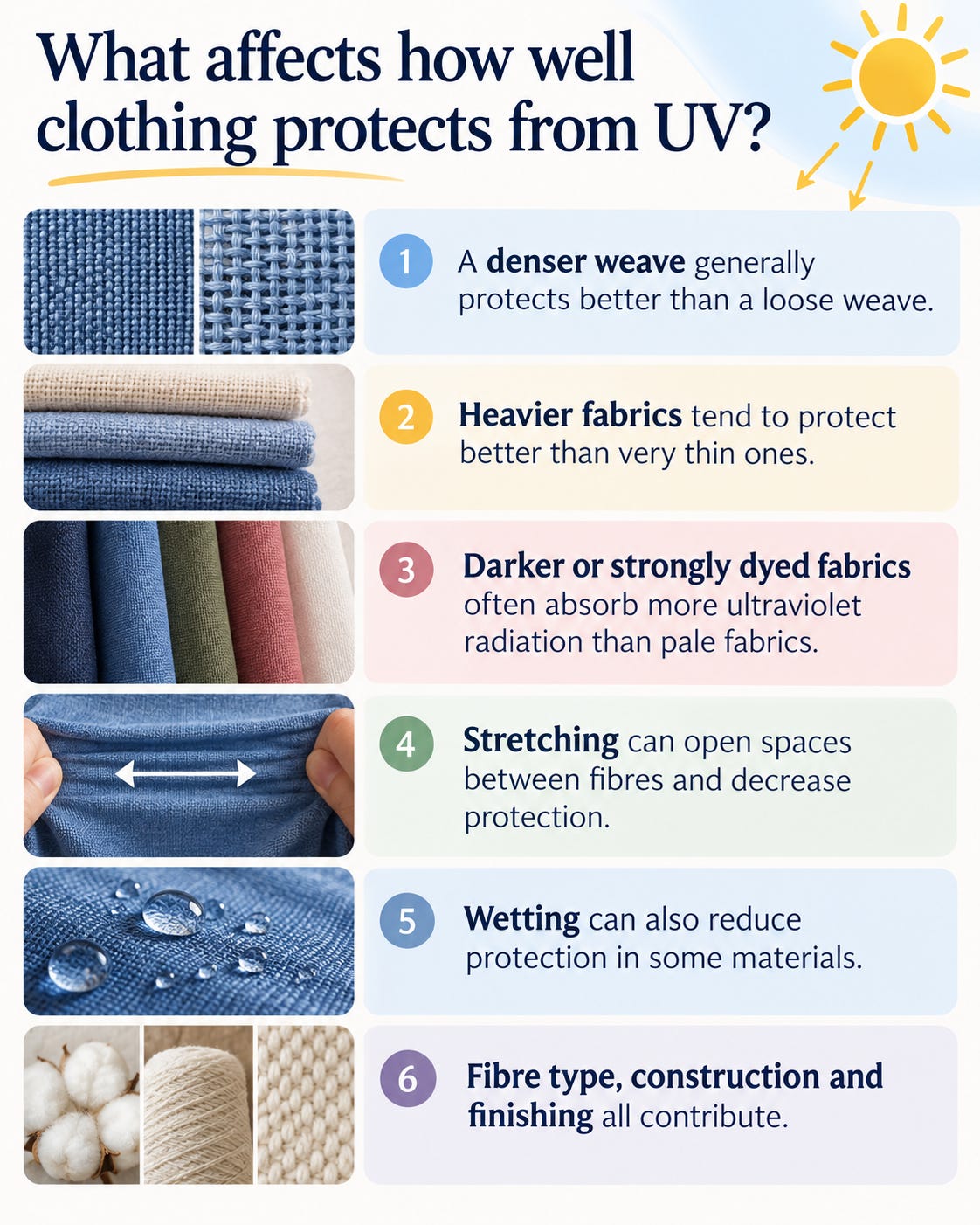
This has an obvious Indian relevance. A thin, loose, white cotton shirt may feel ideal in hot weather, but the fact that it covers the skin does not guarantee high ultraviolet protection.
Purpose-designed UPF clothing removes much of that uncertainty. For someone with severe photosensitivity or prolonged occupational exposure, a certified UPF garment is considerably more predictable than simply recommending “full sleeves”.
What about visible light?
UPF is an ultraviolet rating. It does not certify protection against visible light.
However, an opaque fabric physically reduces visible light as well as ultraviolet radiation. The principle is simple: if very little light passes through the fabric, very little visible light is reaching the covered skin.
This gives clothing an important advantage in conditions such as melasma.
A conventional transparent sunscreen must separately provide protection against UVB, UVA and, where required, visible light. A sufficiently opaque physical barrier can reduce all three simultaneously.
But the word opaque matters. UPF and visible-light transmission are different measurements. A fabric may have good UV protection without being completely opaque to visible light, and a UPF rating by itself tells us nothing about how much visible light passes through.
How do you choose protective clothing without a UPF label?
Certified UPF clothing is not always readily available in India, but there are useful practical clues.
Choose densely woven, reasonably substantial fabrics rather than thin, loose weaves. Darker or strongly dyed fabrics generally provide better ultraviolet protection than very pale fabrics, and stretching should be avoided because it opens spaces between fibres and can reduce protection. Wetting can also reduce protection in some materials.
Perhaps the simplest practical test is to hold the fabric up to bright light. If you can easily see light through it, it is unlikely to be an ideal physical barrier. If very little light passes through, the fabric is more likely to provide good ultraviolet protection and will also reduce visible-light exposure.
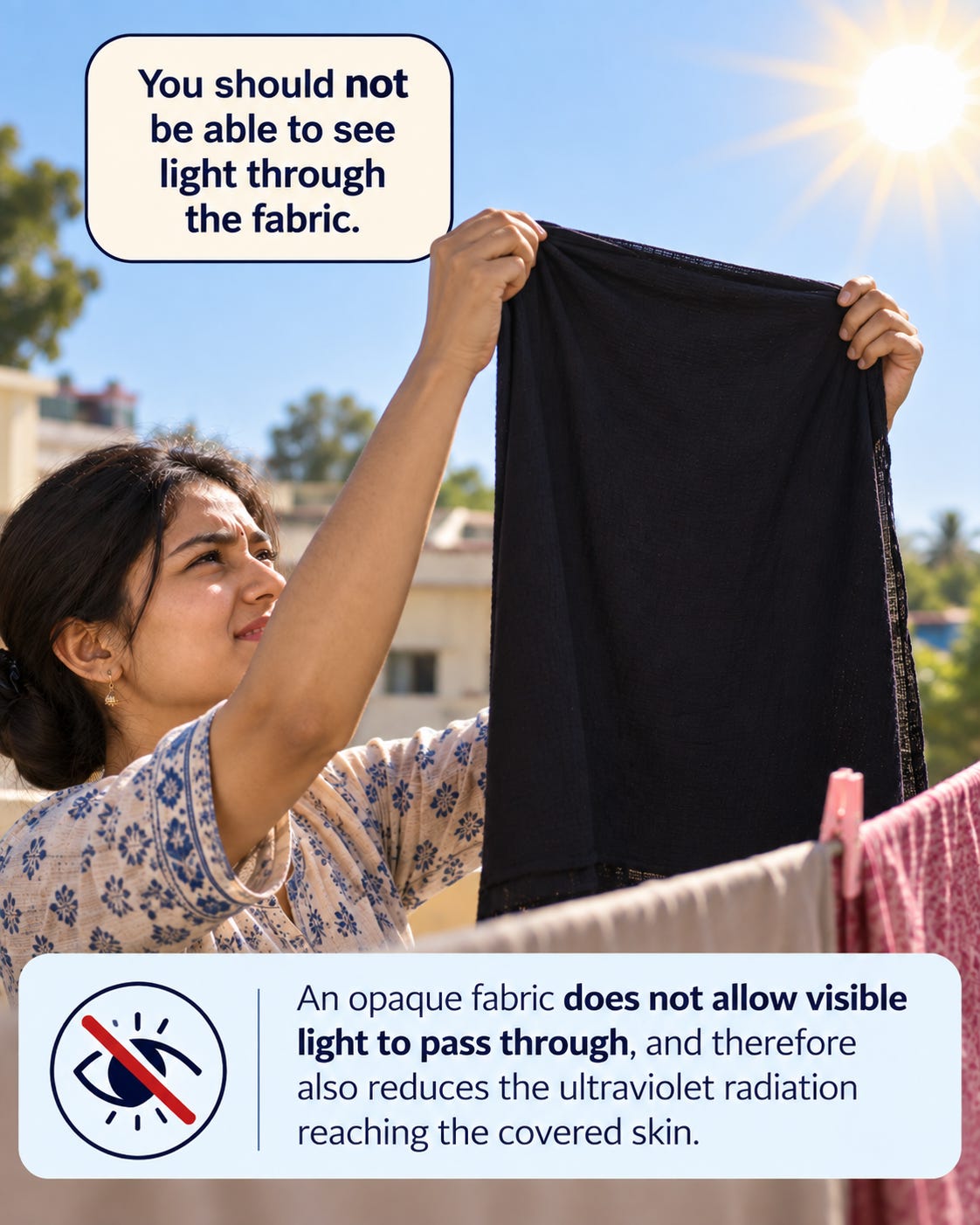
This is not a substitute for a measured UPF rating. But when certified UPF clothing is unavailable, dense weave, adequate thickness, darker colour and minimal light transmission provide a sensible practical guide to choosing more protective clothing.
So is clothing better than sunscreen?
For body sites that can conveniently be covered, it is often more dependable.
That is not the same as saying sunscreen is unnecessary. The face, hands and other exposed sites cannot realistically remain covered throughout normal life. In tropical Indian weather, covering every surface with dense fabric would also be impractical and uncomfortable.
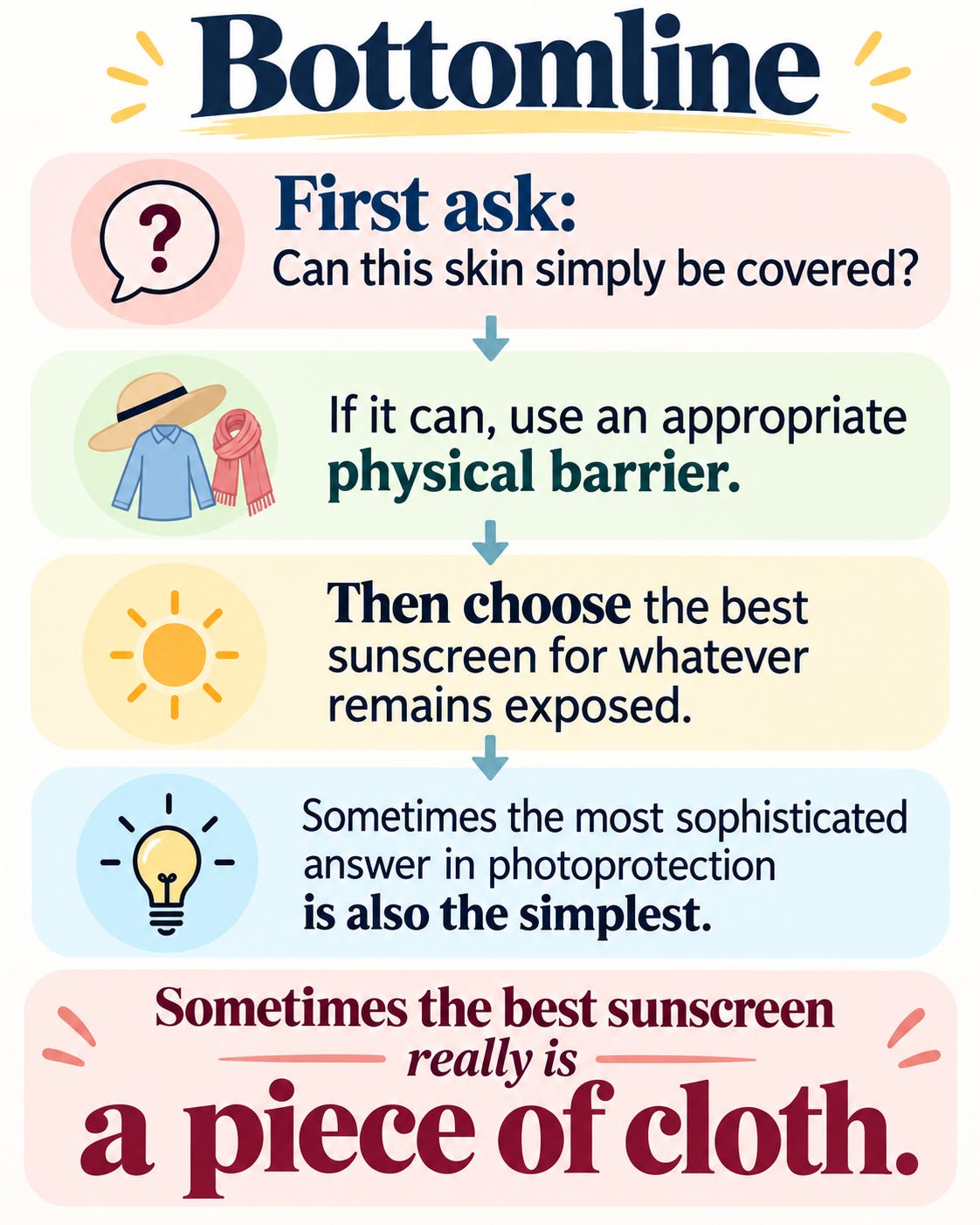
The more rational approach is not clothing versus sunscreen.
It is clothing before sunscreen where practical, and sunscreen for the skin that remains exposed.
An outdoor worker who covers his forearms with appropriate sleeves no longer needs to maintain an adequate sunscreen layer there throughout a day of sweating and wiping.
A broad-brimmed hat can reduce direct exposure to parts of the face and neck, while sunscreen deals with the residual exposure.
A person worried about tanning of the arms may obtain more consistent protection from sleeves than from trying to remember repeated sunscreen application.
What about hats, umbrellas and shade?
They help, but they are not complete barriers. Shade primarily blocks direct sunlight. Ultraviolet and visible radiation can still reach the skin from the open sky and from reflection by buildings, concrete, sand, water and other surfaces. Similarly, an umbrella or hat protects only the regions actually shaded by it.
This is why physical photoprotection works best in layers: reduce unnecessary exposure, use shade, cover what can conveniently be covered, and use sunscreen on what remains exposed.
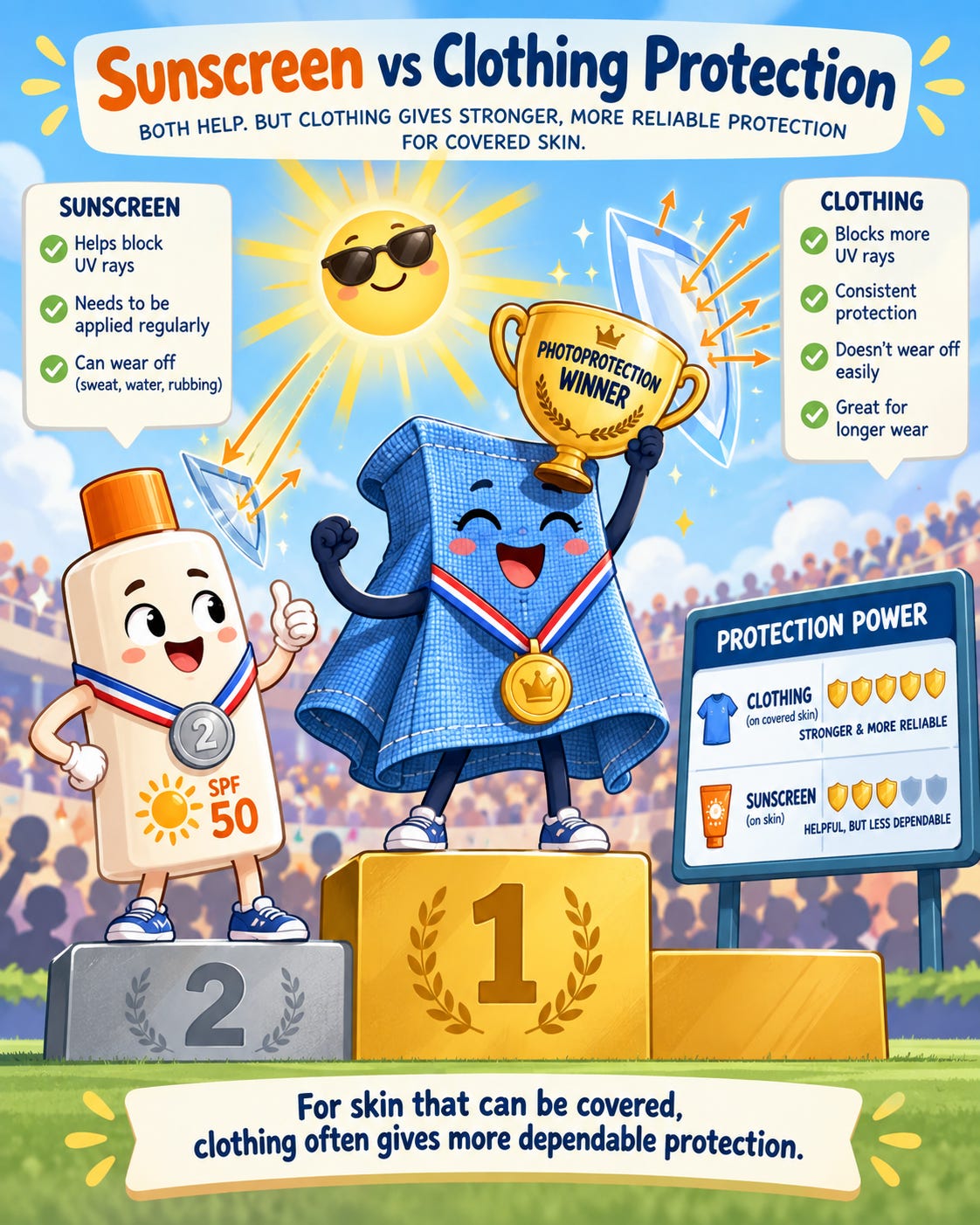
The great weakness of sunscreen is that their effectiveness depends on human behaviour. SPF and UVA Protection Factor are measured on carefully prepared, uniformly coated test sites. Real patients apply less, miss areas, sweat, wipe their skin and fail to reapply.
Clothing largely removes that variability. Once an adequate garment is on the body, the protection is relatively continuous until the garment is removed or its physical properties change.
That may be particularly important for someone whose aim is cosmetic prevention of tanning. Asking that person to apply a generous layer of sunscreen to both arms and reapply it during a hot Indian day requires substantial effort. Wearing appropriate sleeves may achieve the same practical objective far more reliably.
The best photoprotection is often the one that requires the least repeated human effort.
But why go to all this trouble with clothing, shade and sunscreen?
Why not just pop a pill?
That is the question for Part 5: The Oral Sunscreen.
References
Berry EG, Bezecny J, Acton M, et al. Slip versus Slop: A Head-to-Head Comparison of UV-Protective Clothing to Sunscreen. Cancers (Basel). 2022;14:542. doi:10.3390/cancers14030542. Columbia Sportswear funded data collection and portions of the analysis; several authors were company employees or consultants contracted by the company.
Davis S, Capjack L, Kerr N, Fedosejevs R. Clothing as protection from ultraviolet radiation: which fabric is most effective? Int J Dermatol. 1997;36:374–379. doi:10.1046/j.1365-4362.1997.00046.x.
Boothby-Shoemaker WT, Mohammad TF, Ozog DM, Lim HW. Photoprotection by clothing: a review. Photodermatol Photoimmunol Photomed. 2022;38:478–488. doi:10.1111/phpp.12776.
That sounds impressive, but the conflict of interest is important. Columbia Sportswear funded data collection and part of the analysis; several authors were Columbia employees, and other investigators worked for a consultancy contracted by Columbia. Only four fabrics and two sunscreens were compared. It would therefore be wrong to conclude from this study that all clothing is better than all sunscreen.