

Myths and Questions
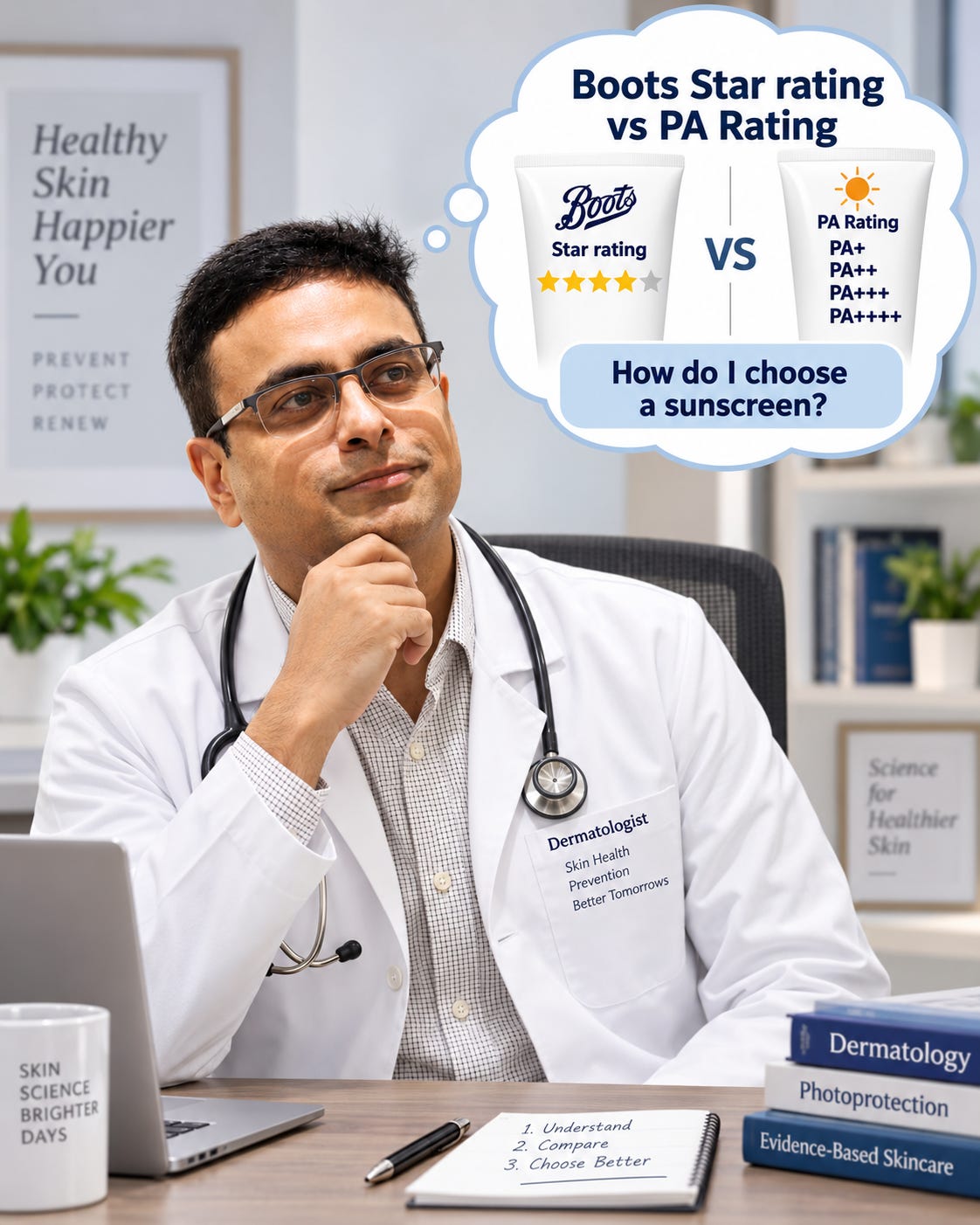
What does PA++++ actually tell us?
How different are PA+++ and PA++++?
Can two PA++++ sunscreens provide very different levels of UVA protection?
Is a five-star Boots rating the same as high UVA protection?
Why is the actual UVA Protection Factor rarely printed on sunscreen labels?
Can we calculate how long somebody can remain outdoors without tanning?
Does one short exposure matter if it causes no visible tanning?
What matters more for everyday pigmentation: one large exposure or small repeated exposures over many days?
Is sunlight before 9 AM or after 4 PM really safe from tanning?
If sunburn is the concern, SPF is extremely useful. I have already discussed this recently in Part 1 of this series……
Part 1: SPF, The Number Everyone Knows but Few Understand

Most people choose sunscreen by one number: SPF, or Sun Protection Factor. It is commonly explained by saying that SPF 30 blocks about 97% of ultraviolet B radiation, SPF 50 about 98%, and SPF 100 about 99%. Those figures make SPF 30, 50 and 100 sound almost identical.
But if tanning, melasma or pigmentation is the concern, another part of sunlight becomes increasingly important: UVA, or ultraviolet A radiation.
UVA occupies wavelengths from approximately 320 to 400 nanometres and penetrates more deeply into the skin than UVB. It contributes importantly to immediate pigment darkening, persistent pigmentation, photoageing and several photodermatoses.
For someone concerned about pigmentation, the most useful numerical measure would therefore be the UVA Protection Factor, or UVA-PF.
What is UVA-PF?
UVA-PF is conceptually similar to SPF. Instead of asking how much radiation is required to produce sunburn, UVA-PF compares the UVA dose required to produce a defined pigment-darkening response on sunscreen-protected skin with that required on unprotected skin.
A UVA-PF of 20 means that approximately 20 times the UVA dose is required to produce that laboratory pigmentation endpoint. A UVA-PF of 40 represents twice that measured protection factor. Unfortunately, the actual numerical UVA-PF is rarely displayed prominently on sunscreen labels. Instead, we usually see the PA system.
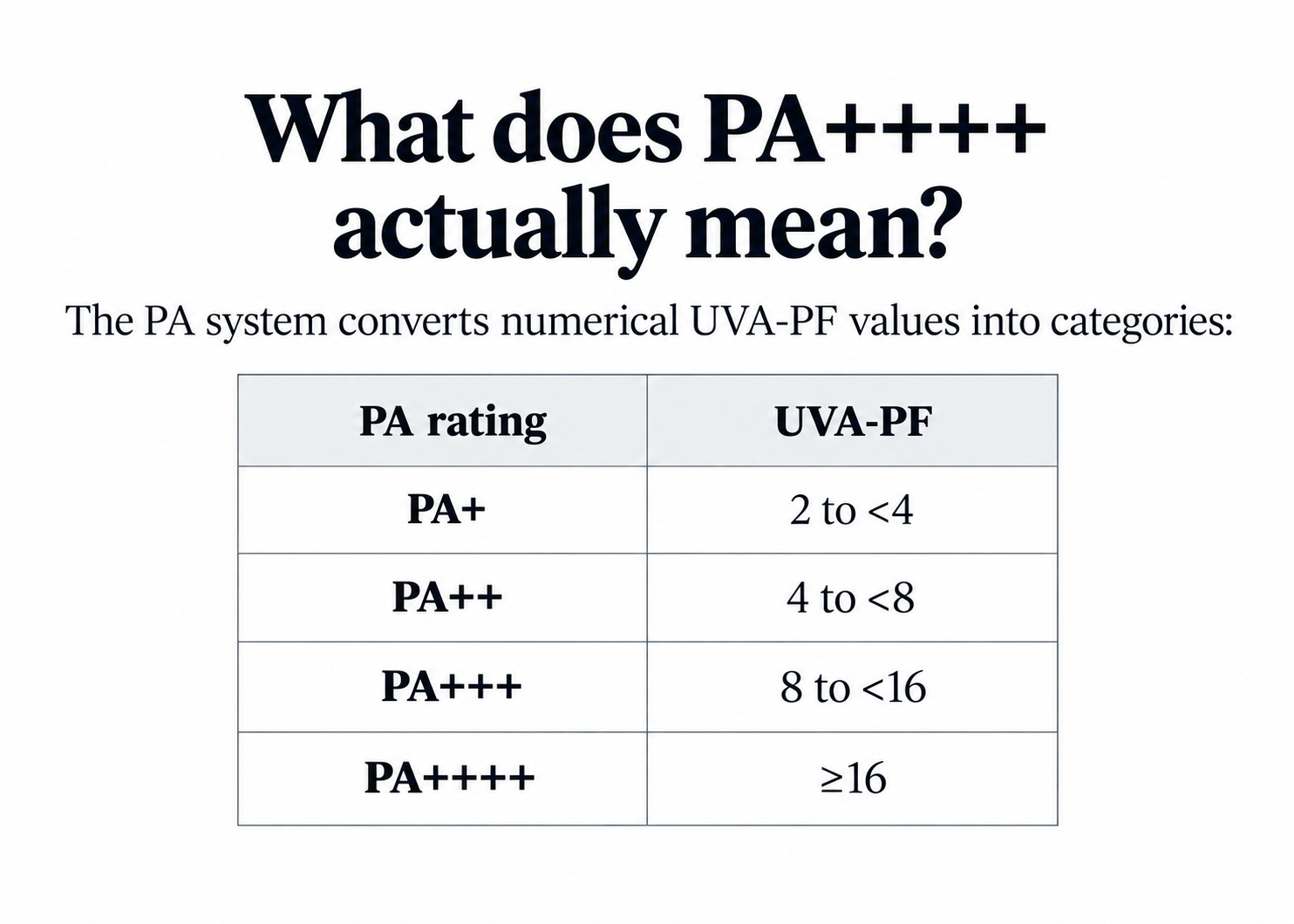
This immediately explains an important point about PA+++ versus PA++++. The minimum UVA-PF required for PA++++ is twice the minimum required for PA+++: 16 versus 8. But that does not mean that every PA++++ sunscreen provides twice the UVA protection of every PA+++ sunscreen.
Consider two products:
UVA-PF 15 = PA+++
UVA-PF 16 = PA++++
They fall into different PA categories despite having very similar measured UVA protection. Now consider another sunscreen with a UVA-PF of 40. It is also simply labelled PA++++. So PA++++ tells us that a sunscreen has crossed a minimum UVA-protection threshold. It does not tell us how far beyond that threshold the product has gone.
That is the fundamental limitation of the PA system: the plus signs tell us which category the sunscreen has reached, not its actual UVA Protection Factor.
Not all PA++++ sunscreens are equal
A 2026 study illustrates this particularly well. Researchers measured UVA-PF in 38 commercial SPF 50 or SPF 50+ sunscreens using the same standardised in-vivo method. UVA-PF values ranged from 3.6 to 46.6, with an average of 21.4. Five products exceeded a UVA-PF of 30. Yet only a minority displayed a numerical UVA value on their packaging.
This means that products carrying apparently similar high-SPF labels can differ substantially in their measured UVA protection.
The study was funded by La Roche-Posay, with several authors employed by L’Oréal or La Roche-Posay and the remaining investigators declaring payments from the company. That does not invalidate the measurements, but the potential conflict should be acknowledged when the study is used as an important source.
And what are Boots stars?
The Boots star system does not measure UVA-PF. Instead, it is essentially a spectral balance rating. It compares the average absorbance of a sunscreen across the UVA range with that across the UVB range, before and after irradiation.
A high star rating therefore means that the sunscreen’s UVA protection is reasonably well balanced relative to its UVB protection. But it does not tell us the absolute strength of that UVA protection.
A five-star sunscreen does not mean:
UVA-PF 50
99% UVA protection
that it provides more UVA protection than another five-star sunscreen
that it necessarily provides better UVA protection than a lower-star product
If your main concern is melasma, tanning, pigmentation or photoageing, the question you really want answered is: How much UVA protection am I actually getting?
For that, numerical UVA-PF is the most informative measure, followed by the PA system, which at least places UVA-PF into defined categories. The Boots star rating does not answer that question.
So the practical message is simple: If strong UVA protection is your priority, do not choose a sunscreen based on Boots stars. Follow the UVA-PF, or at least the PA rating, instead.
Why “How long before I tan?” is the wrong question
This is where pigmentation differs markedly from sunburn. Sunburn is an acute endpoint. After sufficient UVB exposure, erythema develops. SPF testing can therefore compare the radiation dose required to produce that defined endpoint on protected and unprotected skin.
Pigmentation is more complicated. Studies can measure a minimal melanogenic dose, meaning the smallest single UVA exposure capable of producing a detectable pigmentary response. In Asian skin phototypes III and IV, average values in one study were approximately 4.1 and 4.9 J/cm², respectively.
To put that into perspective, measurements from Coimbatore in July found UVA irradiance of about 6.4 mW/cm² at noon. At that intensity, a UVA dose of 4.1–4.9 J/cm² would accumulate in only about 11–13 minutes.
This does not mean that everyone will visibly tan after 11–13 minutes. It simply shows how quickly a UVA dose comparable to experimentally measured melanogenic doses can accumulate in Indian midday sunlight.
But that does not mean someone will necessarily look visibly tanned after a single 10- or 20-minute exposure. There are two important reasons.
First, experimental investigators can detect small pigmentary changes that may not yet be obvious to someone looking in the mirror.
Second, and more importantly, repeated exposure changes the biology.
Small exposures add up
One particularly useful study repeatedly exposed volunteers to fractions of their individual single-exposure tanning threshold. Some received only 20%, 40%, 60% or 80% of the UVA dose that would ordinarily be required to produce pigmentation after a single exposure. These apparently “subthreshold” doses still produced pigmentation when repeated.
After six exposures, the UVA dose required per exposure to produce pigmentation was roughly half the single-exposure threshold. After twelve exposures, it was roughly one-third. Pigmentation accumulated progressively and approached its maximum over approximately 15–19 days.
This is much closer to everyday life than a single laboratory exposure. Someone may spend a modest amount of time outdoors each morning and notice no obvious change on any individual day. After ten or fifteen days, however, the cumulative effect may become visible.
No visible tan after today’s exposure does not mean today’s exposure contributed nothing to next week’s tan.
This is why converting UVA-PF into statements such as “you can remain in the sun 16 times longer without tanning” is scientifically misleading.
UVA-PF describes protection against a defined laboratory pigmentation endpoint under controlled conditions. Everyday pigmentation reflects repeated UVA exposure, UVB-driven delayed melanogenesis, visible light, individual skin biology and the cumulative effects of multiple exposures.
What about early morning and evening?
Another common belief is that sunlight before 9 AM and after 4 PM is harmless. These periods certainly contain less total ultraviolet radiation than midday, particularly less UVB. But UVA does not fall as dramatically as UVB when the sun is lower in the sky.
Measurements from Coimbatore showed that meaningful UVA exposure remained during the morning and afternoon, while sunlight became proportionately more UVA-rich as UVB declined.
So early-morning and late-afternoon sunlight means lower exposure, not zero pigmentation exposure.
Again, cumulative exposure matters. Twenty minutes on one morning may produce no visible change. Twenty minutes every morning for several weeks is a very different biological situation.
The more useful question
For pigmentation, asking: “How long can I stay in the sun before I tan?” may therefore be the wrong way to think about sunscreen protection.
A more useful question is: How much cumulative UVA exposure am I receiving over days and weeks, and how much of it is my sunscreen actually reducing?
That is the question the next parts of this series will build on…..
The Light Your SPF and PA Ratings Ignore — Yet We Are Exposed to All Day

In Part 1, we looked at SPF and why it mainly tells us about protection against sunburn. In Part 2, we moved to UVA protection and examined what PA ratings, UVA Protection Factor and Boots stars actually mean.
References
Japan Cosmetic Industry Association. Standards for Sun Protection Factor, UVA Protection Grade and Water Resistance. PA+: UVA-PF 2 to <4; PA++: 4 to <8; PA+++: 8 to <16; PA++++: ≥16.
Young AR, Tricaud C, Bernerd F, et al. In Vivo Measurement of UVA Protection Factor Across 38 Different SPF 50 and SPF 50+ Sunscreens Reveals High Heterogeneity and Limitations in the Level of Protection. Photodermatol Photoimmunol Photomed. 2026;42:e70092. doi:10.1111/phpp.70092.
Ravnbak MH, Philipsen PA, Wiegell SR, Wulf HC. Skin pigmentation kinetics after exposure to ultraviolet A. Acta Derm Venereol. 2009;89:357-363. doi:10.2340/00015555-0635.
Wong LC, Jamil A, Md Nor N. The effect of pre-phototest sun exposure on minimal erythema dose and minimal melanogenic dose among skin phototypes III, IV and V. Photodermatol Photoimmunol Photomed. 2018;34:400-404. doi:10.1111/phpp.12410.
Balasaraswathy P, Kumar U, Srinivas CR, Nair S. UVA and UVB in sunlight: optimal utilization of UV rays in sunlight for phototherapy. Indian J Dermatol Venereol Leprol. 2002;68:198-201.