

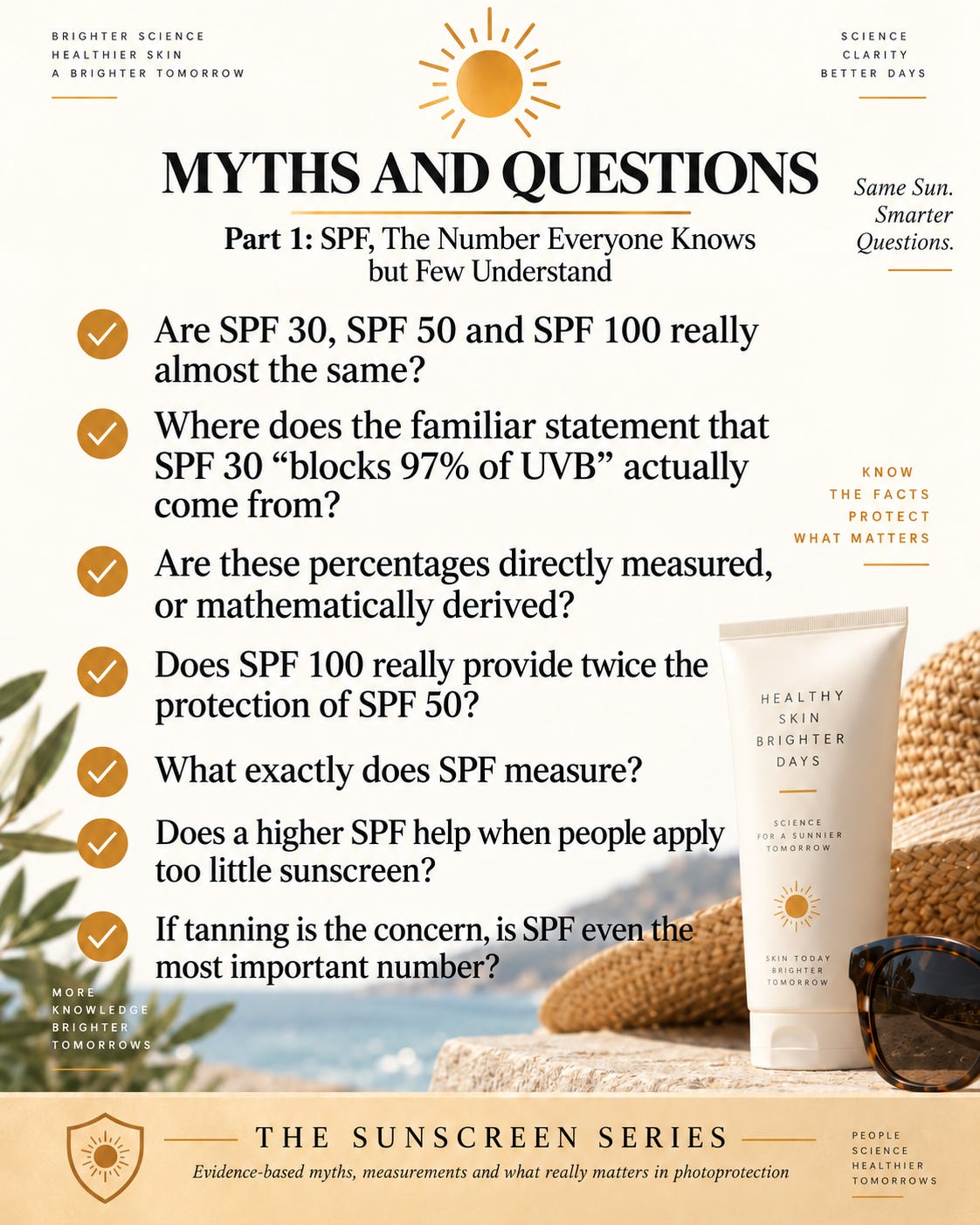
Most people choose sunscreen by one number: SPF, or Sun Protection Factor. It is commonly explained by saying that SPF 30 blocks about 97% of ultraviolet B radiation, SPF 50 about 98%, and SPF 100 about 99%. Those figures make SPF 30, 50 and 100 sound almost identical.
But that explanation is incomplete.
What does SPF actually measure?
SPF is not fundamentally a measurement of the percentage of ultraviolet B photons blocked. It is a biological protection factor based on sunburn.
In standardized testing, sunscreen is applied at 2 mg/cm². Researchers then determine the ultraviolet dose required to produce minimal visible redness, or erythema, on protected skin and compare it with the dose required on unprotected skin. ISO 24444 standard specifically defines SPF as protection against erythema (redness) induced by solar ultraviolet radiation. The US Food and Drug Administration similarly defines SPF according to the amount of solar ultraviolet energy required to produce sunburn on protected versus unprotected skin.
So, conceptually:
SPF = UV dose required to produce erythema with sunscreen ÷ UV dose required without sunscreen.
An SPF 30 sunscreen therefore requires approximately 30 times the erythemally effective ultraviolet dose to reach the same sunburn endpoint under laboratory conditions. SPF 50 means approximately 50 times the dose; SPF 100, approximately 100 times.
Because sunburn is driven predominantly by ultraviolet B radiation, SPF primarily reflects UVB protection, although the test is not literally a measurement of the percentage of all UVB wavelengths being blocked.
So where do 97%, 98% and 99% come from?
They are essentially a mathematical translation of the protection factor.
If SPF 30 means that approximately one-thirtieth of the erythemally effective dose remains, then:
Another way to understand SPF is to look at how much sunburn-causing ultraviolet radiation still gets through.
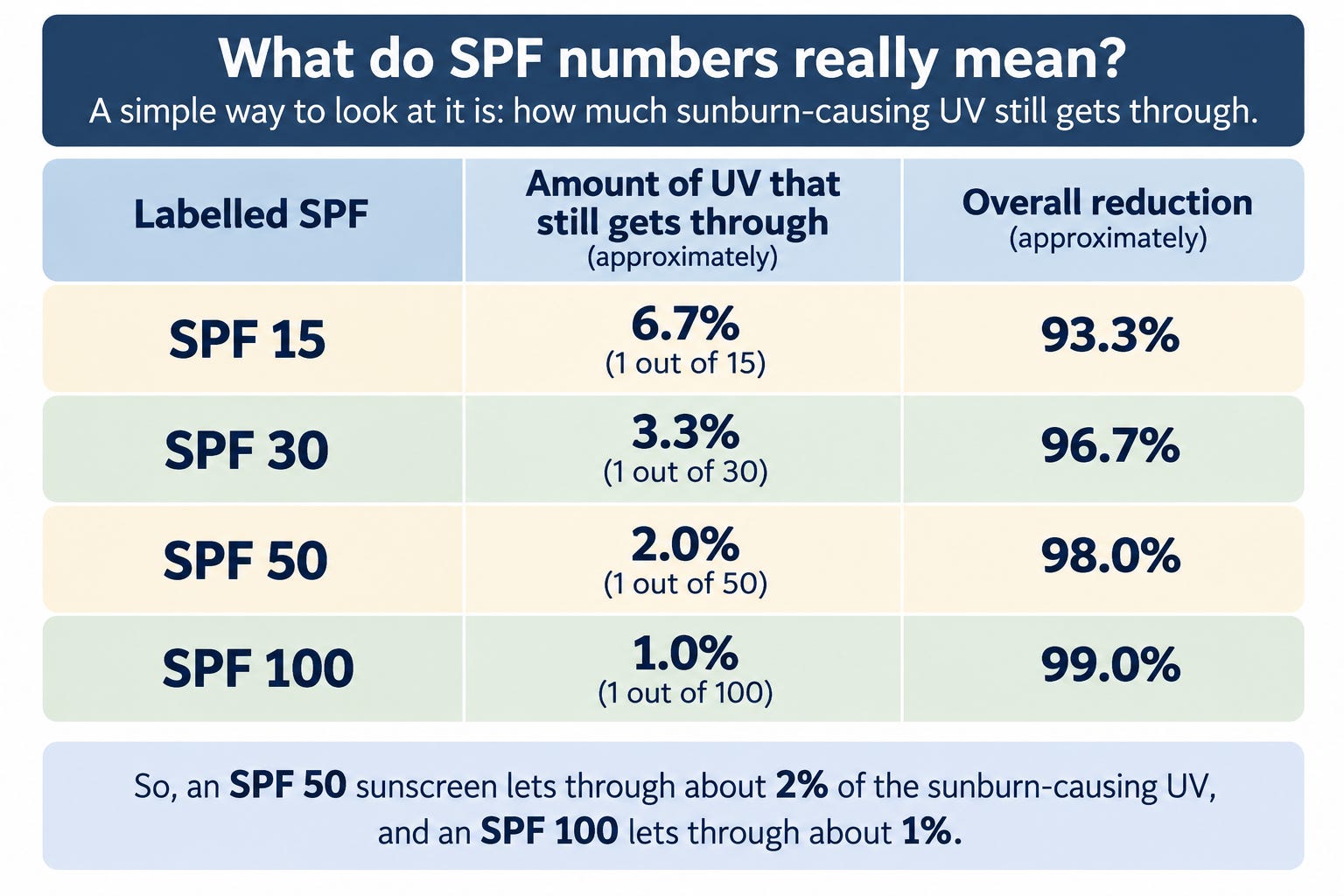
In simple terms, SPF 30 lets through about 3.3% of the sunburn-causing UV, SPF 50 about 2%, and SPF 100 about 1%. That is why SPF 50 and SPF 100 may look similar when described as “98% versus 99% protection,” but SPF 100 actually allows only half as much residual sunburn-causing UV through as SPF 50.
This is the origin of the familiar statement that SPF 30 “blocks 97%” and SPF 50 “blocks 98%”. The American Academy of Dermatology itself uses this simplified language for public education.
But scientifically, it is better to say “approximately 96.7% attenuation of erythemally effective UV under the assumptions of the SPF model” rather than “97% of UVB photons are blocked”.
The distinction matters.
Why SPF 50 and SPF 100 are not almost identical
If we describe protection as percentages, SPF 50 and SPF 100 look very similar:
98% versus 99%.
But look instead at what gets through:
SPF 50 leaves approximately 2% of the erythemally effective dose.
SPF 100 leaves approximately 1%.
The residual dose has therefore been halved.
The difference between SPF 50 and SPF 100 is not merely “one percentage point”. SPF 100 represents twice the protection factor and approximately half the residual erythemally effective exposure.
Under constant laboratory irradiance, SPF 100 would require approximately twice the ultraviolet dose to reach the same erythema endpoint as SPF 50.
This should not be interpreted literally as “SPF 100 lets you stay in the sun twice as long”. The Food and Drug Administration specifically cautions against converting SPF directly into clock time because solar intensity varies enormously with latitude, season, cloud cover and time of day. Sunscreen is also rubbed, sweated and wiped away.
Does this difference matter in real life?
Apparently, yes, at least for sunburn.
In a randomized split-face natural-sunlight study of 199 adults exposed outdoors for an average of 6.1 hours, 55.3% were judged more sunburned on the SPF 50+ side compared with only 5% on the SPF 100+ side.
A later five-day beach study found a similar difference: 56% had greater sunburn on the SPF 50+ side compared with 7% on the SPF 100+ side.
Both studies were supported by Johnson & Johnson Consumer Inc., and company employees were among the investigators. That potential conflict should be acknowledged. More importantly, these studies measured erythema or sunburn. They did not demonstrate that SPF 100 is twice as good as SPF 50 for preventing tanning, melasma, photoageing or skin cancer.
That distinction is crucial.
Then why is SPF 30 usually considered enough?
Because SPF 30 already provides substantial protection against sunburn when it is applied properly. It remains a reasonable minimum recommendation for routine photoprotection.
But “SPF 30 is adequate for most situations” is quite different from saying “SPF 30, 50 and 100 are practically identical”.
Higher SPF also provides some margin for the fact that people rarely reproduce laboratory conditions. Sunscreens are tested at approximately 2 mg/cm², while real-world application is usually considerably lower and often uneven. The American Academy of Dermatology specifically notes that higher SPF can help compensate partly for underapplication. It does not, however, last longer simply because the SPF number is higher; outdoor reapplication is still required.
But what if the concern is tanning rather than sunburn?
This is where SPF becomes much less satisfactory as the only number used to choose sunscreen.
SPF is based on an erythema endpoint and therefore predominantly reflects protection against UVB. UVB remains important in Indian skin because it contributes to DNA damage, delayed melanogenesis and several photodermatoses. Sunburn is also not absent in Indian skin, although it is less readily produced and may be less conspicuous in more deeply pigmented phototypes.
But many Indian patients are not buying sunscreen primarily to avoid sunburn. They are buying it because they do not want to become darker.
For that purpose, ultraviolet A radiation, or UVA, becomes particularly important.
An SPF 100 sunscreen may protect very well against sunburn but still offer less UVA protection than some SPF 50+ sunscreens.
SPF is a sunburn protection factor. It should not be mistaken for an anti-tanning protection factor.
That takes us to Part 2, and to the number I would much rather know when treating pigmentation: the actual UVA Protection Factor.

References
International Organization for Standardization. ISO 24444:2019. Cosmetics — Sun protection test methods — In vivo determination of the sun protection factor (SPF).
US Food and Drug Administration. Sun Protection Factor (SPF). SPF is defined according to the amount of solar ultraviolet energy required to produce sunburn on protected versus unprotected skin.
Williams JD, Maitra P, Atillasoy E, et al. SPF 100+ sunscreen is more protective against sunburn than SPF 50+ in actual use: results of a randomized, double-blind, split-face, natural sunlight exposure clinical trial. J Am Acad Dermatol. 2018;78:902-910.e2. doi:10.1016/j.jaad.2017.12.062. Supported by Johnson & Johnson Consumer Inc.
Kohli I, Nicholson CL, Williams JD, et al. Greater efficacy of SPF 100+ sunscreen compared with SPF 50+ in sunburn prevention during 5 consecutive days of sunlight exposure: a randomized, double-blind clinical trial. J Am Acad Dermatol. 2020;82:869-877. doi:10.1016/j.jaad.2019.09.018. Supported by Johnson & Johnson Consumer Inc.
Petersen B, Wulf HC. Application of sunscreen: theory and reality. Photodermatol Photoimmunol Photomed. 2014;30:96-101. doi:10.1111/phpp.12099.