

The Article in 30 Seconds
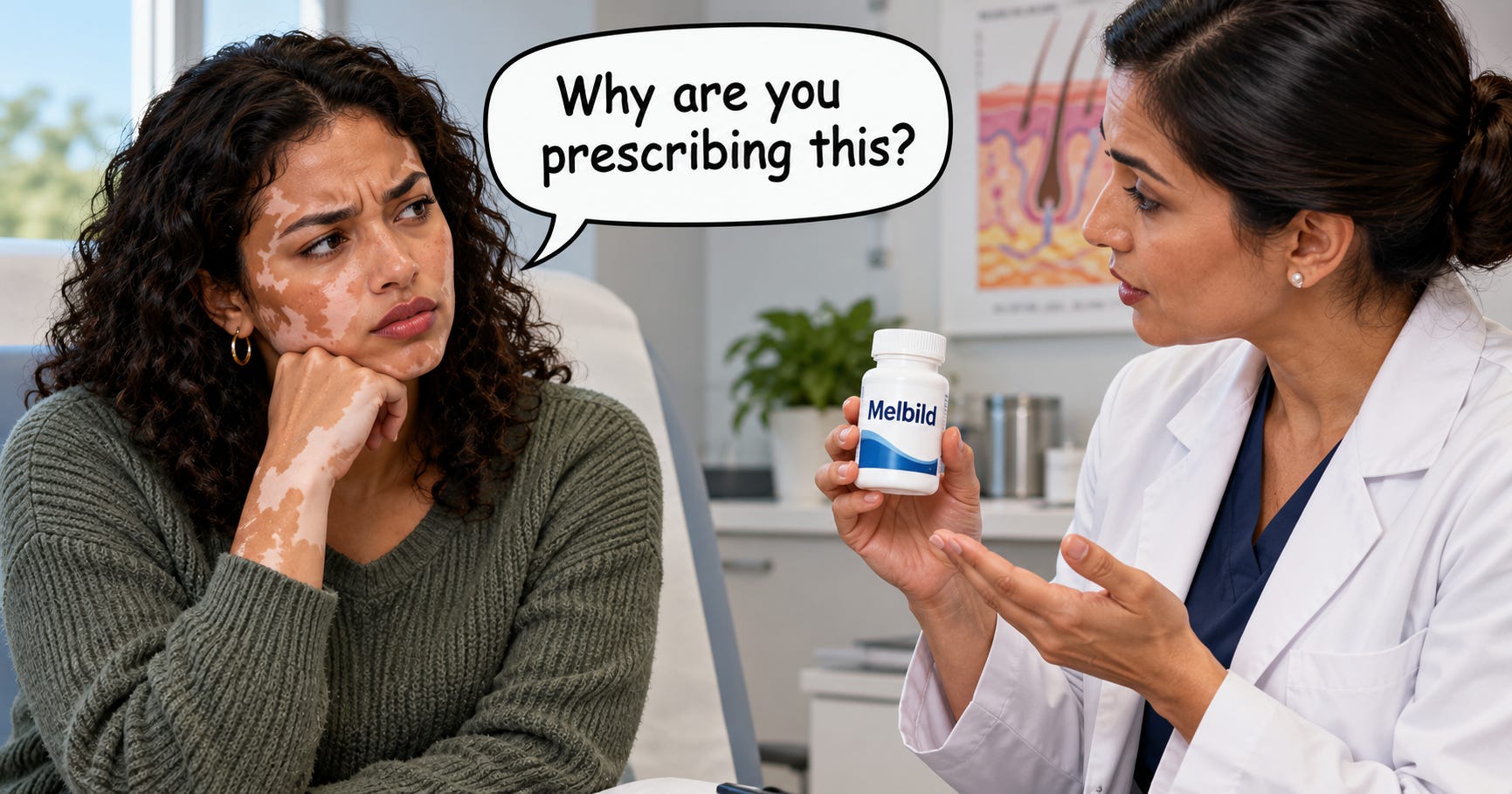
The Hype: Melbild promises a push towards repigmentation, and its label even permits use without other treatment. Little wonder it finds its way onto some vitiligo prescriptions.
The Evidence: The no-UV controlled comparison was negative. A small UV-matched trial was positive, but two larger trials gave extra sunlight only to Melbild users—an awkward detail when sunlight itself treats vitiligo.
My Verdict: I would not routinely add a paid-for peptide when its contribution remains uncertain.
A patient uses tacrolimus, attends phototherapy and applies Melbild. The patch repigments. Which treatment helped? When all three appear on the prescription, there is a temptation to congratulate all three.
Melbild contains a basic fibroblast growth factor-derived decapeptide, intended to encourage melanocyte growth and migration. Alkem’s undated prescribing information allows use alone or alongside other therapies, with optional sunlight or ultraviolet exposure. There is a curious mismatch between that broad claim and what the trials establish.
The small experiment that matters
In 2015, 30 patients contributed paired patches: one received decapeptide, the other vehicle, with identical NB-UVB. After 12 weeks, mean repigmented area was 23% versus 9.02% of baseline patch area (paired P=0.04) in the modified intention-to-treat analysis. A 29-patient evaluable analysis yielded 25.17% versus 8.9% (paired P=0.031). Both differences were statistically significant, although they represent two analyses of the same patients. The absolute additional repigmentation was approximately 14–16 percentage points of baseline patch area over three months. It is uncertain whether patients would consider this a worthwhile cosmetic improvement. The trial did not establish durable repigmentation or improvement in quality of life. Published NB-UVB studies generally report substantially better responses with longer treatment, particularly on the face and neck.
Separately, 32 patients had paired patches protected from UV. Decapeptide performed no better than vehicle. A 2017 paper appears to describe this same sun-protected cohort, so counting it as another independent trial would inflate the evidence. Together, these findings suggest a possible UV-dependent benefit, although they do not prove synergy. The original trial was brief, used a specially prepared formulation, and had an Alkem-affiliated first author. Evidence for the peptide also needs to be distinguished from evidence for the retail product. The label’s monotherapy permission is particularly difficult to support from these data: the only randomised no-UV comparison found no clear benefit, although smaller effects remain possible.
A little extra sunshine
The 2020 open-label tacrolimus study randomised 120 patients. Among 105 completers, more than 50% target-patch repigmentation occurred in 36/54 given Melbild plus tacrolimus and 20/51 given tacrolimus alone: a 27.5-percentage-point difference. Only the Melbild group was instructed to get additional daily sunlight.
In the 2023 open-label oral-PUVA trial, 120 were randomised and 108 completed treatment. The corresponding figures were 34/55 versus 16/53, a 31.6-point difference. Both groups received clinic PUVA; the Melbild group also received daily sunlight instructions. Alkem sponsored the trial, and several investigators worked for the company.
A manufacturer could reasonably argue that the intended treatment includes sunlight. Fair enough. But to discover whether the peptide adds anything to properly delivered UV, ultraviolet exposure should be comparable across groups. In these trials, it wasn’t.
Neither trial included all randomised patients in its final analysis. More importantly, neither established whether the repigmentation would last after treatment stopped or whether patients experienced a meaningful overall improvement.
More combinations, familiar uncertainty
A 2024 single-arm interventional study combined decapeptide, NB-UVB and fractional CO₂ laser: 13 of 20 patients achieved more than 50% repigmentation. Without a comparator, individual contributions remain unknown.
A 2023 retrospective Melgain series reported more than 75% repigmentation in 46/65 patients, including 33 treated with the peptide alone. There was no untreated control; two authors worked for Zydus. One patient reported transient erythema and burning. Short-term safety reports are broadly reassuring, although the 2023 PUVA paper uses inconsistent adverse-event wording and long-term data remain limited.
A 2023 expert consensus supported decapeptide despite limited evidence. The consensus was supported by Zydus, and some of its authors had previously conducted studies on the peptide. In April 2025, a CDSCO expert committee recommended that UV exposure be kept the same across treatment groups in future decapeptide trials.
The decision in India
In my earlier articles on PUVASOL and Whit-Care, I argued that supervised sunlight-based treatment deserves consideration in resource-limited settings. PUVASOL requires psoralen precautions, while NB-UVB remains preferable when accessible. Corticosteroids and tacrolimus have established roles. Melbild retails at roughly ₹575 for 2 ml and ₹925–₹1,175 for 5 ml; course costs depend on area and duration.
Given the limited evidence for any meaningful additional benefit over established treatments, I do not prescribe Melbild and would not recommend it to my patients. Its routine use is difficult to justify, particularly when effective alternatives already exist. If a properly controlled trial demonstrates a worthwhile additional benefit with identical UV exposure in both groups, I would reconsider. Until then, I see little reason to add Melbild to a vitiligo prescription.
References and Further Reading
Ramaiah A, et al. A double blind randomized phase IV clinical trial of basic fibroblast growth factor related deca-peptide in vitiligo. Pigmentary Disorders. 2015;S3. DOI: 10.4172/2376-0427.S3-004. See Tables 1 and 2 for the two analyses.
Ramaiah A, Madhava AS. A double blind randomized clinical trial on basic fibroblast growth factor related deca-peptide to reduce wrinkles on skin and to treat non sun exposed vitiligo macules. Cosmetology & Oro Facial Surgery. 2017;3:112. Original publication
Parsad D, et al. Basic fibroblast growth factor-related decapeptide 0.1% solution with tacrolimus 0.1% ointment compared with tacrolimus monotherapy in stable vitiligo. IP Indian Journal of Clinical and Experimental Dermatology. 2020;6:249–253. DOI: 10.18231/j.ijced.2020.050
Nayak CS, et al. Efficacy and safety comparison of bFGF-related decapeptide plus oral PUVA with oral PUVA monotherapy. Journal of Cutaneous and Aesthetic Surgery. 2023;16:28–33. DOI: 10.4103/JCAS.JCAS_33_21
Kaur N, Kaur J, Sharma S. Novel combination of NB-UVB phototherapy with bFGF-related decapeptide 0.1% and CO₂ laser in stable non-segmental vitiligo. Portuguese Journal of Dermatology and Venereology. 2024;82:104–110. DOI: 10.24875/PJDV.24000030
Sharma A, et al. The safety and effectiveness of decapeptide in patients with vitiligo: A real-world study. Cureus. 2023;15. DOI: 10.7759/cureus.41418
Parsad D, et al. Development of consensus recommendations on the management of vitiligo and the role of decapeptide by the Delphi method. Indian Journal of Dermatology. 2023;68:587. DOI: 10.4103/ijd.ijd_461_23
Central Drugs Standard Control Organization. SEC Dermatology and Allergy recommendations, 22 April 2025. Official committee document
Alkem Laboratories. Melbild: Basic Fibroblast Growth Factor Derived Decapeptide Solution, 2 mg/2 ml. Undated online prescribing information. Manufacturer’s prescribing document
Retail price references, October 2026: Tata 1mg, Apollo Pharmacy, and Skinluv.