

Phototherapy: using ultraviolet light to stimulate the return of normal pigment, is one of the most important treatments for vitiligo, particularly when the disease is extensive or continuing to spread.
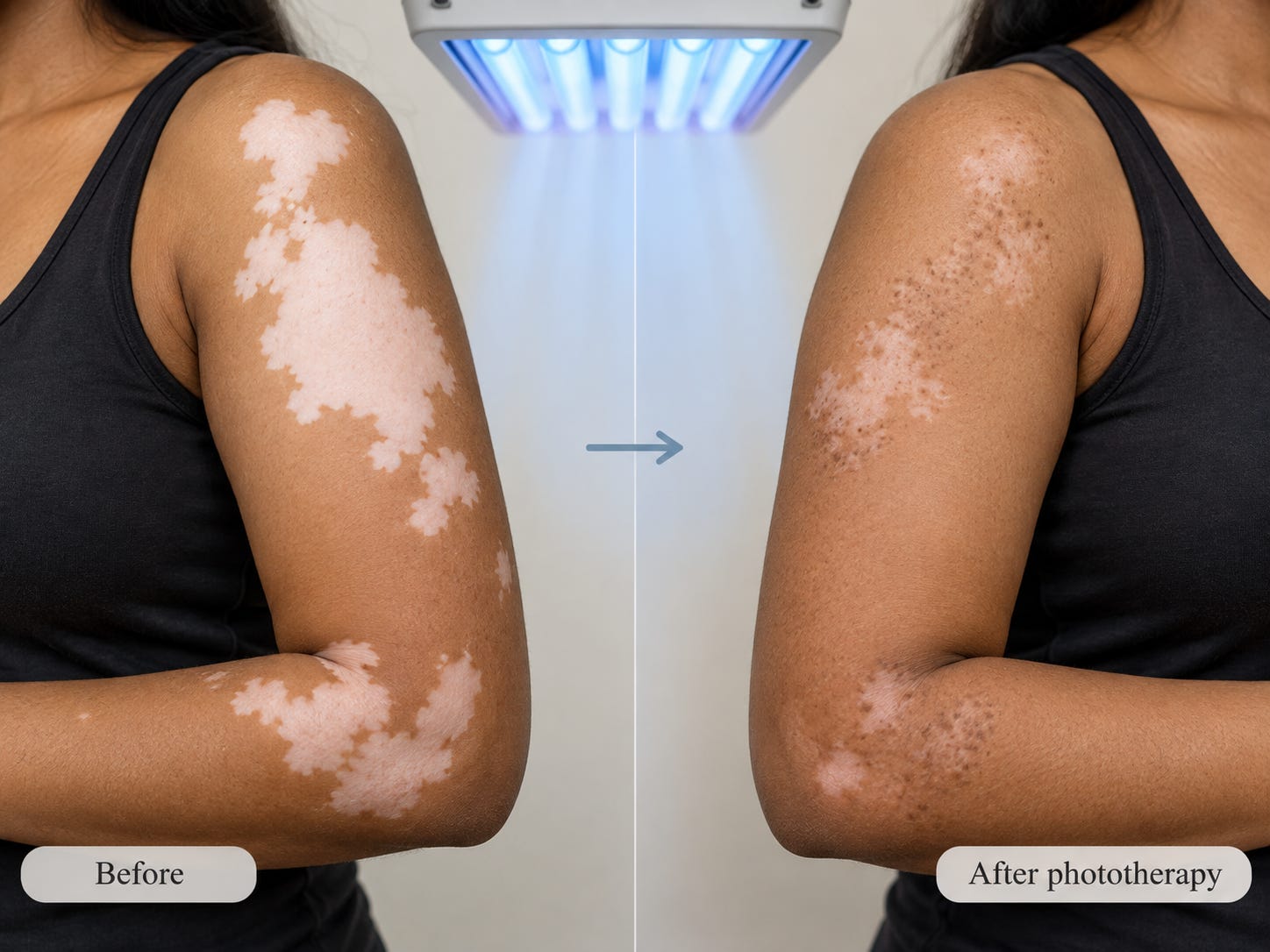
Modern dermatology usually prefers narrowband ultraviolet B (NB-UVB), delivered through a phototherapy machine. But India has used another effective and remarkably inexpensive form of phototherapy for decades: PUVASOL, using an ultraviolet source available everywhere….the sun.
The following write-up takes a pragmatic view: in a country like India, where most healthcare expenditure is paid out of pocket, affordability and accessibility can determine the real-world effectiveness of a treatment far more than its superiority on paper.
First, what are PUVA and PUVASOL?
PUVA means Psoralen + Ultraviolet A.
Psoralens are medicines that temporarily make the skin more sensitive to UVA, the longer-wavelength component of ultraviolet light. Once the skin is sensitised, UVA can stimulate repigmentation. Because treatment combines a drug with light, PUVA is called photochemotherapy.
In conventional PUVA, UVA comes from a phototherapy machine.
In PUVASOL, it comes from SOLar light: PUVA + SOL.
The principle is the same, but the sun replaces the UVA cabinet.
Psoralen can be taken orally, producing whole-body photosensitisation, or applied directly to individual patches. I therefore tend to use systemic PUVASOL for extensive vitiligo and topical PUVASOL for localised disease.
The drug is inexpensive. The UVA source is free. For a country where repeated hospital attendance is often difficult, that matters.
Why did NB-UVB become preferred?
There are a few good reasons. Psoralen deliberately makes the skin photosensitive. Too much UVA can therefore cause phototoxicity—essentially an exaggerated sunburn—with redness, burning and occasionally blistering. Oral psoralen also requires additional precautions, including eye protection from UVA after taking the drug.
PUVA also acquired a reputation for increasing the risk of skin cancer. That concern is genuine, but its origins need context. The strongest carcinogenicity data come mainly from fair-skinned Western patients with psoriasis who received high cumulative doses of PUVA over many years. Extrapolating those risk estimates directly to darker Indian skin, particularly to patients with vitiligo receiving lower and differently delivered exposure, is not the same.
NB-UVB avoids psoralen altogether. Its ultraviolet dose can be measured accurately, it is generally better tolerated, and the pigment that returns often matches the surrounding skin better. These advantages nevertheless explain why modern guidelines favour NB-UVB.
The question is not whether NB-UVB is technically better. It is how much better—and whether that advantage survives the realities of Indian healthcare.
How much more effective is NB-UVB?
The strongest randomized comparison, by Yones and colleagues, found more than 50% improvement in 64% with NB-UVB versus 36% with oral PUVA. Colour matching was also substantially better with NB-UVB. That is a meaningful difference. But it was one small study of oral PUVA delivered using an artificial UVA cabinet, not Indian PUVASOL.
Other comparisons show much smaller differences.
Bhatnagar and colleagues found average repigmentation of 52.2% with NB-UVB versus 44.7% with systemic PUVA—an absolute difference of only 7.5 percentage points. When the notoriously treatment-resistant hands and feet were excluded, the difference was about 13 percentage points.
Ravishankar and colleagues reported at least 50% repigmentation in 56% with NB-UVB versus 48% with PUVASOL—an eight-percentage-point difference. NB-UVB again performed better for colour matching and adverse effects, but the study contained only 25 patients in each group and was not properly randomized.
Systematic reviews reveal the same problem: very few direct trials and wide confidence intervals around the estimates. The evidence therefore does not show that PUVA and NB-UVB are identical. NB-UVB has clear advantages. But neither does it establish overwhelming clinical supremacy in repigmentation.
A statistically significant difference is not automatically a clinically decisive one. And an 8–13 percentage-point advantage begins to look rather different when the better treatment requires hospital attendance two or three times every week for six months or longer.
Now count the patients who cannot reach the machine
This is where conventional efficacy studies become less useful in India. Consider the patient who stops NB-UVB after six weeks because he cannot lose three mornings of work every week. Or the family travelling 50 kilometres with a child. Or the patient who cannot afford months of private phototherapy.
Do not remove these patients from the denominator. Count them as treatment failures.
That is the logic behind intention-to-treat analysis: outcomes are assessed in everyone for whom a treatment strategy was assigned, not merely in the fortunate group who managed to complete it.
We do not have a properly designed Indian trial comparing NB-UVB and PUVASOL this way. So I cannot claim that PUVASOL has already proved superior on an intention-to-treat basis.
But I strongly suspect that the apparent advantage of NB-UVB would shrink—and in some settings could even reverse—once treatment completion, travel, affordability and adherence are included.

The existing Indian literature gives us clues. In Bhatnagar’s study, repeated hospital attendance proved difficult enough to compromise long-term treatment. In Ravishankar’s study, patients who could attend frequently received NB-UVB, while those who could not received PUVASOL.
Access determined treatment before efficacy had a chance to. The machine may be superior. The patient still has to have access to it.
PUVASOL’s drawbacks
PUVASOL’s major disadvantage is that sunlight cannot be dosed as precisely as a phototherapy machine. UVA intensity varies with season, geography and time of day. Measurements from Chandigarh showed that delivering the same UVA dose could require about 11 minutes in June but more than 50 minutes in January.
So “take this tablet and sit in the sun for ten minutes” is not proper PUVASOL.
PUVASOL should be treated as genuine photochemotherapy. Psoralen dosage should be defined, sunlight exposure should begin conservatively and increase gradually, contraindications should be screened for, and patients should receive clear written instructions. Systemic treatment requires appropriate eye protection; topical treatment requires precise application to the affected patches.
Used carelessly, PUVASOL can burn. Used properly and protocolised by an experienced dermatologist, my experience has been that it is remarkably safe.
What about skin cancer in Indian patients?
This is where Western experience should not simply be imported wholesale. In my own practice, I have never seen a skin cancer attributable to PUVA or PUVASOL. My father, also a dermatologist, has used PUVA-based treatment for approximately four decades and has likewise never encountered one.
That is anecdotal experience, not proof. But it aligns with the available Indian evidence.
The largest Indian safety study included 1,300 phototherapy patients, 929 of whom received PUVA. Some had cumulative UVA exposures above 2,000 J/cm². No cutaneous malignancy was detected. Indian reviews have consequently described the malignancy risk with PUVA in darker Indian skin as very low.
I would not claim that the risk is literally zero. The available Indian follow-up is not long enough to exclude every late cancer, and rare PUVA-associated malignancies have been described outside India.
But in practical terms, the carcinogenic risk of carefully administered PUVA/PUVASOL in darker Indian phototypes appears extremely low and may be negligible, particularly compared with the much larger risk estimates derived from heavily treated, fair-skinned Western psoriasis populations. That distinction is important!
Systemic for extensive disease, topical for localised disease
The argument for reviving PUVASOL is not merely an argument for topical therapy.
For extensive vitiligo, systemic PUVASOL is often the more practical approach. Treating dozens of individual patches topically makes little sense. Oral psoralen followed by carefully timed sunlight provides whole-body photochemotherapy without requiring repeated visits to a UVA unit.
For localised vitiligo, topical PUVASOL is more logical. Psoralen is confined to the white patches, avoiding systemic exposure, although excessive local UVA can still cause phototoxicity.
A case for reviving PUVASOL
The best phototherapy is not the one that produces the highest response rate among patients who manage to complete it. It is the one that produces the best outcome among all the patients we intended to treat.
Until we measure that properly in Indian patients, declaring PUVASOL obsolete may be evidence running ahead of the evidence, especially since the difference in repigmentation between NB-UVB and PUVA has often been modest in small comparative studies, while the difference in accessibility can be enormous.
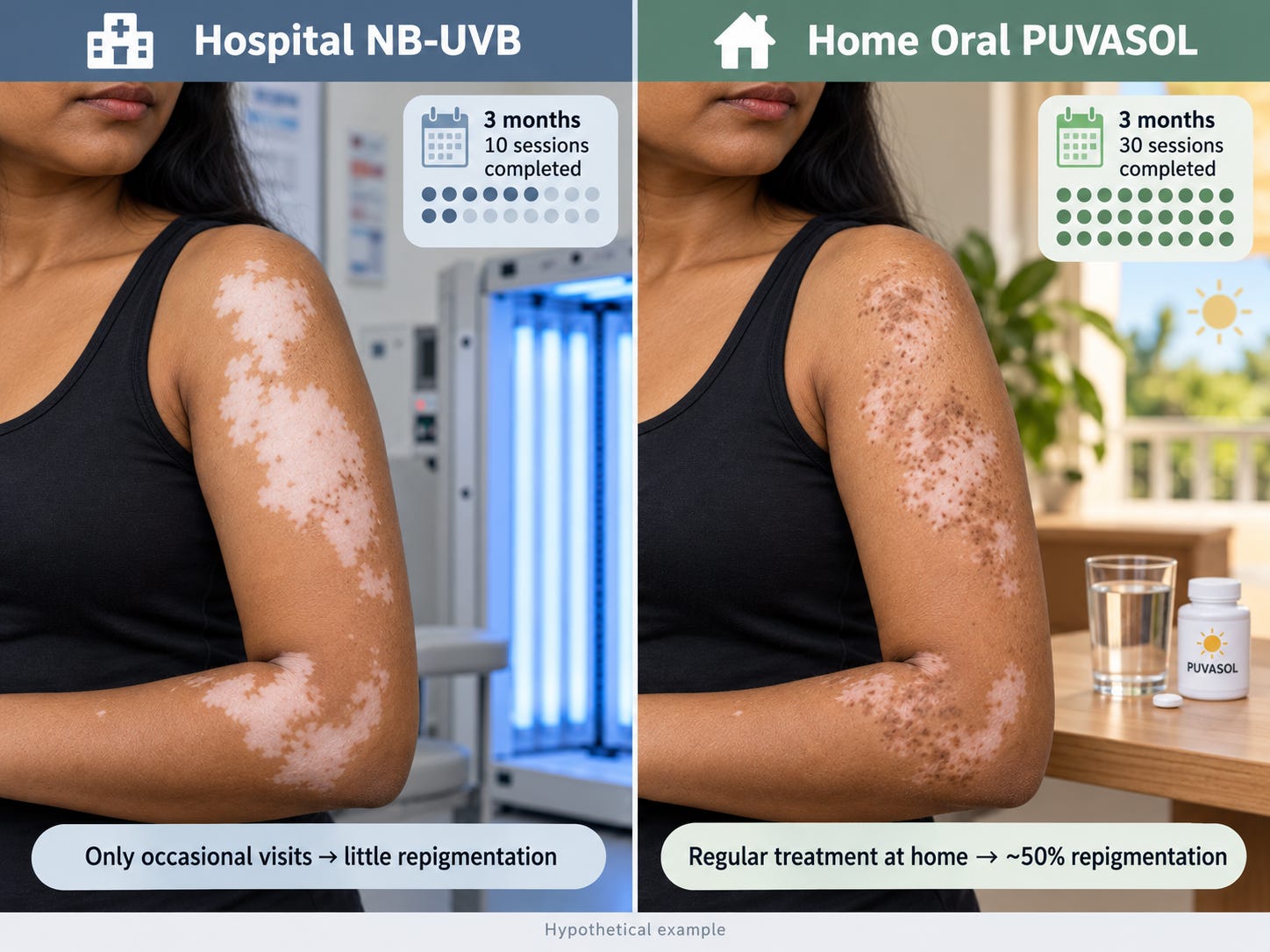
For adults with extensive vitiligo who cannot realistically attend NB-UVB several times every week, systemic PUVASOL deserves reconsideration. For localised disease where targeted phototherapy is inaccessible, topical PUVASOL deserves the same reconsideration.
This is not an argument for casual home treatment. It is an argument for bringing PUVASOL back as properly selected, protocolised and medically supervised photochemotherapy.
The sunlight is free.
The medicine is inexpensive.
Indian safety experience is reassuring.
And unlike a phototherapy machine, the sun does not require a patient to travel to hospital three times a week.
References
Yones SS, Palmer RA, Garibaldinos TM, Hawk JLM. Randomized double-blind trial of treatment of vitiligo: efficacy of psoralen–UV-A therapy vs narrowband UV-B therapy. Arch Dermatol. 2007;143:578–584.
Bhatnagar A, Kanwar AJ, Parsad D, De D. Comparison of systemic PUVA and NB-UVB in the treatment of vitiligo: an open prospective study. J Eur Acad Dermatol Venereol. 2007;21:638–642.
Xiao BH, Wu Y, Sun Y, Chen HD, Gao XH. Treatment of vitiligo with NB-UVB: a systematic review. J Dermatolog Treat. 2015;26:340–346.
Ravishankar V, Rathod SP, Saikia S, Chaudhary RG, Solanki RB. A study of comparison of PUVASOL and NBUVB in patients with vitiligo. Pigment Int. 2018;5:96–102.
Kaushik A, De D, Handa S, Mittal A. To determine irradiance of ultraviolet A in ambient sunlight and optimum exposure time for PUVASOL in a North Indian location. Indian J Dermatol Venereol Leprol. 2019;85:462–465.
Ravindran S, Pai BS, Shetty VM. Risk of cutaneous carcinogenesis with phototherapy in Indian subpopulation: a 10-year analysis and review of literature. Dermatol Ther. 2022;35.
Very well summarised Sasi. I practice in urban tertiary care private hospital with phototherapy chamber in mumbai. But realistically how many are able to reach the chamber for treatment in the busy life of mumbai that has to fight the traffic jams. So have resorted to puvasol for majority of my patients. THe difference is i use psoralen ointment that is applied 15 minutes prior to sun exposure. I start with only 2 minutes of sun exposure and then gradually increase exposure time by half minute every 2 weeks. This way the chance of burning is minimal. Skin and patient get used to the sun exposure routine and the precautions. Get results in most with minimal disasters.