

The Article in 30 Seconds
The Hype: Whit-Care offers a gentler, herbal alternative to conventional psoralen phototherapy.
The Evidence: Babchi contains naturally occurring photosensitisers, but convincing product-specific evidence establishing Whit-Care’s efficacy or superior safety is lacking.
My Verdict: If phototoxicity worries us with PUVASOL, why are we more comfortable prescribing a herbal preparation containing related compounds, with less standardised dosing and weaker clinical evidence?
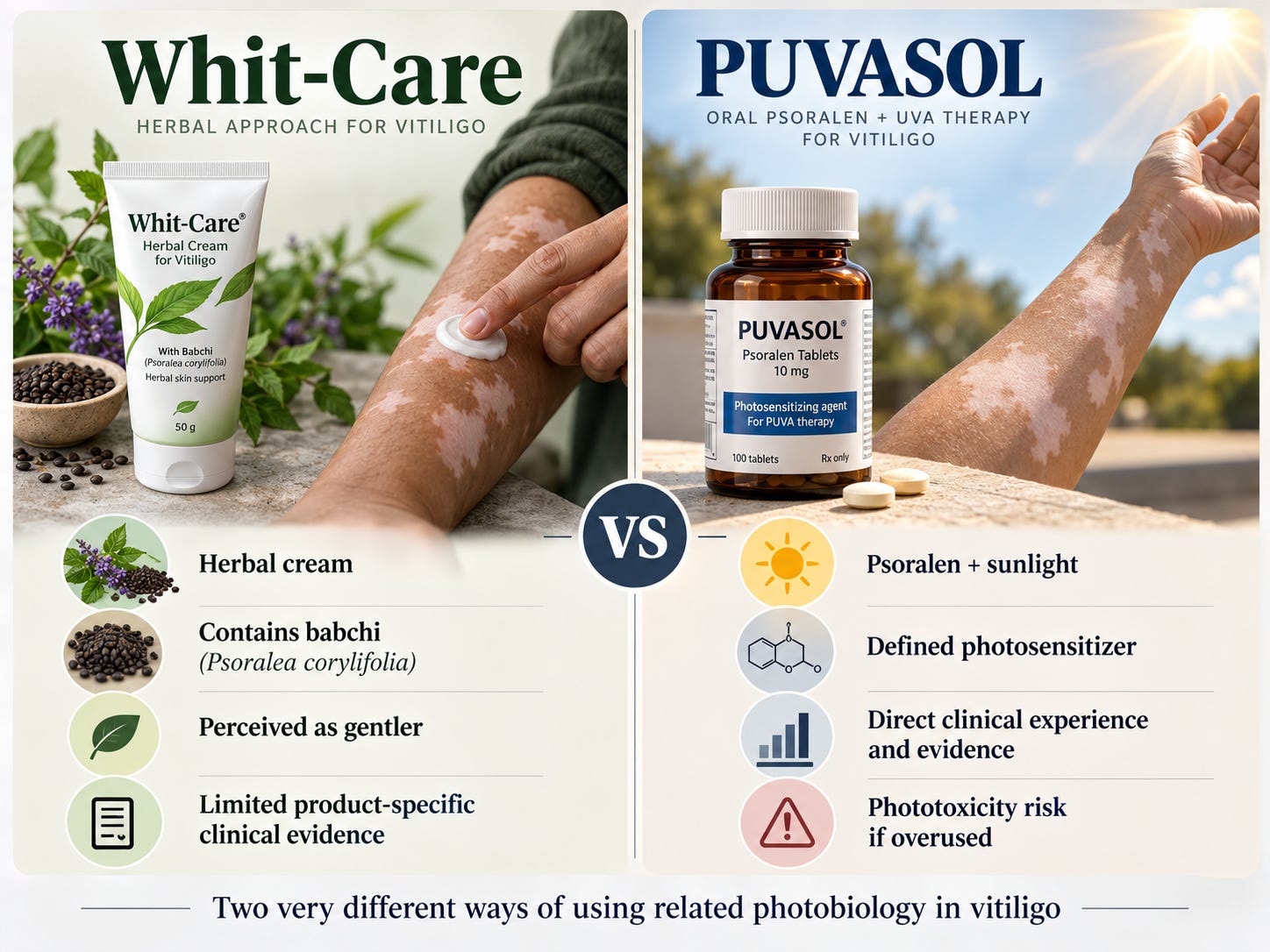
We became uncomfortable with PUVASOL because it could cause burns. So why are we more comfortable prescribing a herbal cream containing naturally occurring psoralens?
In my previous article on PUVASOL, I questioned whether dermatologists had abandoned an inexpensive and accessible vitiligo treatment too readily.
Vitiligo’s Free Phototherapy: Why Are We Abandoning PUVASOL?

Phototherapy: using ultraviolet light to stimulate the return of normal pigment, is one of the most important treatments for vitiligo, particularly when the disease is extensive or continuing to spread.
My argument was not that PUVASOL is superior to narrowband UVB. Rather, in India, a treatment patients can actually complete may sometimes be more useful than one requiring repeated hospital visits.
That discussion raises another uncomfortable question. If we became wary of topical PUVASOL because of phototoxicity, why have some of us become comfortable prescribing Whit-Care instead?
What’s actually in Whit-Care?
Whit-Care is an Ayurvedic preparation marketed in India by Mark (India) Cosmed. Its ingredients include Psoralea corylifolia (babchi or bakuchi), Plumbago zeylanica and several other botanical compounds.
Babchi has a long history of use in vitiligo. Its seeds contain psoralen and isopsoralen (angelicin), compounds belonging to the photosensitising furocoumarin family.
In other words, one of the principal pharmacological explanations for Whit-Care’s proposed effect is closely related to the same photochemistry that makes PUVASOL work.
Apparently, psoralen becomes considerably less alarming when it arrives inside a herbal cream.
Different packaging. Similar photobiology.
With topical PUVASOL, we deliberately apply a pharmaceutical psoralen of known concentration and then expose the treated skin to sunlight. We recognise this as photochemotherapy and therefore worry about the dose.
Whit-Care presents a different problem. Published product listings for the 25-g cream specify 5% Psoralea corylifolia. However, 5% babchi does not mean 5% psoralen.
It tells us how much botanical ingredient the formulation reportedly contains, not the concentration of the active photosensitising compounds. Their actual delivery to the skin depends on extraction, formulation, stability and penetration.
Even the application instructions are interesting. Some commercial descriptions explicitly recommend sunlight exposure after applying Whit-Care, while another current retail listing simply advises applying the cream twice daily.
Neither provides a validated, standardised ultraviolet exposure protocol for the cream. This is rather ironic.
With PUVASOL, we know we are performing photochemotherapy and therefore try to control the exposure. With a babchi-containing formulation, we may be introducing related photosensitisers without comparable information about the active dose.
Of course, sunlight-based PUVASOL is itself imperfectly controlled. Its ultraviolet dose depends on the time of day, season and weather. I discussed these limitations in my previous article.
But replacing an imperfectly controlled treatment with one whose active drug concentration is uncertain hardly solves the problem.
Where are the clinical trials?
This is my principal concern. I could not identify a published randomised controlled trial specifically evaluating Whit-Care for vitiligo, nor a convincing head-to-head comparison with PUVASOL, tacrolimus, corticosteroids or narrowband UVB.
There is, however, some clinical literature on babchi preparations.
A 2016 study evaluated an ointment containing 10% Psoralea corylifolia seed powder in 20 patients with vitiligo over 12 weeks. The authors reported statistically significant repigmentation compared with untreated control areas. But the study had important limitations. It was small, non-blinded and self-controlled. Patients were also instructed to expose treated areas to sunlight for as long as they could tolerate. Five of the 20 participants developed moderate irritation. There was no comparison with established treatments, and the formulation was not Whit-Care. We therefore cannot extrapolate these findings to establish the efficacy or safety of the commercial product.
But surely Whit-Care is safer?
A lower concentration of active furocoumarins might conceivably produce less phototoxicity. It might also produce less repigmentation.
Without knowing the actual dose and clinical outcomes, neither possibility establishes superiority. And babchi itself is certainly capable of causing significant phototoxicity.
A 2021 case report described a woman who developed severe phytophotodermatitis after using babchi oil followed by sunlight exposure, requiring management in a burns unit.
In 2024, dermatologists from AIIMS New Delhi published a report of severe erythema and blistering in a child with vitiligo following the application of crushed Psoralea corylifolia seeds.
Neither report involved Whit-Care. It would be scientifically incorrect to suggest that the commercial cream necessarily carries the same risk.
But these reports establish an important principle.
Plant-derived psoralens do not lose their phototoxic properties simply because they are natural.
“Herbal” and “non-phototoxic” are not synonyms.
Then why prescribe Whit-Care at all?
There may be perfectly reasonable clinical explanations.
Some dermatologists may have prescribed it for years, observed satisfactory repigmentation and found it easier for patients to tolerate than pharmaceutical psoralen.
Clinical experience matters. I would not dismiss it. But we need to recognise the difference between a useful clinical observation and an established treatment.
The problem begins when repeated prescribing gradually transforms “this seems to work in my practice” into “this is an evidence-based treatment” without the necessary clinical evidence ever appearing.
It is precisely this shortcut that we criticise in alternative medicine.
So what would I prescribe?
For most patients with localised vitiligo, appropriately selected topical corticosteroids or calcineurin inhibitors remain established options. When phototherapy is indicated and accessible, narrowband UVB or targeted UVB offers better-controlled treatment.
But if the choice is specifically between Whit-Care and carefully supervised topical PUVASOL in an adult, I find PUVASOL easier to defend scientifically……..We know the pharmaceutical drug concentration, understand the photochemical mechanism, have published clinical evidence of repigmentation and recognise the principal adverse effect.
That does not eliminate phototoxicity. It allows us to explain, anticipate and attempt to minimise it.
With Whit-Care, we have biological plausibility, traditional use and perhaps encouraging clinical experience, but inadequate product-specific evidence to establish comparative efficacy or safety.
In children, I would be even more cautious. We already have better-established topical treatments, and phototherapy can be selected when clinically indicated.
There is little justification for routinely introducing an inadequately studied botanical photosensitiser simply because it appears gentler, or else we are we giving herbal medicine a scientific free pass..
What troubles me is the apparent double standard.
We tell patients that traditional use is not proof, that natural does not necessarily mean safe, and that biological plausibility is not a substitute for clinical trials.
Yet we sometimes appear willing to overlook these limitations when herbal products enter our own prescriptions.
References and Further Reading
Tata 1mg. Whit Care Skin Cream, 25 g. Current product information, ingredients and application instructions.
Truemeds. Whit Care Cream, 25 g. Published ingredient composition, including Psoralea corylifolia 5%.
Mfine. Whit Care Skin Cream: Product information. Commercial description recommending sunlight exposure after application.
Chen L, Chen S, Sun P, et al. Psoralea corylifolia L.: A comprehensive review of its botany, traditional uses, phytochemistry, pharmacology, toxicology, quality control and pharmacokinetics. Chinese Medicine. 2023;18:4.
Hussain I, Hussain N, Manan A, et al. Fabrication of anti-vitiligo ointment containing Psoralea corylifolia: In vitro and in vivo characterization. Drug Design, Development and Therapy. 2016;10:3805–3816.
Faulkner J, Uthayakumar AK, Atkins J. Babchi oil-induced phytophotodermatitis mimicking burn injury. JPRAS Open. 2021;27:23–26.
Mehta N, Arora V, Verma KK. Severe phototoxic reaction to Psoralea corylifolia seeds in a child with vitiligo. Contact Dermatitis. 2024;90(6):619–621.
Seneschal J, Speeckaert R, Taïeb A, et al. Worldwide expert recommendations for the diagnosis and management of vitiligo: Position statement from the International Vitiligo Task Force—Part 2: Specific treatment recommendations. Journal of the European Academy of Dermatology and Venereology. 2023;37(11):2185–2195.