

The Article in 30 Seconds
The Hype: Wear a red-light cap and regrow hair without drugs, lotions or needles.
The Evidence: Controlled trials demonstrate genuine but modest improvements in hair density. Visible benefits, long-term effectiveness and superiority over conventional treatments remain uncertain.
My Verdict: It works. But for most patients, I would spend the money elsewhere.
A cap that shines red light onto your scalp and promises hair regrowth sounds suspiciously convenient. No tablets, no lotions, no needles. Just put it on and let the photons do their work.
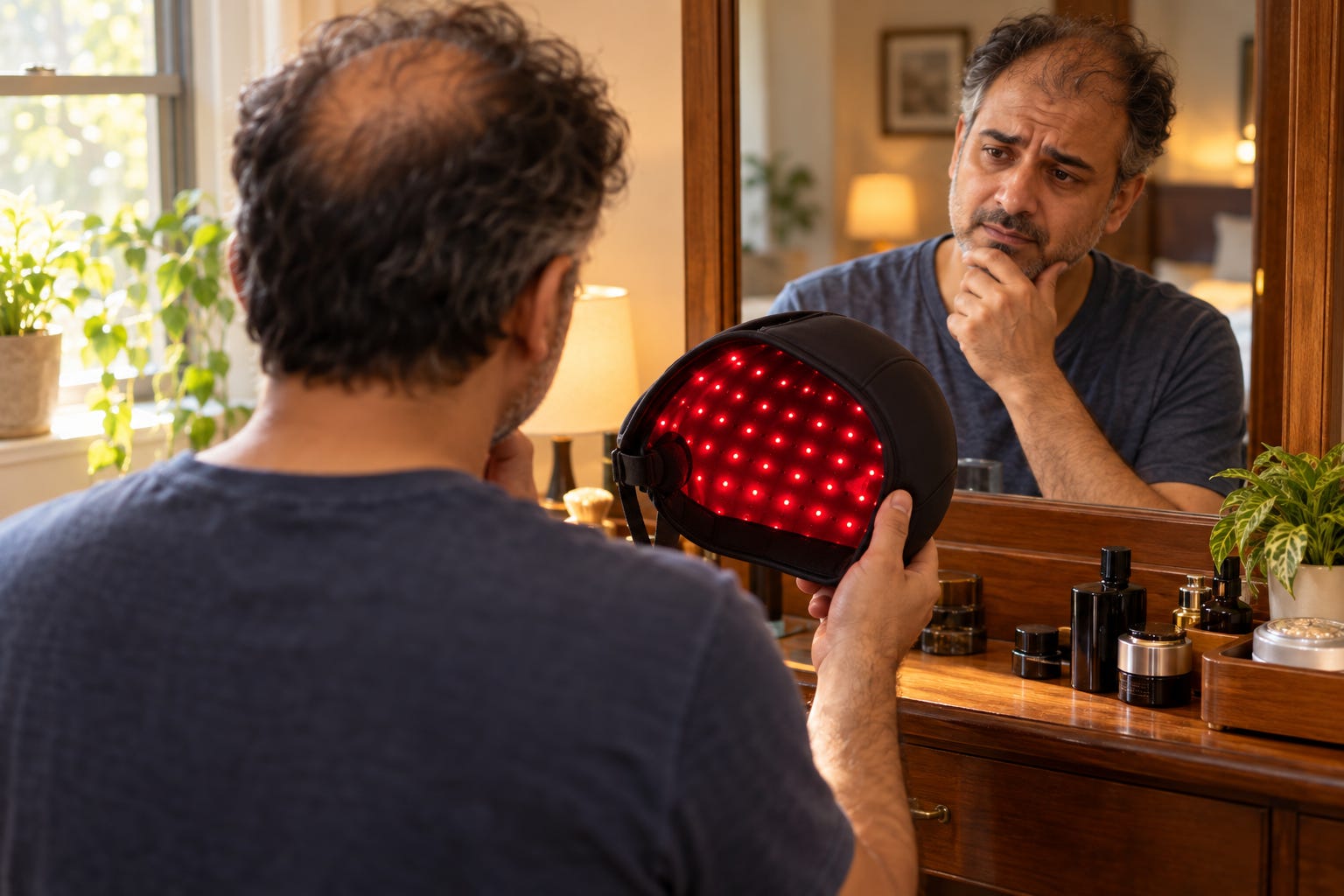
Ordinarily, that would be reason enough to raise an eyebrow.
But low-level light therapy (LLLT), also called photobiomodulation, has something many hair-growth gadgets lack: randomised controlled trials demonstrating that it works.
The proposed mechanism involves mitochondrial signalling and modulation of the hair-growth cycle. The biology remains incompletely understood, but fortunately, we have clinical outcomes to examine.
The hairs are real. But how many?
Jimenez and colleagues reported four sham-controlled LaserComb trials involving 269 randomised participants, with 225 included in the efficacy analysis. After 26 weeks, treated participants gained approximately 18–26 terminal hairs/cm² from baseline, with a pooled sham-adjusted advantage of approximately 15 hairs/cm².
The manufacturer supplied devices, partly funded the research and had investigator relationships. Worth acknowledging, without automatically dismissing the findings.
A 2026 meta-analysis reported 18.56 additional hairs/cm² over sham. Another review encompassing 38 studies and 3,098 participants found benefits, although results varied substantially.
For perspective, a landmark trial of topical 5% minoxidil reported an increase of 18.6 non-vellus hairs/cm², compared with 3.9 on placebo, after 48 weeks. The placebo-adjusted benefit was therefore 14.7 hairs/cm².
Interesting numbers. But not interchangeable ones. The studies involved different populations, endpoints, measurement methods and treatment durations. Similar numerical improvements do not establish equivalent effectiveness.
More importantly, extra hairs under a trichoscope do not necessarily translate into impressive cosmetic coverage. Hair thickness, pigmentation and baseline density matter. We lack an agreed threshold defining a clinically meaningful improvement.
More Hairs Don’t Always Mean Better Hair Coverage
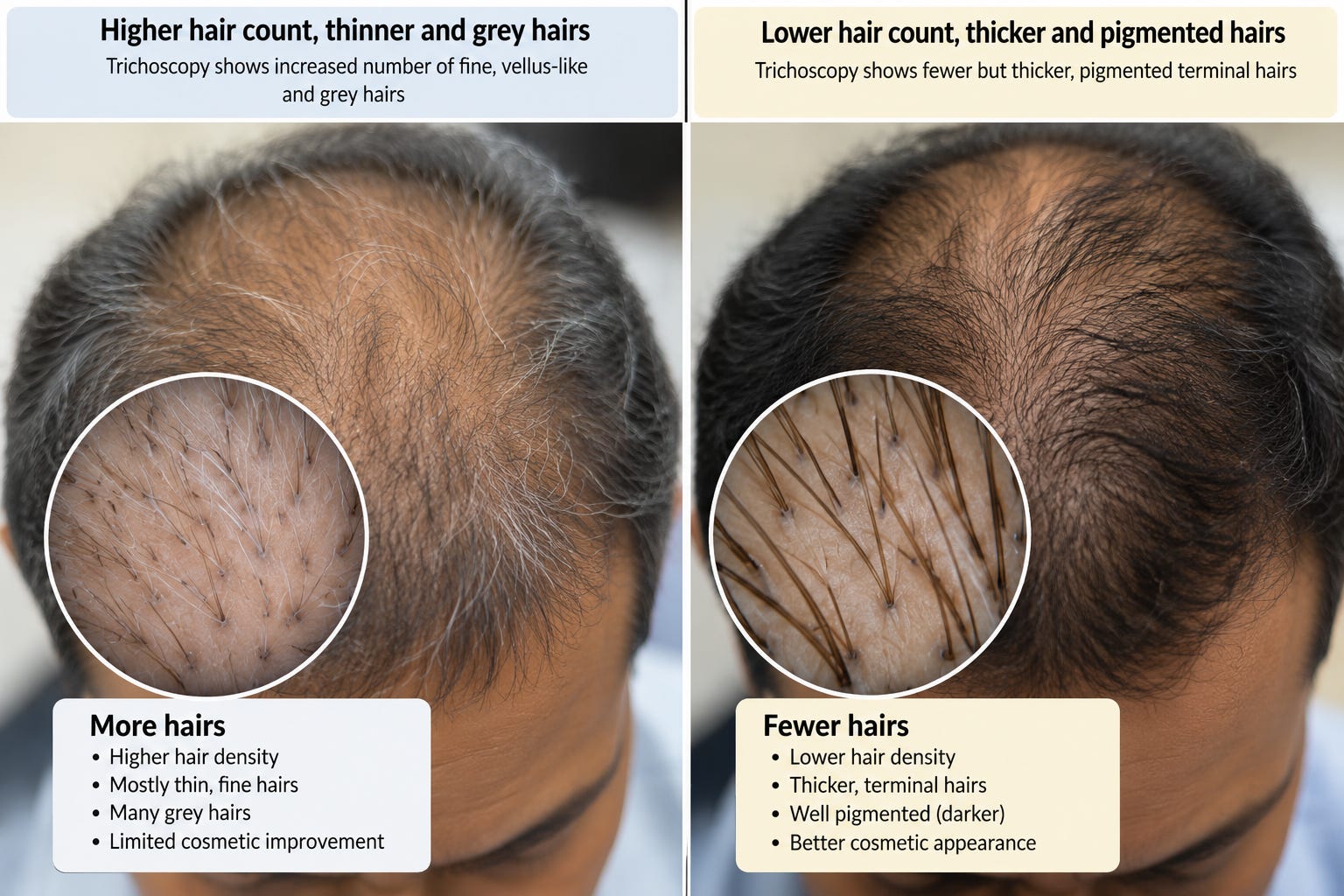
Hair thickness and pigmentation can matter more for cosmetic appearance than hair count alone.
Can laser caps replace minoxidil?
An Indian trial randomised 91 men to LLLT or topical 5% minoxidil. Of these, 75 completed six months. Both groups improved, without a statistically significant difference.
However, the study was relatively small, single-blind and lacked a sham group. Failure to demonstrate a difference is not proof of equivalence.
Two reviews published in 2025 disagreed on whether adding laser therapy to minoxidil improves hair growth. Another laser-cap trial enrolled 160 participants but included only 69 in its per-protocol analysis. Neither treatment group individually showed a statistically significant benefit on the main outcome. Overall, the evidence for additional benefit remains uncertain.
Buying a Laser Cap? What Do You Need to Know?
First, ask yourself: Am I prepared to wear a laser cap for 20–30 minutes every other day, consistently, for at least 3–6 months?
If the answer is yes, here is what to look for:
Wavelength: Around 650–660 nm (red light).
Light intensity (irradiance): Approximately 2.3–3.5 mW/cm² at the scalp.
Energy dose (fluence): Approximately 4 J/cm² per session.
Treatment schedule: 20–30 minutes, three times weekly or every other day.
Clinical evidence: Look for published trials supporting the specific device, not just the technology in general.
Regulatory clearance: Check the device’s regulatory status. FDA clearance does not guarantee superior results.
These specifications are based on successful clinical trials (Friedman, 2017; Suchonwanit, 2019), not universally established optimal doses.
Remember: More LEDs do not necessarily mean more hair. A cap boasting 200 LEDs without meaningful dose specifications is selling you a number, not necessarily an effective treatment.
The uncomfortable price comparison
Imported laser caps can cost approximately ₹60,000–₹2.5 lakh in India.
Generic 5% minoxidil may cost around ₹500–₹600 per 60 mL, approximately ₹6,000–₹7,200 annually at 2 mL daily. Generic dutasteride may cost considerably less annually, although its indications, contraindications and adverse-effect considerations differ.
Peptide-based serums can also be relatively inexpensive, but their evidence is substantially weaker than that supporting minoxidil or LLLT.
These are illustrative retail comparisons, not formal cost-effectiveness analyses.
For further reading on the weaker evidence surrounding commercial hair-growth formulations, see
Indulekha and the Claim of 11,000 New Hairs: What Does the Study Really Show?

Hair-loss advertisements frequently use the phrase “clinically proven.”
My clinical verdict
As a dermatologist, I would not routinely recommend purchasing a laser cap for hair loss/ androgenetic alopecia.
Because:
The upfront cost is considerable
Treatment requires sustained commitment
The additional benefit over established therapy remains uncertain, and long-term evidence is limited.
For most suitable patients, I would prioritise topical minoxidil and, where appropriate, oral finasteride or dutasteride after discussing their risks and benefits. These have a stronger established therapeutic role and generally offer a more attractive practical return on expenditure.
LLLT may be reasonable for selected patients who cannot tolerate medication, decline it or want an additional treatment despite uncertain incremental benefit.
The science supports modest hair regrowth. Whether the price is justified is a completely different question.
References and Further Reading
Jimenez JJ, et al. American Journal of Clinical Dermatology. 2014;15:115–127. DOI
Perez SM, et al. Dermatologic Surgery. 2025;51:179–183. DOI
Alahmadi M, et al. Skin Appendage Disorders. 2026. DOI
Thomas M, et al. Dermatologic Surgery. 2025;51:416–421. DOI
Neema S, et al. Medical Journal Armed Forces India. 2025;81:445–452. DOI
Alosaimi A, et al. Journal of Dermatological Treatment. 2025;36:2447355. DOI
Mawu FO, et al. Lasers in Medical Science. 2025;40:338. DOI
Kanti V, et al. Journal of the European Academy of Dermatology and Venereology. 2018;32:11–22. DOI
Olsen EA, et al. Journal of the American Academy of Dermatology. 2002;47:377–385. DOI
Friedman S, Schnoor P. Dermatologic Surgery. 2017;43:856–867. DOI
Suchonwanit P, Chalermroj N, Khunkhet S. Lasers in Medical Science. 2019;34:1107–1114. DOI
Lueangarun S, et al. Journal of Clinical and Aesthetic Dermatology. 2021;14:E64–E75. Full text