

Over the past few months, three of my manuscripts have been rejected partly or primarily because they supposedly carried an excessive “AI imprint.”
Disclosure: AI was used to assist with language refinement and organisation. The experiences, arguments and conclusions are mine, and I take full responsibility for the final article.
Ironically, this disclosure may itself increase the article’s “AI score.”
One rejection stated:
“There is 61% assistance of AI in manuscript writing, which is not acceptable.”
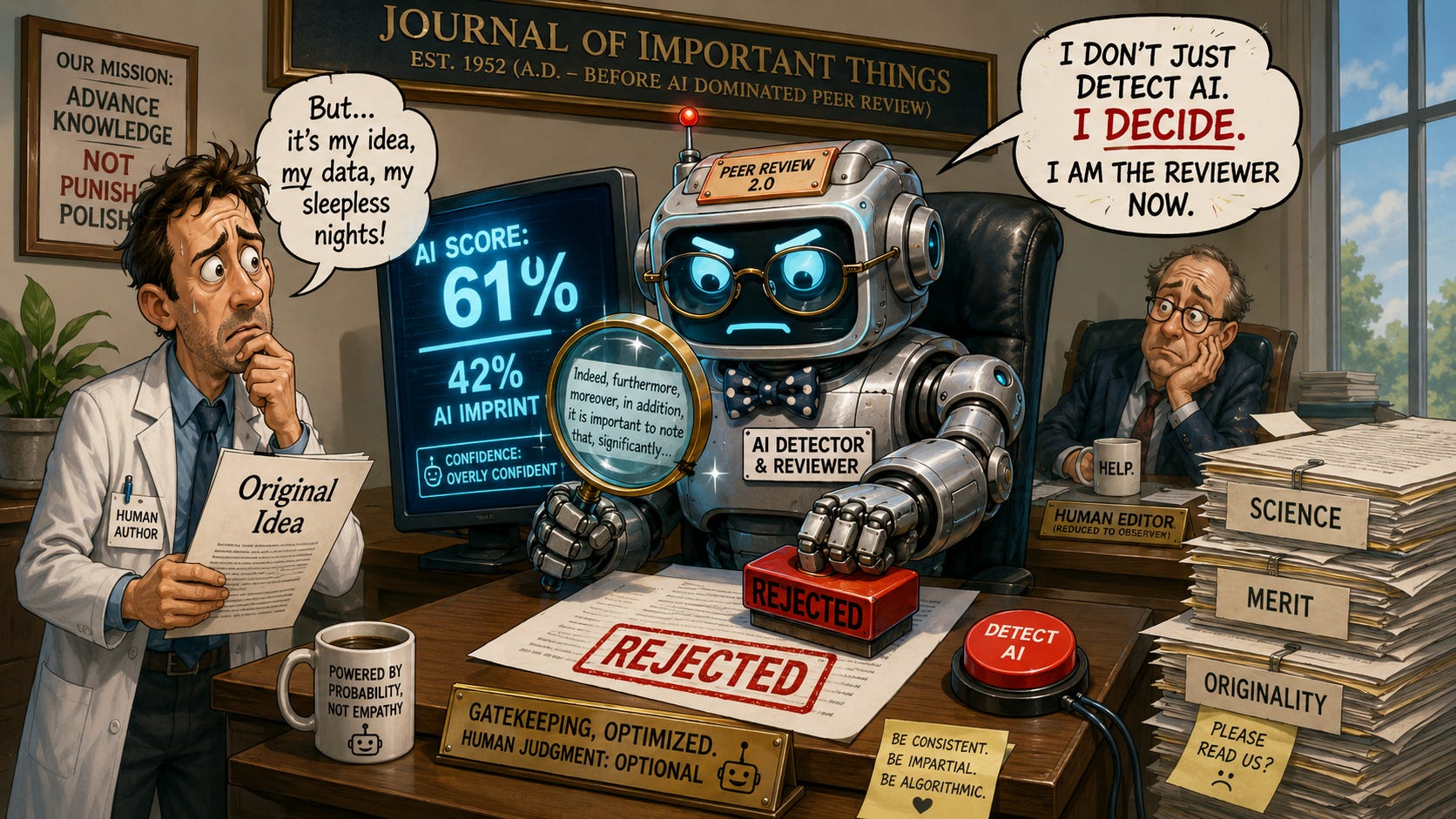
In another instance, I was told that the idea was worthwhile, but the manuscript showed a “42% AI imprint.” I was advised to remove it and resubmit.
That instruction raises a simple question: How exactly does an author “remove” an AI imprint?
Am I expected to discover which detector the journal used and then employ a more sophisticated AI tool to rewrite the manuscript until it can fool the first one?
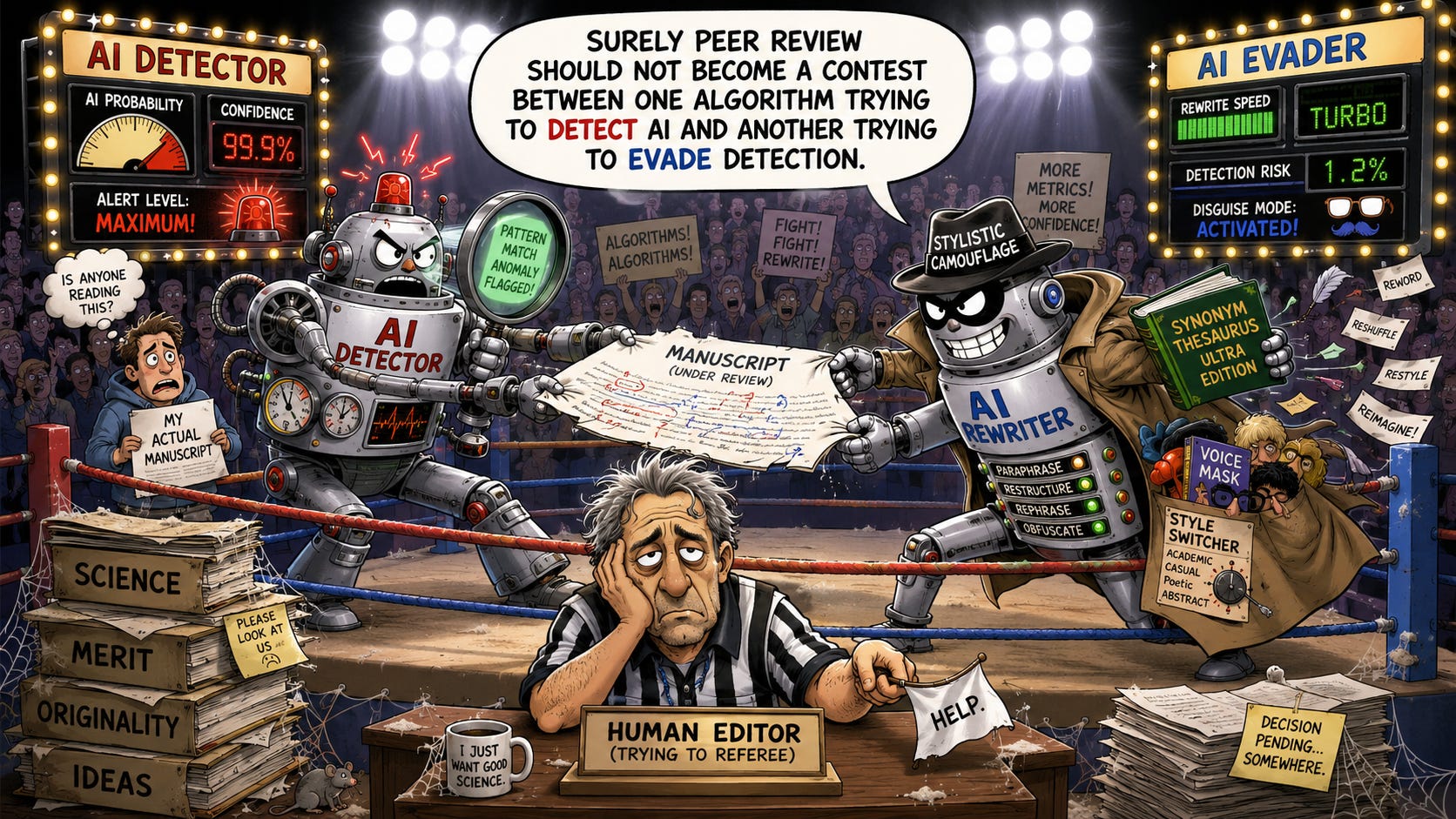
What does “61% AI assistance” mean?
Does it mean that 61% of the words were generated by AI? That there is a 61% probability that AI was used? Or that 61% of the intellectual contribution came from AI?
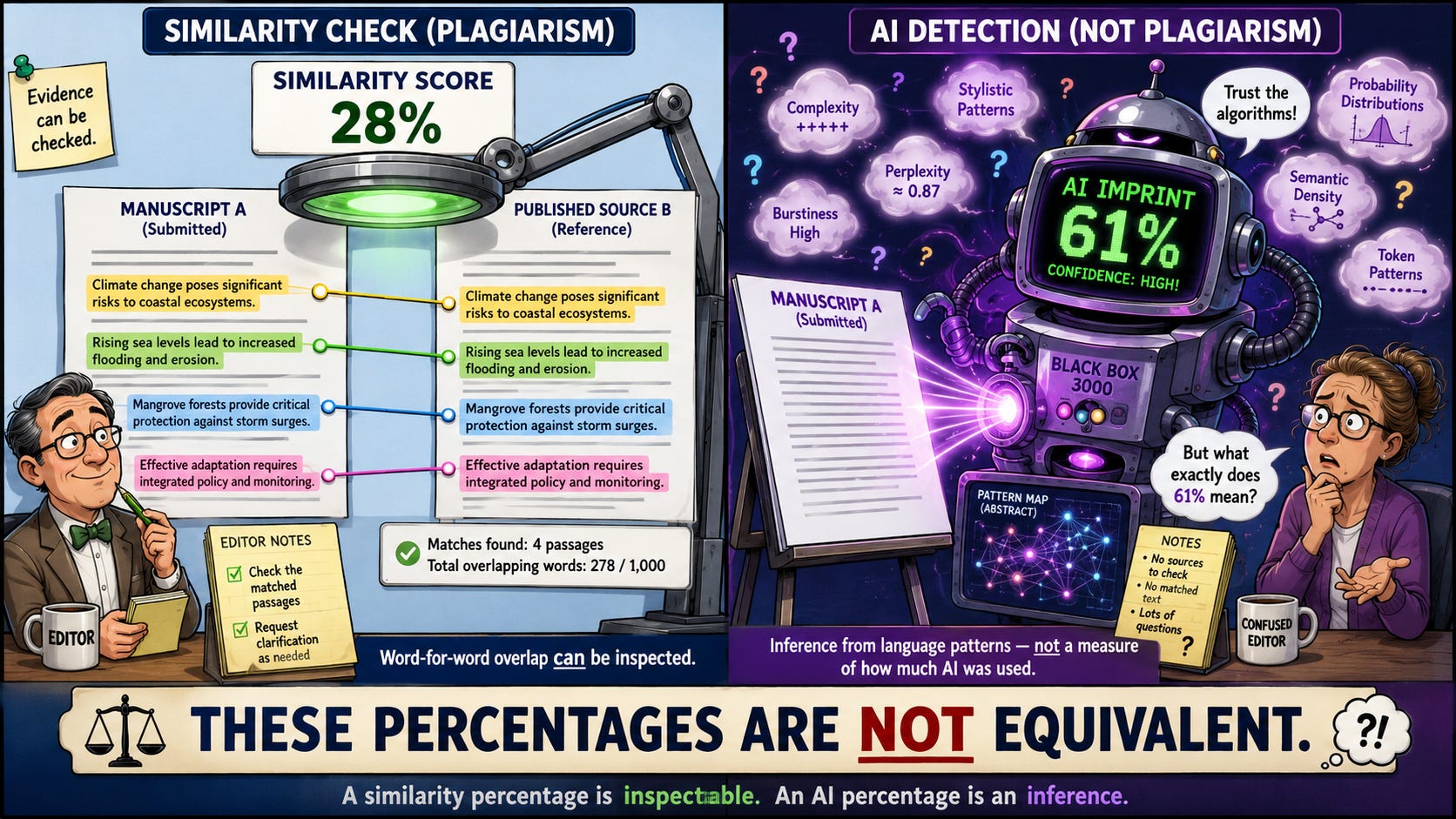
Editors may be influenced by the familiar percentage generated by plagiarism-checking software. But the two numbers are fundamentally different. A similarity score is based on identifiable textual overlap: the submitted manuscript can be compared word by word with specific published sources, and every matched passage can be inspected. An “AI percentage,” by contrast, does not measure how much AI was actually used. It is an algorithmic inference based on linguistic patterns and cannot quantify the proportion of human thought, AI assistance or intellectual contribution. Presenting both as percentages gives them a misleading appearance of equivalence.
These are entirely different claims.
Unless the journal identifies the detector and its version, explains what the score means, provides its validation and false-positive rate, and indicates which passages were flagged, the percentage is not scientifically interpretable.
A precise-looking number is not necessarily reliable evidence.
Language assistance is not intellectual authorship
This is the central error.
AI may correct grammar, improve sentence structure, reduce repetition or help organise ideas already developed by the author. That is fundamentally different from generating the hypothesis, interpreting the evidence or deciding what conclusions are justified.
A detector sees only the final prose. It cannot determine who conceived the idea, reviewed the literature, developed the argument or took the scientific decisions.
It examines the surface of the writing—not the origin of the thought.
In a 2023 study, seven widely used detectors assessed 91 human-written TOEFL essays by non-native English speakers. The average false-positive rate was 61.22%; 89 of the 91 essays were flagged by at least one detector. This does not prove that every modern detector is unreliable or biased. It does prove that false-positive results can be substantial—and that a detector score cannot be treated as proof of inappropriate authorship.
This matters particularly in countries such as India, where many researchers think and conduct excellent science in a language other than English.
AI language editing is a boon for editors too
Those of us who worked in journal editing before generative AI remember how much time was spent correcting grammar, restructuring sentences and rewriting poorly expressed but scientifically worthwhile manuscripts.
Authors struggled to communicate their ideas in polished English. Editors then spent hours repairing the language before they could properly address the science.
AI-assisted language refinement can reduce that burden enormously. It is a boon not only for authors, but also for editors. It allows both to spend less time correcting English and more time examining originality, methodology, interpretation and relevance.
Why should language refinement by a paid professional editor be acceptable, while comparable assistance from software becomes grounds for rejection?
The relevant questions are whether the ideas belong to the authors, whether the content is accurate and whether the assistance has been transparently declared.
The journals’ problem is real
Journals are not irrational to use screening tools.
Editors face increasing volumes of submissions, paper-mill manuscripts, fabricated references and fluent-looking text that may conceal very little scholarship. Automated triage may therefore be necessary.
The World Association of Medical Editors explicitly recognises that editors need tools to detect AI-generated or altered content. But it also distinguishes simple word-processing and grammar assistance from the generation of ideas, text and substantive research.
That distinction is crucial.
Triage is not adjudication.
A detector may reasonably identify a manuscript for closer human scrutiny. It should not silently become the reviewer, the editor and the final verdict.
Disclosure should not become self-incrimination
The International Committee of Medical Journal Editors requires authors to disclose whether AI-assisted technologies were used, explain how they were used, verify the resulting material and remain fully responsible for its accuracy and integrity.
That is entirely reasonable.
But when authors who openly declare AI-assisted language refinement are penalised, disclosure becomes a trap. The policy then rewards those who conceal AI use or successfully rewrite the manuscript until the detector no longer recognises it.
That is the opposite of ethical publishing.
What should journals do?
Journals may use AI detectors for preliminary screening. But no manuscript should be rejected materially on the basis of an AI percentage unless the journal:
identifies the detector and version used;
explains what the percentage represents;
provides the relevant threshold and validation evidence;
identifies the passages that raised concern;
distinguishes language editing from intellectual generation; and
allows the author to respond.
The author may be asked to explain how the manuscript was developed, provide earlier drafts or demonstrate command of the argument and evidence.
That is human editorial assessment. A bare number is not.
The real threats from AI—fabricated data, invented references, plagiarism, false claims and manuscripts that no human author has critically evaluated—must be addressed firmly.
But AI-assisted writing is not the same as AI-substituted scholarship.
ICMJE, WAME and other editorial bodies should now address detector-based rejection explicitly. Responsible disclosure should be encouraged, not converted into evidence against the author.
Scientific publishing cannot demand transparency from authors while offering only an unexplained percentage in return.