

I want to begin with a moment that stopped me cold.
On February 23, 2026, the Centre of India stood before the Supreme Court and argued that concerns about patient safety in the NEET-PG cut-off debate were — and I am using their exact word — “misplaced.” The reasoning offered was straightforward: these candidates are already MBBS doctors. They have already passed. What is there to worry about
I am a dermatologist and dermatopathologist. I trained at Andhra Medical College in Visakhapatnam and did my postgraduate specialist training in the United Kingdom. I have practiced medicine in India for years. I have watched this system from the inside, not the outside. And when I read that headline, I did not feel outrage immediately. I felt something quieter and more disturbing.
I had heard this before…..
Because what the Centre said in that courtroom is what the Indian education system has been saying, in a thousand different ways, for decades. It has been saying: the certificate is enough. The process is enough. The number on the paper is enough. Stop asking what the number actually represents.
It is not enough. It has never been enough. And we have been pretending otherwise for so long that the pretence has become policy.
The Question Nobody Wants to Answer
Let me ask something directly.
If you needed a complex surgical procedure tomorrow — not a routine one, but something serious, something where the margin for error was narrow — would you want to know your surgeon’s NEET rank? Or would you want to know something else entirely? Would you want to know whether they actually trained? Whether they attended their ward rounds? Whether anyone ever seriously evaluated their clinical judgment under pressure?
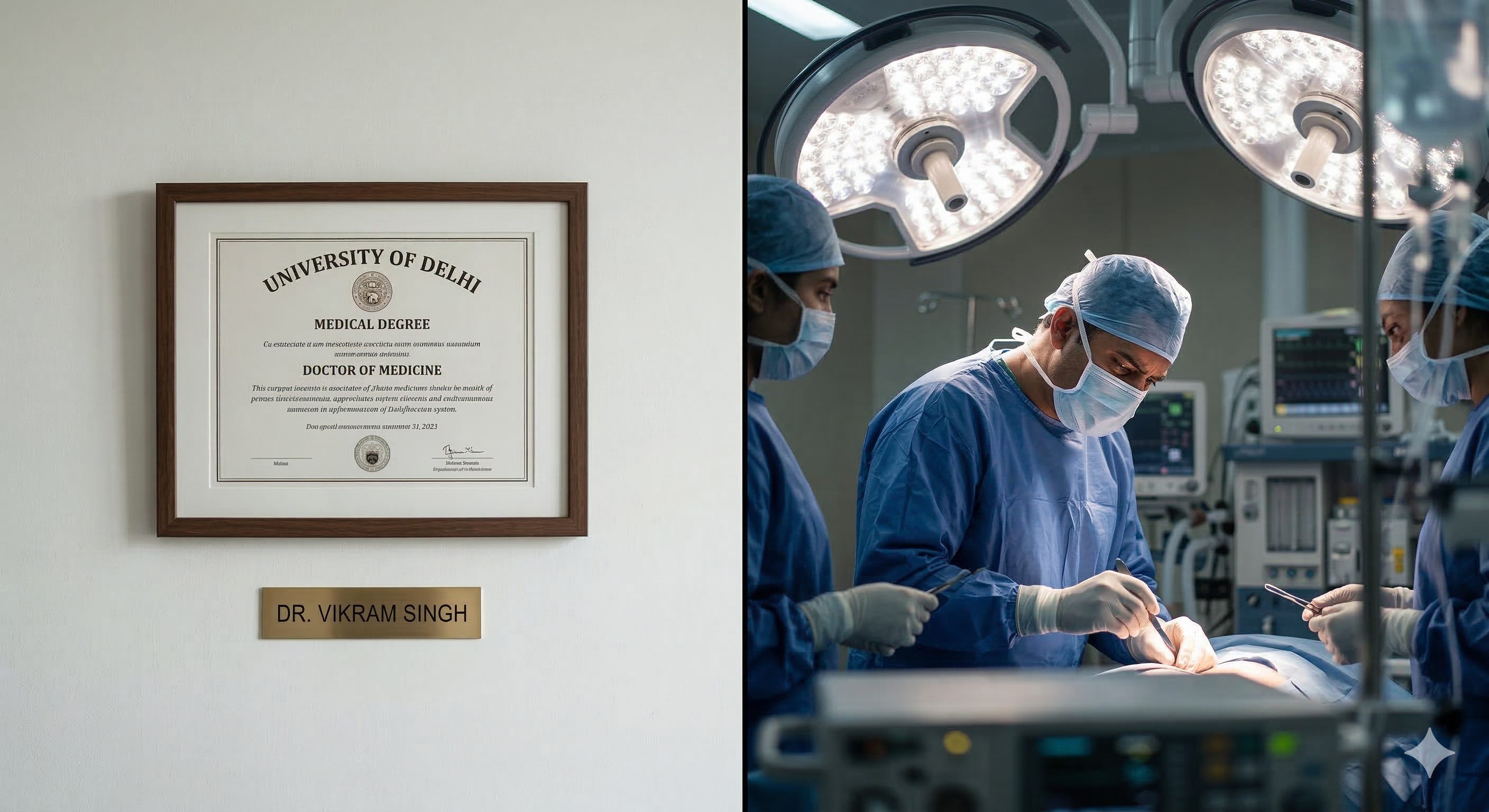
Certificate vs Competence!
I suspect you would want to know the latter. Every person reading this, when their own body or the body of someone they love is on the line, instinctively understands the difference between a certificate and a competence.
The tragedy is that we have built a system that produces the former while claiming it guarantees the latter.
Passing MBBS is a threshold. It is the beginning of a medical education, not its culmination. What postgraduate specialist training is supposed to do — what it does in the systems I have seen function well, including in the United Kingdom — is take that foundation and build something real on top of it. Clinical judgment. Procedural mastery. The capacity to make independent decisions at two in the morning when a patient is deteriorating and there is no senior to call and no textbook that covers exactly this situation.
That is what specialist training is supposed to produce. The question the Centre refused to answer before the Supreme Court — the question nobody in official India seems willing to answer — is whether our postgraduate training system is actually producing that.
The answer, in far too many institutions, is no.
And here is a signal that should concern us far more than it currently does: some of the candidates seeking relaxed NEET-PG cut-offs have scored negative marks in the examination. Negative marks. After five and a half years of medical undergraduate training. Not zero. Negative. Meaning they got more answers wrong than right on a test covering the very subject they spent half a decade studying.
That fact alone does not prove incompetence — MCQ-based exams have limitations, and negative marking penalises risk-taking. But it raises a serious and uncomfortable question: what does it say about knowledge retention after five and a half years of training?
If that does not raise serious questions about the effectiveness of undergraduate training, I genuinely do not know what would. And the system’s response to that signal — the official, institutional, policy-level response — is to lower the postgraduate entry bar rather than confront what produced it in the first place.
We are not fixing the problem. We are carrying it forward.
What Money Has Actually Done
I want to talk about something that everyone in Indian medicine knows and almost no one says plainly in professional public discourse.
A postgraduate medical seat in a private college in India today costs a family anywhere between two and four crores of rupees. In some specialties and some states, it costs more. This is not a secret. It is not even particularly controversial in the circles where it happens. It is simply the price of entry.
Now think about what that money does — not just to the institution that receives it, but to the psychology of everyone involved.
When a family pays two crores for their child’s education, something fundamental shifts in the relationship between that family, that student, and that institution. The transaction has occurred. The money has moved. And with it, an unspoken but powerful assumption settles into place: we have paid, therefore we must receive. Not learn — receive. The outcome is no longer something to be earned. It is something that has been purchased.
I have seen this play out, and colleagues across institutions describe similar patterns.
Colleagues of mine who teach in private medical colleges have described — repeatedly — postgraduate students who simply refuse to show up. Not occasionally. Routinely. Students who will not attend ward rounds, who absent themselves from lectures, who treat the entire training programme as an inconvenience they have paid to avoid. And when faculty members confront these students about their absence, the students do not come to explain themselves.
Their parents come.
Affluent, confident, entirely sincere parents who sit across from a faculty member and say: why should my child face this kind of stress? We have paid so much. Do you understand what we have invested?
I want to be precise about what is happening in that room. Those parents are not being unreasonable by their own logic. They have paid crores. They have watched money move outcomes their entire lives. They are applying the same logic to their child’s medical education that they would apply to any other significant purchase. They expect a return.
The problem is that the return they expect — a degree, a career, a title — is something that will be used on real patients. Patients who never agreed to be part of the transaction. Patients who will walk into a clinic or an operating theatre trusting that the system filtered for competence, not purchasing power.
Those patients are the silent third party in every one of these conversations. And nobody is speaking for them.
The Biometric Arms Race

The regulatory system is not blind to the ghost faculty problem. It has tried to address it.
Regulatory inspections and media reports over the years have repeatedly identified discrepancies between declared and actual faculty presence in some institutions.
First came fingerprint attendance systems — a reasonable response to the widespread practice of listing faculty on paper who never set foot in the institution. The logic was sound. If you cannot fake a fingerprint, you cannot fake presence.
There have been instances where even these systems were circumvented.
When this became apparent, face recognition was introduced as a more secure alternative. Harder to fake, the thinking went. Unique to the individual in a way that a fingerprint clone cannot replicate.
And yet, even these systems have not fully solved the problem.
I want you to sit with this for a moment. Not with outrage — with clinical attention. What does it tell us about an institution when it repeatedly finds ways to bypass systems designed to ensure the basic presence of its own faculty?
It tells us that the financial incentive to appear compliant is so large, and the consequences of non-compliance so manageable, that the investment in circumvention becomes rational.
And if an institution will go to those lengths to simulate the presence of a teacher, it raises an uncomfortable but necessary question: where does that stop?
The Research Marketplace
There is a mandatory requirement in Indian medical academia: to be promoted, faculty must publish research. This is, in principle, a reasonable expectation. Academic medicine should produce knowledge. Teachers should be scholars.
In practice, it has created a marketplace.
For ten to fifteen thousand rupees — less than the cost of a decent smartphone — a doctor can have their name attached to a paper they did not conceive, did not design, did not conduct, and did not write. The paper will be submitted to a journal whose primary qualification criterion is the ability to pay a publication fee. It will be indexed. It will appear on a CV. It will count toward a promotion.
This service is not hidden. It is openly advertised.
Now contrast that with what actual research involves.
A genuine researcher identifies a question. Designs a methodology. Collects data, often over years. Writes the paper. Submits to a rigorous journal. Faces rejection. Revises. Resubmits. Repeats.
At the end of this process, the honest researcher and the person who paid for authorship often appear equivalent on paper. The system counts output. It does not consistently evaluate quality.
Over time, this is not neutral. It is selective.
When doing the right thing costs years of effort while shortcuts deliver the same formal reward, the system does not merely tolerate poor research — it selects for it.
The Honest Doctor Loses at Every Stage
A hardworking student without financial backing earns every mark, clears NEET, completes MBBS, and prepares for NEET-PG.
They compete in a system where others may have structural advantages — financial, institutional, or policy-driven.
After training, the distortion continues.
Digital visibility increasingly shapes patient choice. Search rankings, reviews, and online presence are not neutral reflections of competence. They are, at least in part, functions of marketing capacity.
The result is a system where training may be uneven, evaluation inconsistent, and visibility influenced by factors unrelated to clinical ability.
The patient, understandably, cannot distinguish between them.
This Is India’s Disease, Not Medicine’s Alone
These are not isolated curiosities. They reflect a broader pattern many of us encounter in practice and hiring.
I know personally of someone who scored 96% in centrally evaluated Class 10 board examinations. I know this person well. I can say with confidence that those marks bore little relationship to their actual ability — something their later performance made clear.

When I recently advertised for a basic data entry role, I received applications from graduates with computer-related degrees who could not operate Microsoft Word or Excel.
These are not rare exceptions. They are symptoms of a larger problem.
Across fields — medicine, engineering, law, management — the same pattern appears: marks, degrees, and certifications that do not reliably reflect competence.
And at the end of that chain is always someone who trusted the credential.
What We Are Willing to Tolerate
This is not the failure of a single government. It is cumulative.
Across years and institutions, small compromises have aggregated into a systemic pattern.
India’s ambitions are real. But human capital that has been mislabelled is not an asset. It is a liability.
And the people who recognise this — students, researchers, clinicians — respond rationally. They leave. Or they disengage.

What we call brain drain is not accidental. It is a response.
What Must Change
Standards must be enforced at exit, not adjusted at entry. A nationally standardised, independently administered exit examination — one that evaluates real clinical competency, not just recall — should determine readiness for specialist practice.
Regulation must be unpredictable and consequential. Independent, unannounced audits — with real institutional consequences — are essential.
Academic credit must reflect quality, not volume. Predatory journals must be excluded from promotion criteria. Methodology must matter.
And fundamentally, we must stop treating the certificate as the thing.
A certificate is not a reward. It is a claim.
When it stops representing reality, it does not become harmless.
It becomes dangerous.
The Patient on the Table

A patient seeking care does not know:
how a seat was obtained
how training was delivered
how credentials were built
They know only what the system signals:
This person is qualified.
That signal is a promise.
If that promise is unreliable — not universally, but often enough — then the cost is not borne primarily by institutions or even by the professionals within them.
It is borne by the patient who trusted that someone, somewhere, had ensured that the certificate meant what it claimed to mean.
Someone should have been asking those questions.
I am asking them now.
Dr. Sasi Kiran Attili is a practicing Dermatologist and Dermatopathologist based in Visakhapatnam, India. He completed his MBBS at Andhra Medical College and his postgraduate training in the United Kingdom. He writes on medicine, medical education, and public health.