

Some medical rules become so familiar that eventually we stop asking whether the evidence still supports them.
One of these is:
“Never use topical tretinoin during pregnancy.”
For oral isotretinoin, the prohibition is unquestionably justified. Systemic isotretinoin is a potent human teratogen capable of producing a characteristic retinoid embryopathy.
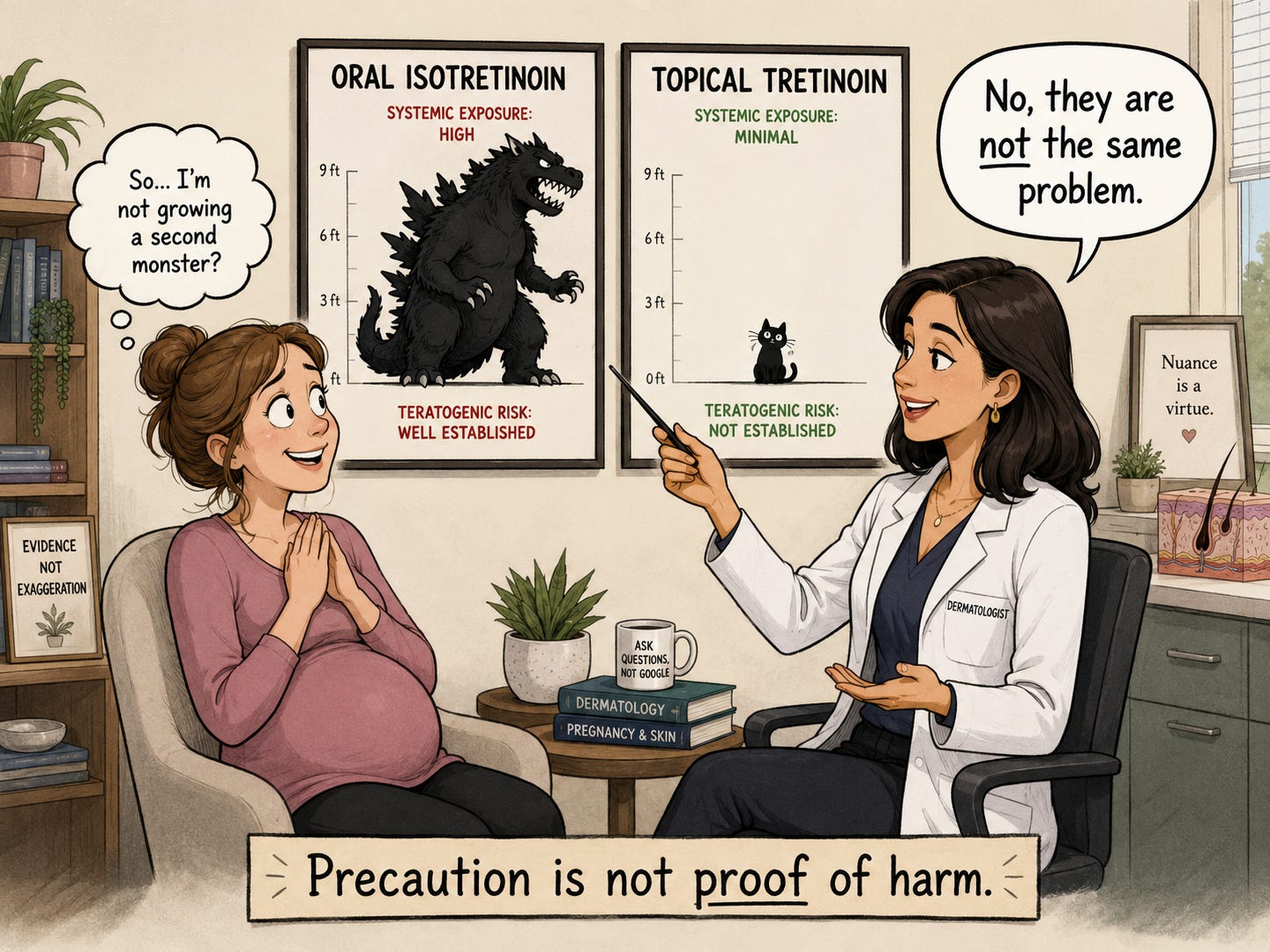
But topical tretinoin is not oral isotretinoin.
The route is different. The systemic exposure is dramatically different. And, crucially, decades of human pregnancy data have failed to demonstrate the teratogenic signal that we continue to warn patients about.
That is why my own practice differs from the conventional recommendation.
I do prescribe topical tretinoin during pregnancy when I think there is a reasonable dermatological indication, particularly when it is being used conventionally in a small quantity over a limited area such as the face.
I do not do this because tretinoin has been proved to carry absolutely zero fetal risk. Almost no drug can meet that standard in pregnancy.
I do it because the available evidence does not establish that conventional topical tretinoin exposure is teratogenic, while its systemic exposure is extremely small.
That distinction matters.
Oral and topical exposure are not pharmacologically equivalent

The anxiety around topical tretinoin is understandable.
Retinoids influence embryonic development. Oral retinoids can be profoundly teratogenic. So when congenital abnormalities were reported after maternal topical tretinoin exposure, concern was inevitable.
But teratogenicity depends not merely on the identity of a molecule, but on the dose reaching the embryo.
A tablet deliberately designed to create systemic drug concentrations and a pea-sized amount of cream applied to facial skin are not equivalent exposures simply because both involve a retinoid.
The relevant question is therefore not:
Can retinoic acid cause fetal abnormalities?
Clearly, sufficiently high systemic exposure can.
The relevant question is:
Does ordinary topical tretinoin use produce sufficient systemic exposure to cause them?
So far, the evidence suggests that it does not.
How much actually reaches the bloodstream?
Not zero—but very little.
In the classic pharmacokinetic study by Latriano and colleagues, approximately 2% of applied topical tretinoin was absorbed after short-term use. In long-term users, absorption averaged approximately 1.1%.
Even more importantly, regular topical application did not significantly alter circulating tretinoin concentrations from endogenous pretreatment levels.

That point is often lost.
Retinoic acid already exists naturally in human plasma as part of normal vitamin-A metabolism. Detecting some percutaneous absorption does not itself establish biologically meaningful fetal exposure.
For conventional facial application, the important pharmacological observation is that treatment has not been shown to appreciably raise circulating retinoic-acid concentrations.
That makes extrapolation from oral isotretinoin biologically questionable from the outset.
The case reports mattered—but they were never proof
Several early reports described congenital abnormalities after maternal topical tretinoin exposure, some resembling parts of the retinoid embryopathy phenotype.
They were important.
They generated a safety signal that deserved investigation.
But case reports establish temporal association, not causality. Congenital malformations occur spontaneously in every population, so some will inevitably occur in pregnancies exposed to commonly used medications.
The correct response was therefore to ask whether larger controlled studies demonstrated either:
an overall excess of congenital abnormalities; or
a reproducible pattern resembling retinoid embryopathy.
They have not.
What happened when pregnancy outcomes were actually studied?
The prospective multicentre study by Panchaud and colleagues followed 235 pregnancies exposed to topical retinoids and compared them with 444 controls.
Major birth defects occurred in 3.4% of exposed pregnancies versus 2.0% of controls, but the difference was not statistically significant, with an OR of 1.8 and a very wide 95% CI of 0.6–5.4.
More importantly, none of the affected infants showed the characteristic pattern of retinoid embryopathy.
The authors were nevertheless cautious. They concluded that topical retinoids still could not be recommended during pregnancy because the risk-benefit ratio remained uncertain.
That deserves acknowledgement.
But their recommendation and their data are two different things.
The data said:
We did not demonstrate teratogenicity.
Their clinical interpretation was:
Given the remaining uncertainty and limited therapeutic necessity, we still would not advise using them.
That is a perfectly reasonable position.
It is not the only possible interpretation of the evidence.
The subsequent evidence became more reassuring, not less
The 2015 systematic review and meta-analysis included 654 pregnancies exposed to topical retinoids, 532 involving tretinoin.
The estimated odds ratio for major congenital malformations was 1.22 (95% CI 0.65–2.29). It also found no significant increase in miscarriage, stillbirth, low birth weight or prematurity.
Its main limitation was precision: it could exclude a very large teratogenic effect, but not a smaller one.
A later US claims-database study included 1,430 pregnancies exposed specifically to topical tretinoin. Birth defects occurred in 4.5% of exposed pregnancies compared with 4.2% of unexposed pregnancies, giving an adjusted OR of 1.16 (95% CI 0.85–1.58). The recent Nordic investigators cite these findings as consistent with their own.
Again, no convincing signal emerged.
And then came the largest study so far.
More than 2,000 first-trimester exposures
The recent Nordic cohort included pregnancies across Denmark, Iceland, Norway and Sweden.
Among 2,172 infants exposed to topical retinoids during the first trimester, major congenital malformations occurred in 3.3%.
Among more than 3.6 million unexposed infants, the rate was 3.0%.
The adjusted risk ratio was:
1.10 (95% CI 0.87–1.38).
No significant excess was demonstrated. Nor was there an increased group-level pattern of malformations characteristic of fetal retinoid syndrome.
Analyses separating tretinoin and adapalene produced results broadly similar to the combined analysis, although—as expected—the smaller numbers produced much less precise estimates.
So after several decades of looking for a teratogenic signal, the largest study yet again failed to find one.
That is difficult simply to dismiss as “lack of evidence”.
At some stage, repeatedly failing to detect an expected effect is itself evidence that any effect, if present, is probably small.

But could there still be a small risk?
Absolutely.
The Nordic confidence interval is important.
The point estimate was 1.10, but the upper 95% confidence limit was 1.38.
Using the approximately 3% background risk, the investigators calculated an adjusted risk difference of 0.30%, with a 95% confidence interval extending up to 1.14 additional percentage points.
In other words, their data are compatible with anything from essentially no effect to, at the upper statistical boundary, roughly one additional major malformation per 100 exposed pregnancies.
That is not trivial.
But neither is it evidence that such an increase actually exists.
It is the residual statistical uncertainty around an estimate that did not demonstrate increased risk.
This is where pregnancy counselling becomes a question of how we interpret uncertainty.
“We cannot exclude harm” is not the same as “this causes harm”
Regulators and investigators generally take the more conservative position.
That is understandable.
Acne and pigmentation are rarely life-threatening. Alternative treatments such as azelaic acid exist. Why accept even a theoretical fetal risk for a treatment that can usually be deferred?
Indeed, the Nordic authors themselves conclude that topical retinoids should still be avoided in pregnancy despite their reassuring results, largely because their study cannot establish absolute safety and pregnancies ending before 22 weeks were incompletely represented.
I understand that reasoning.
I simply reach a somewhat different clinical conclusion.
If a patient has mild acne that can be managed equally well with azelaic acid, I have no philosophical commitment to prescribing tretinoin merely to prove a point.
But neither do I regard pregnancy itself as an automatic contraindication to conventional, limited-area topical tretinoin when I believe the treatment offers sufficient benefit.
Because my starting question is slightly different:
What evidence shows that this level of topical exposure actually causes fetal harm?
At present, I do not think that evidence exists.
I am not talking about every topical retinoid
This distinction is important.
I would not extrapolate this argument indiscriminately to tazarotene.
Tazarotene has a stronger animal developmental-toxicity signal, pregnancy exposure data remain extremely sparse, and current prescribing information specifically contraindicates its use during pregnancy. Systemic exposure can also increase substantially when larger body surface areas are treated.
The Nordic study contained only 10 tazarotene-exposed pregnancies, far too few to provide meaningful human reassurance.
My argument applies principally to the drugs for which we actually have accumulating human evidence—particularly tretinoin, with supportive data for adapalene—used conventionally over limited skin surface area.
“Topical retinoid” should not become another careless class label any more than “retinoid” should.
Nor am I merely talking about accidental exposure
There is another distinction worth making explicit.
Most papers understandably frame their results as reassurance for the woman who accidentally used tretinoin before discovering that she was pregnant.
That is the easiest clinical conclusion.
I go somewhat further.
I am prepared to initiate or continue limited facial topical tretinoin during pregnancy when I think the indication justifies it.
That position goes beyond what the authors of these studies recommend.
I do not pretend otherwise.
But the disagreement is primarily about the risk-benefit threshold, not about what the studies found.
Their position is:
There is residual uncertainty, the indications are usually non-essential, therefore avoid treatment.
Mine is:
Systemic exposure is extremely low, repeated human studies have failed to demonstrate teratogenicity, and a theoretical risk that has progressively diminished with accumulating evidence should not automatically be treated as a contraindication.
Both approaches acknowledge uncertainty.
They simply place the threshold differently.
The problem with the word “unsafe”
This is why I think the language surrounding topical tretinoin needs updating.
There are three very different statements:
1. Topical tretinoin has been demonstrated to cause congenital malformations.
There is no convincing human evidence for this.
2. Topical tretinoin has been demonstrated to have absolutely zero fetal risk.
We cannot say this either.
3. Available pharmacokinetic and epidemiological evidence suggests that ordinary topical exposure carries little, if any, measurable teratogenic risk, although a small increase cannot be conclusively excluded.
That is the statement that best fits the evidence.
Yet textbooks, patient information and clinical conversations frequently compress all of this into:
“Tretinoin is unsafe in pregnancy.”
And once that statement is repeated often enough, a precaution begins to sound like an established pharmacological fact.
It isn’t.
Medicine should update probabilities, not merely preserve warnings
The purpose of accumulating evidence is not simply to keep repeating that absolute safety has never been proved.
It is to update what we believe the probability of harm actually is.
We began with a plausible theoretical concern because systemic retinoids are powerful teratogens.
We then demonstrated that systemic exposure after topical tretinoin is minimal.
We accumulated prospective pregnancy data.
We performed a meta-analysis.
We accumulated more than a thousand tretinoin-exposed pregnancies in a large US database.
And now we have more than 2,000 first-trimester topical-retinoid exposures in a Nordic population study, again without a substantial malformation signal.
None of this proves that risk is zero.
But the evidence has certainly not been moving towards teratogenicity.
It has been moving away from it.
For me, that is clinically meaningful.
I therefore do not regard a small amount of topical tretinoin applied to limited facial skin as equivalent to systemic retinoid exposure, and I do not believe current evidence justifies describing it as a proven teratogen in pregnancy.
Others may quite reasonably decide that the residual uncertainty is sufficient reason never to prescribe it.
That is a legitimate clinical choice.
But it should be described accurately:
a precautionary choice in the face of residual uncertainty—not a conclusion that topical tretinoin has been shown to harm the human fetus.
Those are very different things.
And after three decades of reassuring human data, perhaps it is time we stopped pretending otherwise.