

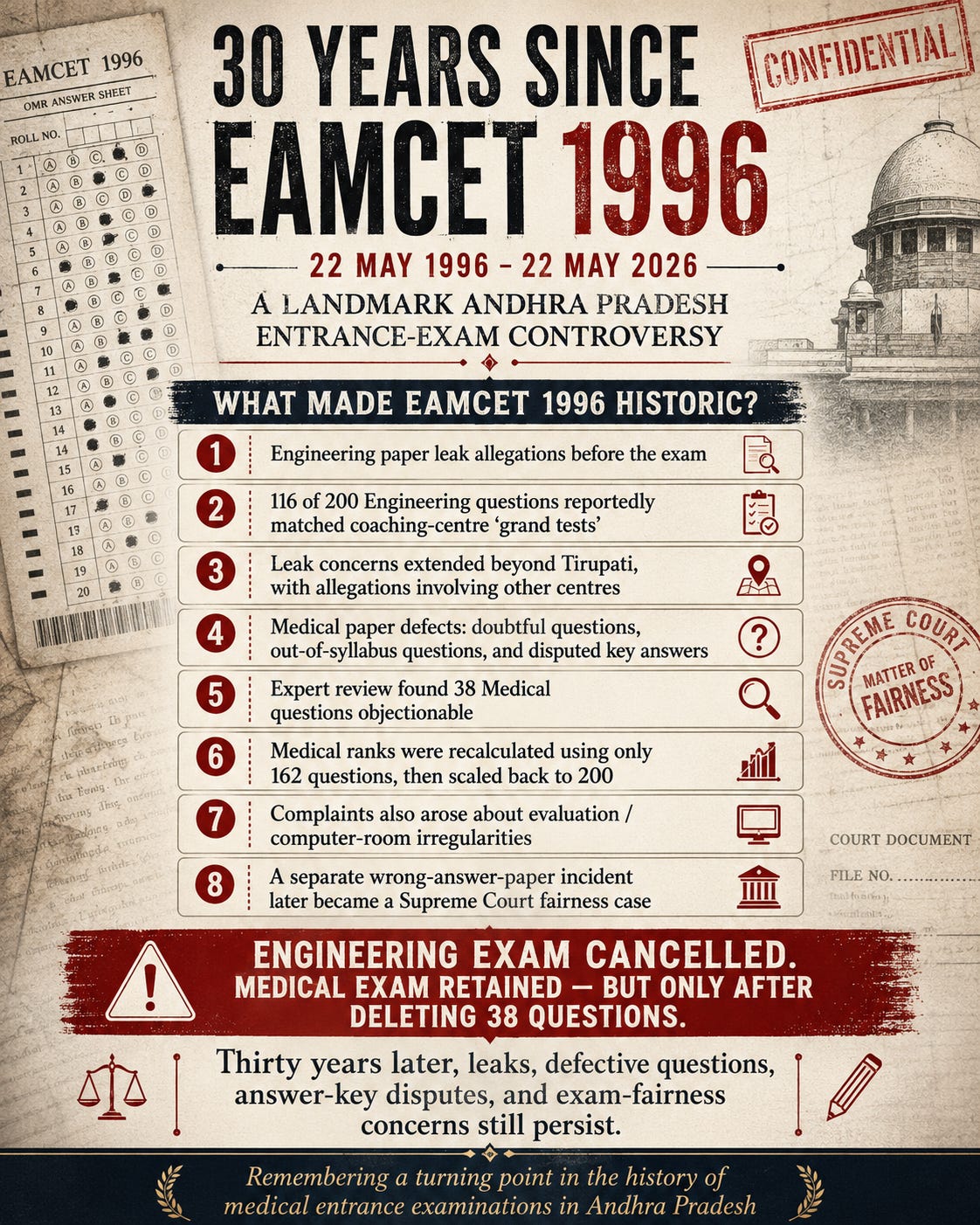
Thirty years since EAMCET 1996 — a landmark Andhra Pradesh entrance-exam controversy whose themes still feel familiar.
On 22 May 1996, I wrote the Andhra Pradesh EAMCET medical entrance examination. I secured State 19th rank.
That rank changed my life. It helped me enter medicine. It remains a personal milestone, and the old newspaper and coaching-centre clippings I am sharing with this post are part of that memory.
But thirty years later, what I remember most sharply is not the rank. It is the uncertainty that followed.
EAMCET 1996 was not just another entrance examination. In undivided Andhra Pradesh, EAMCET was the gatekeeper to medicine and engineering. For thousands of middle-class families, it represented a simple promise: work hard, perform well, and the system will reward you fairly.
That promise was badly shaken in 1996.
I was fortunate to emerge from that examination with a high rank. But the examination itself became a landmark controversy involving paper-leak allegations, defective medical questions, disputed answer keys, litigation, administrative uncertainty, and anxious students waiting to know whether their futures would be decided by merit or by damage control.
Thirty years later, India is still struggling with the same disease.
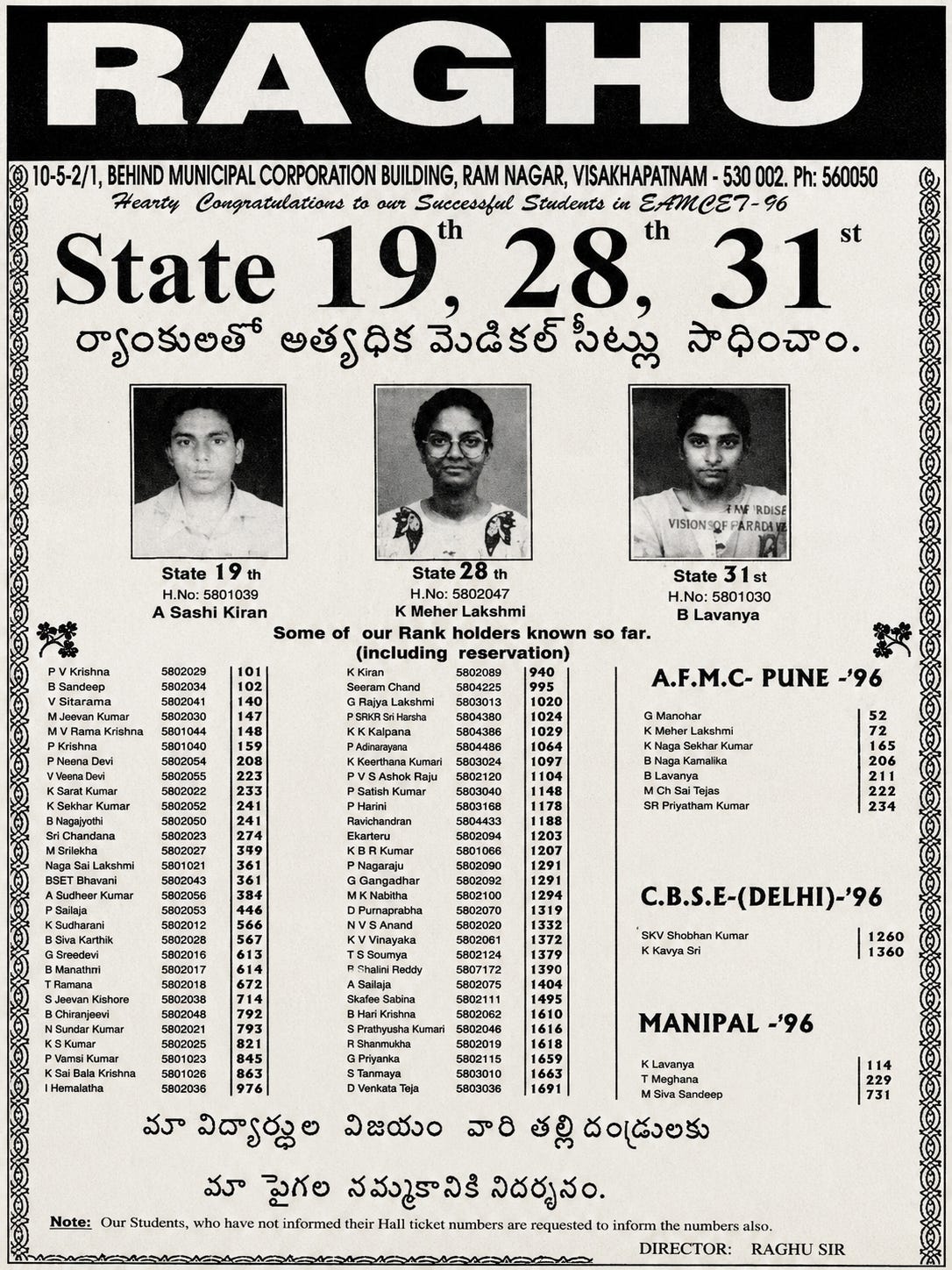
The old newspaper and coaching-centre clippings I am sharing with this post are part of that memory
What made EAMCET 1996 a landmark controversy
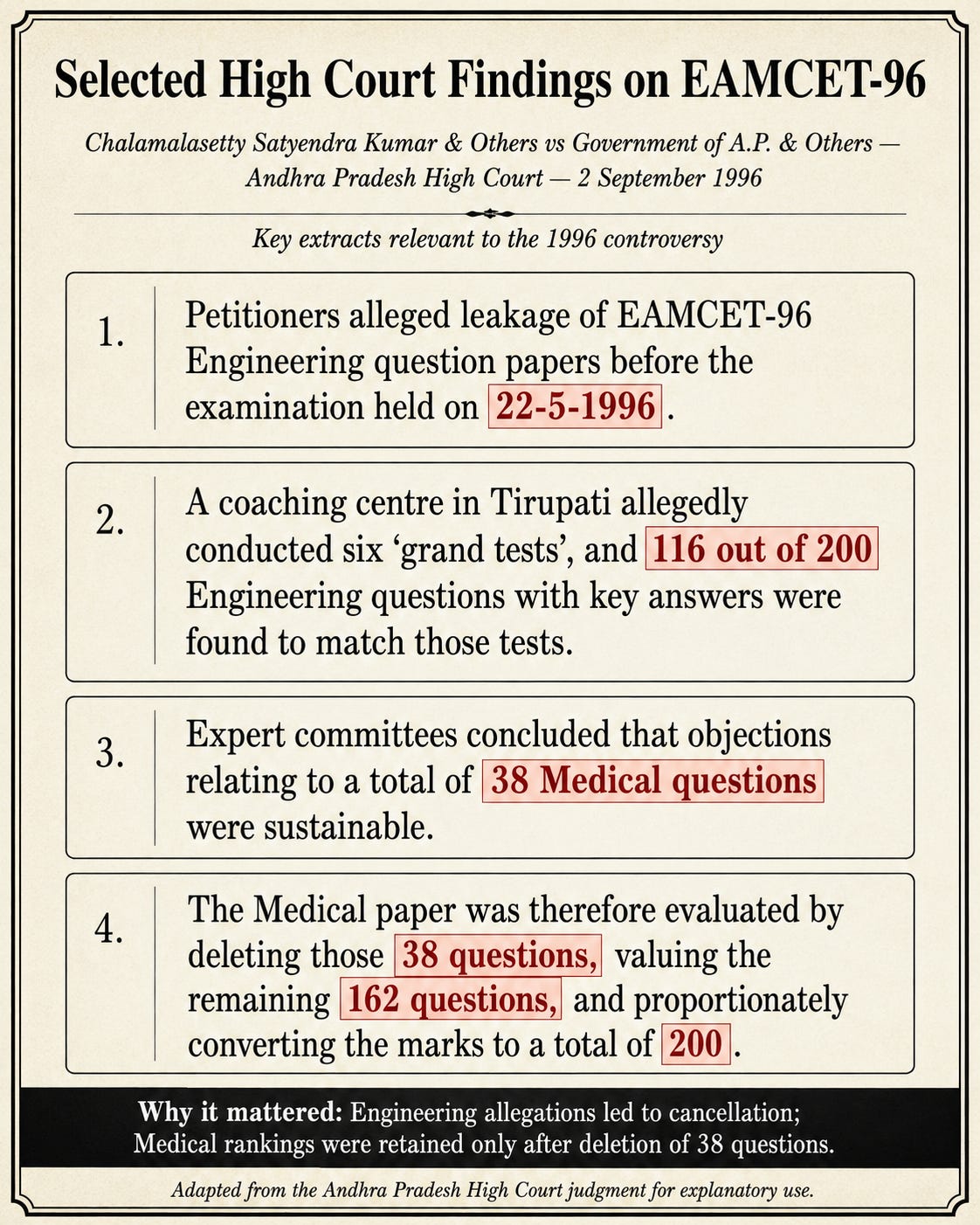
The Andhra Pradesh High Court record in Chalamalasetty Satyendra Kumar v. Government of A.P. shows how serious the controversy was.
Petitioners approached the court seeking cancellation of EAMCET-96, alleging leakage of the Engineering question paper before the examination held on 22 May 1996. According to the pleadings recorded by the court, a coaching centre in Tirupati had conducted six “grand tests” between 16 and 20 May 1996, and 116 out of 200 Engineering questions, along with key answers, were alleged to have appeared in those tests. There were also allegations that the leakage may have extended to other centres, including Vijayawada and Visakhapatnam.
The Engineering examination was eventually cancelled.
The Medical paper was not treated in the same way. There was no firm finding that the Medical paper had leaked. But the Medical examination had a different and equally serious problem: defective questions and disputed answers.
The High Court recorded that 11 questions had been marked as doubtful, seven were alleged to be out of syllabus, and some questions had disputed or multiple possible answers. The court directed expert review before the Medical results could proceed.
That expert review eventually found objections sustainable for 38 Medical questions out of 200. The solution adopted was to delete those 38 questions, evaluate the remaining 162 questions, and then scale the marks back to 200 for ranking.
That is how our medical ranks were finalised.
A medical entrance examination that decided careers was salvaged by deleting nearly one-fifth of the paper.
The uncomfortable truth about merit
I worked very hard for my rank. I did not go through the full-time coaching-factory route that later became dominant. I relied largely on self-study, repeated multiple-choice practice, and weekly tests at Raghu Tutorials, attending only selected classes where I felt I needed help. That was enough for me then.
So my rank was earned.
But the final rank list emerged from a compromised process.
Both statements are true.
This is the uncomfortable truth about high-stakes examinations. A student can work honestly. A rank can be legitimately achieved. And yet the system producing that rank can still be flawed.
The High Court itself did not pretend that the Medical examination had been conducted properly. It accepted deletion of the 38 questions because it would “keep the damage at the minimum,” not because the process was flawless. The court also noted that cancellation of 38 questions had caused “substantial erosion” in the assessment of merit.
That phrase matters: substantial erosion.
In competitive entrance examinations, especially at the top end, even a small mark difference can alter rank. I cannot prove exactly how the deleted questions changed the 1996 rank distribution, because I do not have the full rank-versus-marks dataset. That limitation should be stated honestly. But it is obvious that deleting 38 questions from a 200-question paper creates uncertainty in the measurement of merit.
Some students may have spent valuable time on the deleted questions. Some may have known the disputed topics better than others. Some may have gained rank. Some may have lost rank. The court had to choose the least damaging solution. That does not mean the damage disappeared.
This is why EAMCET 1996 deserves to be remembered not merely as an old controversy, but as an early warning.
The personal experience of institutional uncertainty
After the exam, the tension was real.
We had done what students are supposed to do: study, practise, enter the hall, write the paper, and wait for results. Suddenly the question was no longer just, “How many marks did I get?” It became: Will the exam stand? Will there be a re-exam? Will the Medical results be delayed? Will the rank list change? Were the questions fair? Were some students unfairly advantaged? Would the court intervene?
I remember being anxious, but also reasonably confident that if a re-exam happened, I could write it again. I had prepared hard enough to trust my ability.
But not every student experiences uncertainty that way.
For many families, an entrance examination is not simply an academic event. It is an emotional, financial, and social investment. When an exam is questioned after it is conducted, the damage is not limited to the answer key. It affects sleep, morale, family atmosphere, and the ability to trust public institutions.
This is why examination integrity is not a technical issue alone. It is a governance issue. It is a mental-health issue. It is a public-trust issue.
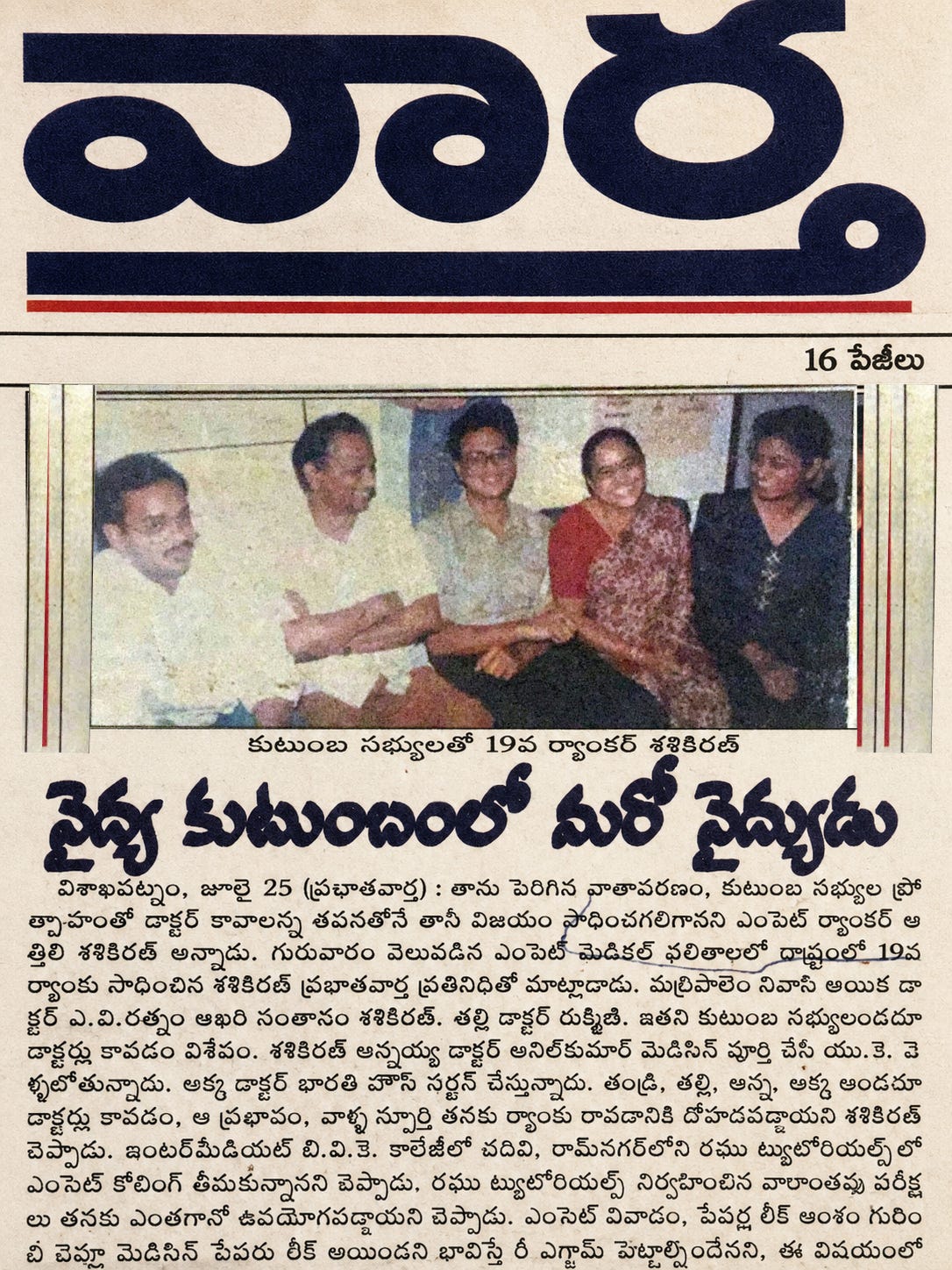
Local Telugu newspaper coverage after the EAMCET-96 results, showing the personal side of a much larger public controversy.
Courts should not have to rescue examination systems
EAMCET 1996 also produced another important legal episode: C. Tulasi Priya v. A.P. State Council of Higher Education.
In that case, a candidate appearing for EAMCET on 22 May 1996 was initially given the wrong answer paper. The Supreme Court later considered the administrative lapse, the dispute over lost time, and the failure to preserve relevant answer sheets. The Court observed that it was unrealistic to expect a young, nervous student in the middle of an important examination to lodge a written protest immediately.
That observation remains powerful.
A student in an examination hall is not a lawyer preserving evidence. A student is not expected to understand procedural safeguards in real time. The burden of fairness must fall on the examination authority, not on the frightened candidate.
When courts repeatedly have to intervene in entrance-exam disputes, the problem is not judicial overreach. The problem is administrative failure.
From EAMCET to NEET: what has changed, and what has not
It would be unfair to say that nothing has changed since 1996.
Examination systems today are far more technologically sophisticated. There are centralised agencies, biometric checks, digital processing, surveillance, encrypted logistics, and more formalised objection mechanisms. These are real improvements.
But technology has not solved the deeper problem: trust.
Recent NEET controversies show how persistent the underlying disease remains. NEET-UG 2026 has reportedly faced paper-leak allegations, cancellation, rescheduling, CBI investigation, and renewed calls for reform of the National Testing Agency. Media reports have described cancellation of NEET-UG 2026 after leak allegations and its rescheduling to 21 June 2026. Reports have also described CBI action in relation to the alleged NEET-2026 leak, and calls from professional bodies for stronger action against systemic failures.
Even before 2026, NEET-UG 2024 had become a major national controversy. Reports described allegations of paper leak, grace-mark disputes, litigation, and investigation into the origin of the leak.
The names of the exams have changed. The scale has changed. The technology has changed.
But the vocabulary remains painfully familiar: paper leak, defective question, disputed key, grace marks, re-exam, litigation, investigation, student distress.
That should embarrass us.
A country that can run complex digital systems, process biometric identities, and build vast national databases should not repeatedly fail at the basic task of conducting clean high-stakes examinations.
The coaching arms race is a symptom, not the disease
There is another change between 1996 and now: the age at which examination pressure begins.
In my time, coaching existed, but it had not yet swallowed childhood the way it often does today. I used a coaching centre selectively, mainly for tests. Today, many children begin formal or informal competitive-exam preparation from middle school. My own daughter started structured coaching in Class 9, and had tutorials even earlier.
I do not blame parents for this. They are responding rationally to an irrational system.
When admissions are scarce, competition brutal, and uncertainty high, families try to buy every possible advantage. Coaching becomes less a choice and more an insurance policy. The tragedy is that even this insurance cannot protect students from paper leaks, defective questions, or administrative incompetence.
Students can prepare for difficult questions. They cannot prepare for a compromised examination.
What serious reform should look like
India does not need another round of vague assurances after every leak. It needs enforceable examination-integrity standards.
First, question papers must undergo independent academic audit before the exam. This cannot be a casual internal review. It should involve external subject experts, conflict-of-interest declarations, documentation of changes, and accountability for defective questions.
Second, answer keys must undergo structured validation before publication. In a high-stakes exam, a wrong key is not a clerical error. It can alter careers. Objections should be handled transparently, with reasoned decisions published in a time-bound manner.
Third, the chain of custody for question papers must be treated as a security protocol, not an administrative routine. Every stage — setting, printing, encryption, storage, transport, centre-level access, and post-exam handling — should have audit trails.
The reported decision to move NEET-UG to a computer-based format from 2027 is therefore welcome. Digital examinations can reduce the vulnerabilities inherent in physical paper printing, transport, storage, and centre-level access. In that sense, CBT is not merely a technological upgrade; it is a security reform.
But it would be naive to treat online testing as a complete cure. A digital exam can still be compromised through weak question-bank security, insider access, poor centre-level controls, impersonation, technical failures, or opaque post-exam processing. Computer-based testing must therefore be accompanied by independent cybersecurity audit, encrypted question delivery, randomised question sequencing where appropriate, biometric verification, secure logging, and transparent post-exam review.
Fourth, answer sheets, digital logs, CCTV records, and related examination material must be preserved for a legally defined period, especially when litigation or complaints arise. The Tulasi Priya case shows why preservation of records is not a minor procedural matter. It can decide whether justice is possible.
Fifth, examination agencies must face institutional consequences. It is not enough to arrest brokers or low-level facilitators after a leak. If an agency repeatedly fails, there must be leadership accountability, external review, and structural reform.
Sixth, students must be supported when exams are cancelled or rescheduled. A re-exam is not merely a new date on a calendar. It is a psychological and logistical burden. Authorities should provide clear timelines, helplines, counselling support, and transparent communication.
Finally, India must stop treating exam controversies as episodic scandals. They are structural failures. Each leak is not an isolated event; it is evidence of a system that has not built enough redundancy, transparency, and accountability.
Why EAMCET 1996 still matters
The old clippings I am sharing are personally meaningful to me. They show a young student from Visakhapatnam who secured State 19th rank in the medical entrance examination. My family was proud. My teachers were proud. I was proud too.
But looking back now, I see something more complicated.
I see a student who worked hard and benefited from a rank. I also see an examination system that had to be rescued after serious failure. I see courts trying to balance fairness and practicality. I see administrators trying to preserve admissions after damage had already occurred. I see students and parents forced to live with uncertainty they did not create.
That is why EAMCET 1996 should not be remembered only as a local controversy from a pre-NEET era. It should be remembered as an early case study in a national problem India has still not solved.
The lesson is simple but uncomfortable.
Merit is not produced by students alone. It is produced by systems that measure students fairly.
When those systems fail, even the successful candidates carry a shadow of uncertainty, and the unsuccessful candidates are left wondering whether they lost to merit or to malfunction.
Thirty years after EAMCET 1996, that is unacceptable.
India’s students deserve difficult exams. They do not deserve defective exams.
They deserve competition. They do not deserve chaos.
They deserve meritocracy. They do not deserve a lottery disguised as merit.
After thirty years, the excuses have run out.