

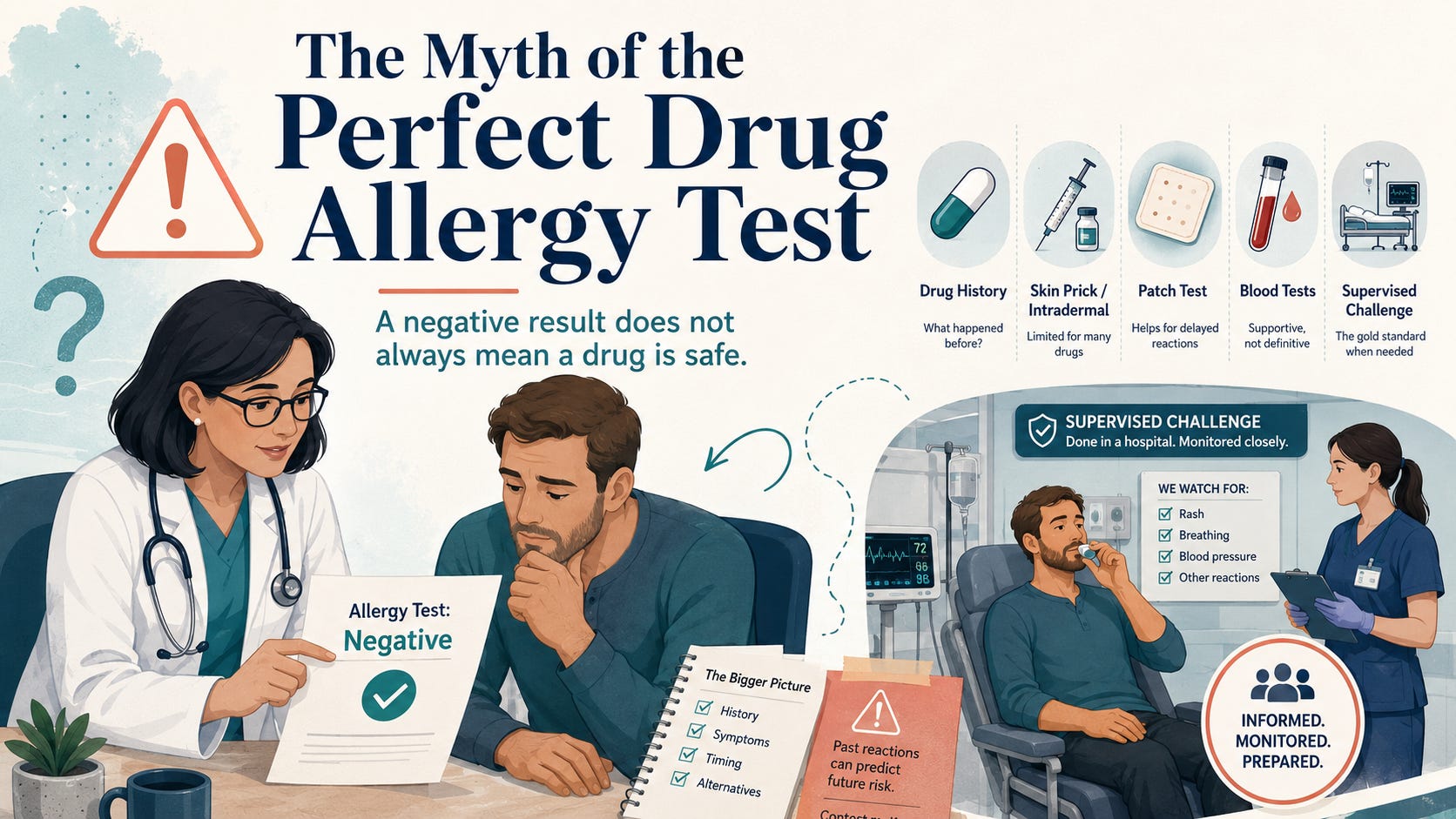
The most dangerous drug allergy report is not always the positive one.
Sometimes, it is the completely negative one.
A patient is told, “Your allergy test is negative.”
The doctor feels reassured.
The patient feels safe.
The medicine is given.
But what exactly was tested?
A skin prick test?
A patch test?
A blood test?
A diluted injection into the skin?
A supervised drug challenge?
These are not the same thing. They do not answer the same question.
A negative drug allergy test often does not mean, “This medicine is safe.”
Very often, it only means:
“This particular test did not show this particular type of reaction under these particular testing conditions.”
That distinction matters.
First: was it really an allergy?
Before asking for an allergy test, we must ask a more basic question.
Was the reaction truly allergic?
Vomiting after an antibiotic may be a side effect.
Acidity after a painkiller may be gastritis.
Sleepiness after an antihistamine may be expected pharmacology.
Loose motions after an antibiotic may be alteration of gut flora.
Palpitations after salbutamol may be a known drug effect.
These symptoms may be unpleasant. Some may need medical attention. But they are not automatically allergies.
A true drug allergy means the immune system is involved. Even then, all drug allergies are not the same.
Some occur within minutes.
Some occur days later.
Some are mild.
Some are dangerous.
No single “drug allergy test” detects all of them.
Five drug reactions people often confuse
1. Side effects
These are expected or predictable effects of a medicine.
Examples include nausea, acidity, drowsiness, diarrhoea, tremor, and headache.
Allergy testing usually does not help here.
2. Drug intolerance
The patient cannot tolerate the drug, but it may not be a classic allergy.
Many painkiller reactions fall into this area. A skin prick test is usually not the answer.
3. Immediate allergy
This usually occurs within minutes to a few hours.
Symptoms may include hives, swelling of lips or eyelids, wheezing, throat tightness, dizziness, collapse, or anaphylaxis.
This is where skin prick testing or intradermal testing may sometimes help.
4. Delayed allergy
This appears after many hours or days.
It may cause a widespread rash, fixed drug eruption, eczema-like rash, or fever with rash.
A prick test is not designed to detect most of these reactions. Patch testing may help in selected cases, but it is not a guarantee.
5. Severe drug reactions
These include Stevens–Johnson syndrome or toxic epidermal necrolysis, where skin and mucosa can blister and peel; DRESS, a severe drug reaction that may involve fever, rash, blood abnormalities, liver, kidney, or other organs; AGEP, a sudden pustular drug eruption; severe vasculitis; hepatitis; nephritis; or any reaction with mucosal erosions, skin peeling, fever, or organ involvement.
These are high-risk reactions.
Routine prick testing or casual drug challenge is inappropriate.
In many such cases, the safest answer is:
Avoid the culprit drug unless a specialist centre has a compelling reason to reassess it.
What the tests actually tell us
A skin prick test mainly checks for immediate skin reactivity. It asks whether the skin reacts immediately to the tested drug at the tested concentration.
It does not reliably tell us whether the patient can take a full dose.
It does not rule out delayed rashes.
It does not rule out severe delayed reactions.
It does not rule out side effects.
For penicillin and selected related antibiotics, skin testing has a stronger role. For many other drugs, the evidence is weaker.
An intradermal test is a deeper skin test in which a small amount of diluted drug is injected into the skin. It may be more sensitive than a prick test, but it also has more risk of false positives, irritant reactions, and occasional systemic symptoms.
A patch test is different. It is mainly used for selected delayed skin reactions. It may help in some cases of drug rash or fixed drug eruption, but a negative patch test does not rule out drug allergy.
A blood test sounds attractive because it feels scientific and safe. But for most drug allergies, blood tests are limited. Total IgE is not a drug allergy test. A high total IgE does not prove drug allergy. A normal total IgE does not exclude it. Drug-specific IgE blood tests are useful only for selected drugs and selected immediate reactions.
So before accepting a “drug allergy blood panel,” ask:
Which exact drug reaction does this test detect, and what does a negative result actually mean?
If that cannot be answered clearly, the test may not be helping you.
The drug challenge: often the closest practical answer
The most clinically meaningful test is often not a prick test, patch test, or blood test.
It is a supervised drug challenge.
This means giving the drug under medical supervision, often in graded doses. This must be done in a clinical setting equipped to recognise and treat allergic reactions, including anaphylaxis. It is not a home test and should not be improvised.
For example:
10% of the dose—>observe
then the remaining 90%—> observe again
In very low-risk cases, a single-dose challenge may be appropriate.
A drug challenge answers the question most patients actually care about:
“Can I tolerate this medicine today, at this dose, under supervision?”
But drug challenge is not for everyone.
It should not be casually performed after severe reactions such as Stevens–Johnson syndrome, toxic epidermal necrolysis, DRESS, severe organ involvement, or life-threatening delayed reactions.
In those situations, the risk may be unacceptable.
The penicillin allergy lesson
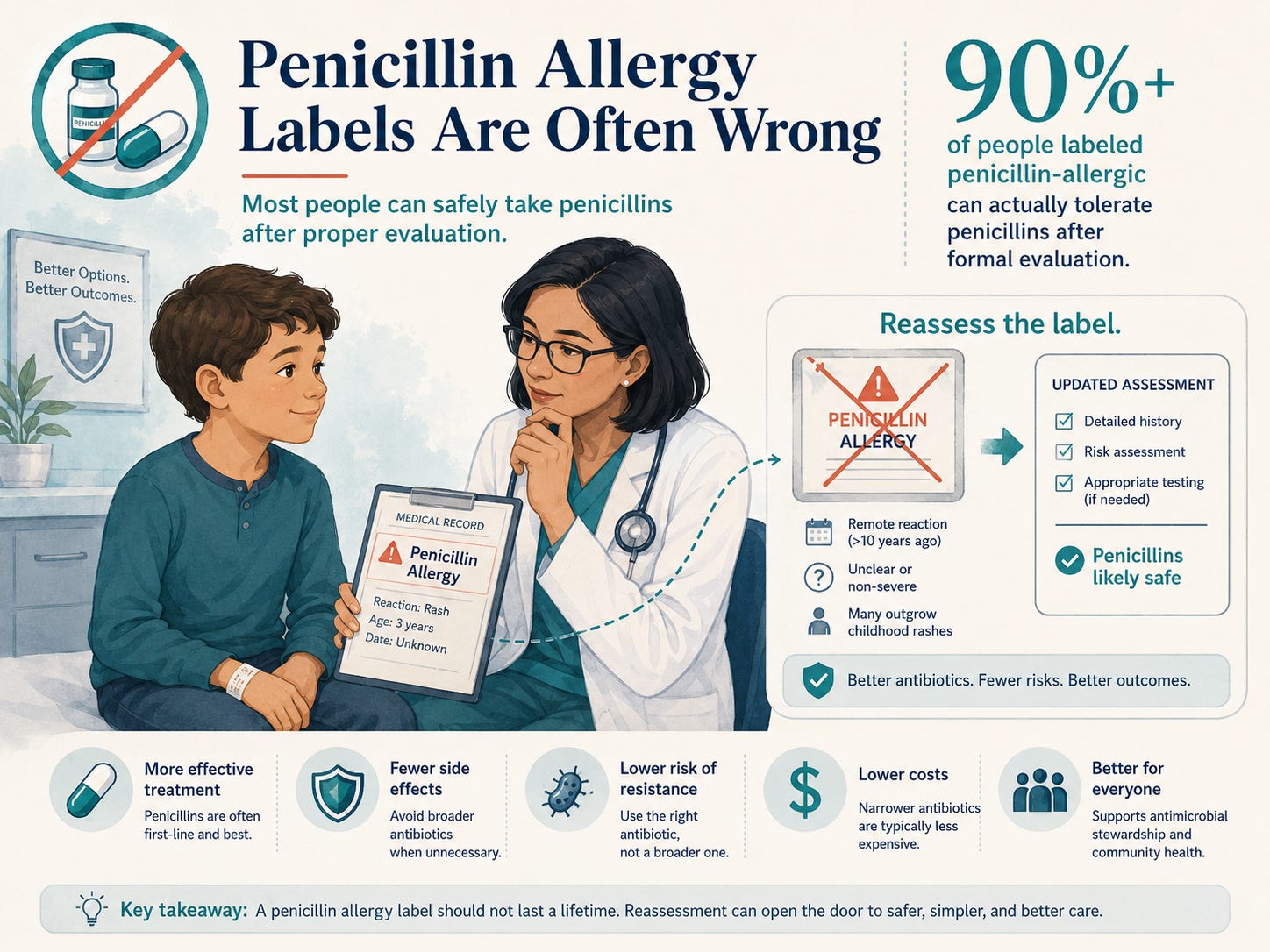
Penicillin allergy is the classic example of why labels can mislead.
Many people are told in childhood that they are allergic to penicillin. Years later, the label remains in the medical record. Nobody remembers the exact reaction. The patient avoids penicillin and related antibiotics for life.
Formal allergy evaluation repeatedly shows that 90% or more of people carrying a penicillin allergy label can actually tolerate penicillins.
That does not mean all penicillin allergy labels are fake.
It means many are inaccurate, outdated, or based on childhood rashes that were never true allergy.
This matters because an incorrect penicillin allergy label can push doctors toward broader-spectrum antibiotics, more expensive drugs, more side effects, and sometimes poorer treatment choices.
The right response is not to ignore the history.
The right response is to assess the risk properly.
Was it hives or a flat rash?
Did it happen within minutes or after days?
Was there swelling, wheezing, collapse, fever, mouth ulcers, eye redness, skin peeling, or hospitalisation?
Has the patient tolerated amoxicillin, penicillin, or a related antibiotic since?
For a low-risk history, a supervised oral challenge may be more useful than a prick test.
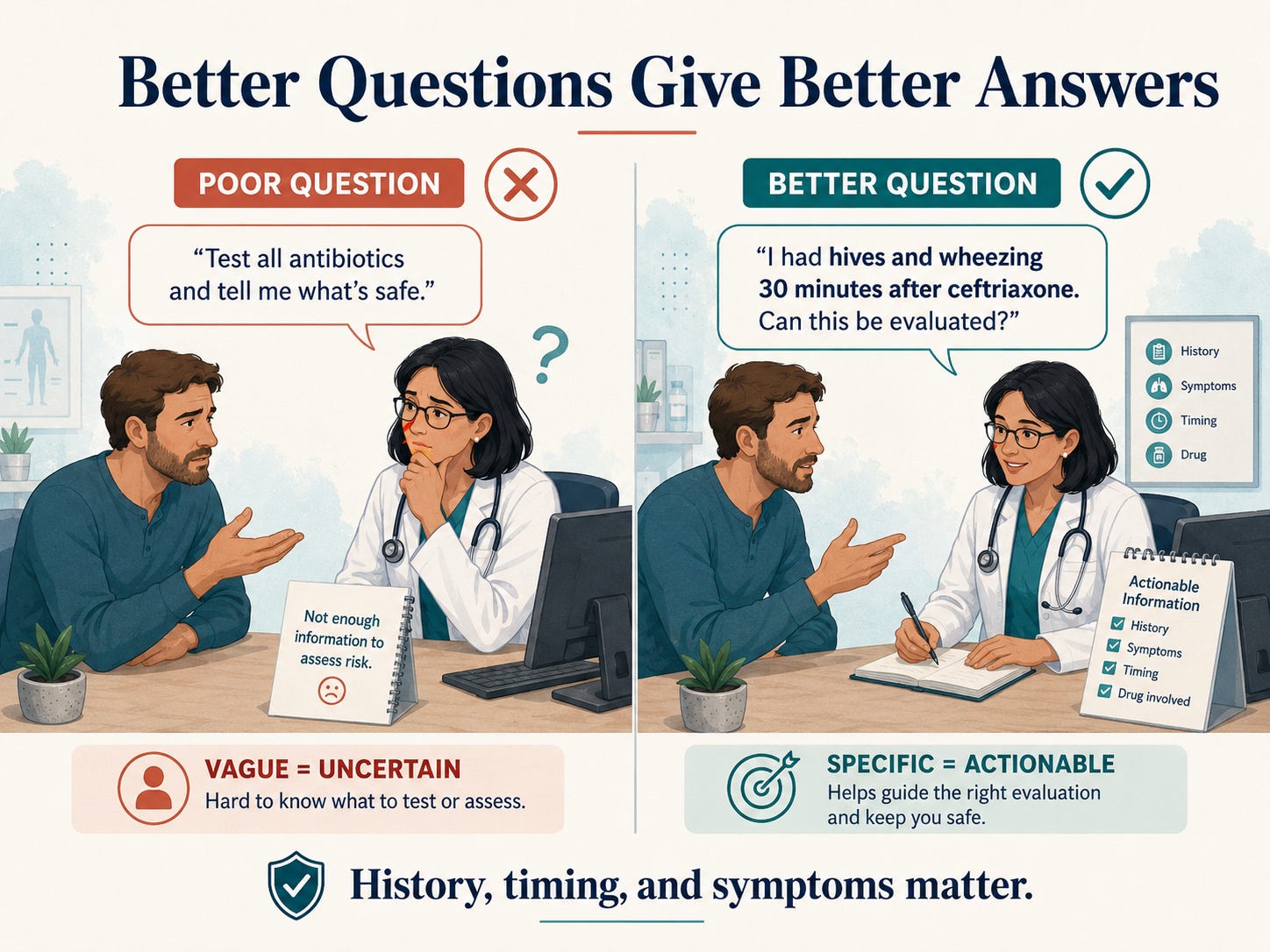
Poor question:
“Please test all antibiotics and tell me which ones are safe.”
Better question:
“This patient developed hives and wheezing 30 minutes after ceftriaxone. Can we evaluate immediate beta-lactam hypersensitivity and advise on safer alternatives?”
Poor question:
“Do a prick test with this tablet and certify that the patient is not allergic.”
Better question:
“The patient had a mild rash after amoxicillin five years ago, with no mucosal lesions or systemic symptoms. Is a supervised oral amoxicillin challenge appropriate?”
Poor question:
“The patient vomited after azithromycin. Please do allergy testing.”
Better question:
“Was this a side effect, intolerance, or immune reaction? Is allergy evaluation needed at all?”
Poor question:
“The child had a rash during fever while taking an antibiotic. Please label the child allergic.”
Better question:
“Was the rash due to the infection, the drug, or both? Is this a low-risk history where the allergy label can be removed?”
Poor question:
“The blood allergy panel is negative. So the drug is safe, right?”
Better question:
“What exact type of drug allergy does this blood test detect, and does a negative result meaningfully reduce risk?”
The quality of the answer depends on the quality of the question.
Three situations where this matters
A child develops a rash while taking amoxicillin during a fever. The rash may be due to the infection, the drug, or both. A lifelong “penicillin allergy” label should not be applied casually.
An adult says, “I am allergic to anaesthesia.” That phrase is too vague to guide safe care. It may mean nausea after surgery, shivering, fainting, low blood pressure, rash, bronchospasm, or true perioperative anaphylaxis. The right next step is not random allergy testing to “all anaesthesia drugs.” The right next step is to obtain the anaesthesia record, identify the exact drugs used, document the timing and features of the reaction, and decide whether specialist allergy evaluation is needed before the next procedure.
A patient says, “I reacted to a painkiller.” Some painkiller reactions are true allergy. Many are intolerance reactions related to NSAID pharmacology. The practical question is often not whether a prick test is positive. The practical question is: which painkiller can this patient safely take?
In all three situations, the history is not a formality.
It is the foundation of the diagnosis.
What a responsible report should say
A poor report says:
“Drug allergy test: negative.”
That is too vague.
A responsible report says what was tested and what the result means.
For example:
“No immediate skin-test reactivity was detected to the tested drug at the tested concentration. This reduces the likelihood of immediate hypersensitivity but does not exclude delayed allergy, non-IgE reactions, side effects, or future reactions.”
If a supervised challenge is tolerated, the report may say:
“The patient tolerated the supervised graded challenge to the tested drug and dose today. This supports current clinical tolerance. It does not exclude unrelated future adverse effects or delayed reactions after the observation period.”
That is the difference between a useful medical report and a false sense of safety.
The bottom line
Drug allergy testing is possible.
But there is no universal “drug allergy test.”
A prick test mainly assesses immediate skin reactivity.
A patch test may help in selected delayed skin reactions.
Blood tests are useful only for selected drugs and reaction types.
A supervised drug challenge is often the closest practical test of current tolerance, but it must be risk-stratified.
The next time someone offers you a “drug allergy panel,” ask one question:
“What exact question does this test answer?”
If the answer is simply, “It tells whether you are allergic,” that is not reassurance.
A test that cannot name the question it answers should not be used to reassure anyone.