

This article is based on a recent consensus position statement published online ahead of print in the Journal of Cutaneous and Aesthetic Surgery (JCAS) by a task force of the Association of Cutaneous Surgeons of India.
Social media regularly presents new treatments for hair loss, skin ageing and pigmentation as scientific breakthroughs. Terms such as exosomes, salmon DNA, stem cells, regenerative medicine and vitamin drips sound impressive—and may create the impression that these procedures are already proven.
A recent JCAS article examined six increasingly promoted treatments:
Exosomes
Polynucleotides and PDRN
Rigenera micrografts
Nanofat and stromal vascular fraction for hair loss
Cosmetic intravenous drips
Thread lifts
The expert task force reviewed the available evidence, assessed safety and assigned recommendations for each treatment. Its overall conclusion was clear: several of these procedures are being marketed more confidently than the scientific evidence currently allows.
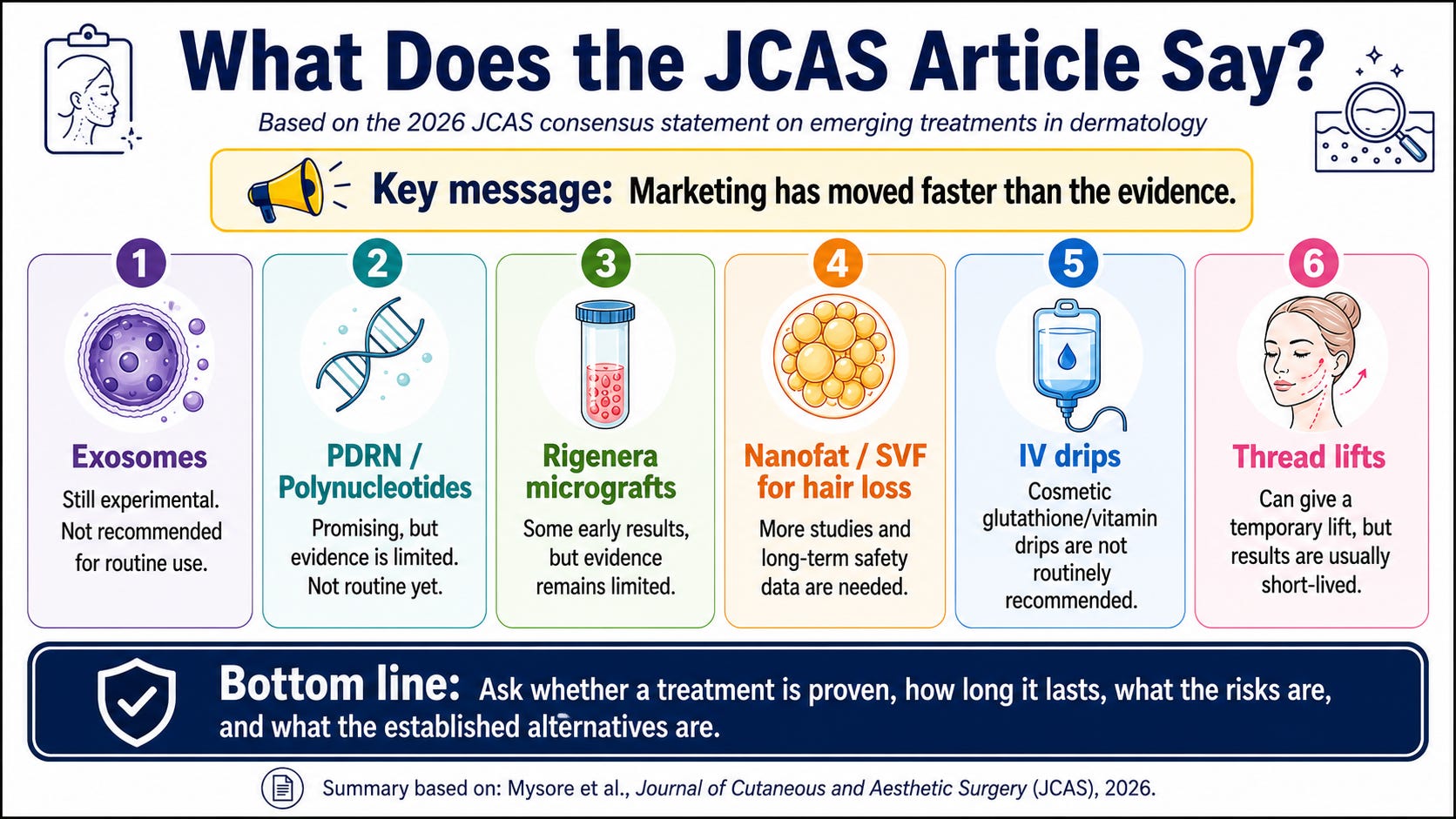
The article is a consensus position statement rather than a new clinical trial. It therefore does not prove whether each procedure works or does not work. Instead, it evaluates how reliable the existing evidence is and whether these treatments are ready for routine clinical use.
Here is a detailed layman summary of the concensus statement:
Exosomes: promising science, but still experimental
Exosomes are tiny packages released by cells. They contain proteins, fats and genetic material that allow cells to communicate.
Laboratory studies suggest that exosomes may influence inflammation, wound healing, collagen production and hair growth. However, commercially available exosome products vary considerably according to their source, contents, purification and manufacturing process.
Most supporting evidence comes from laboratory research, animal studies, case reports or small clinical studies. Long-term safety is also uncertain.
The JCAS task force therefore classified exosome treatment as having very low-level evidence and concluded that commercial exosome products should be regarded as experimental rather than routinely recommended treatments.
PDRN and polynucleotides: the “salmon DNA” injections
Polynucleotides and polydeoxyribonucleotides—usually abbreviated as PN and PDRN—are DNA fragments commonly obtained from salmon or trout.
They are promoted for:
Fine lines and skin texture
Under-eye rejuvenation
Pigmentation
Scars
Hair loss
Wound healing
Some small studies have reported improvement. However, the studies differ considerably in their methods, products, treatment schedules and outcome measurements. Most involve relatively few patients and short follow-up periods.
There is no widely accepted protocol establishing the ideal product, dose, number of sessions or duration of benefit. Long-term safety data are also limited.
The JCAS consensus therefore considers PN and PDRN experimental and not ready for routine recommendation.
This does not prove that they have no effect. It means that current advertising often expresses far greater certainty than the evidence supports.
Rigenera: using your own scalp tissue for hair loss
Rigenera involves removing tiny pieces of scalp tissue, mechanically processing them and injecting the resulting micrograft suspension into areas of hair loss.
Small studies have reported increased hair density and thickness. However, most have been small, non-randomised and limited by short follow-up.
The JCAS article judged the evidence for pattern hair loss as limited, with only a cautious recommendation.
An important distinction must be understood:
Regulatory clearance of a processing device does not automatically prove that every treatment performed using that device is effective.
Rigenera may be considered in selected patients, but it should not be presented as an established replacement for standard treatments for pattern hair loss.
Nanofat and stromal vascular fraction for hair growth
These procedures involve removing fat from the patient and processing it to obtain a mixture containing supporting cells, growth factors and other tissue components. This material is then injected into the scalp.
Several small studies have reported improved hair counts. However, the techniques vary greatly. Some use enzymes, others use mechanical processing, while some combine the procedure with platelet-rich plasma or microneedling.
This makes it difficult to determine which component produced any observed improvement.
The JCAS task force concluded that more well-designed trials, standardised protocols and long-term safety data are required. It recommended restricting these procedures to carefully selected patients with proper documentation and informed consent.
Cosmetic IV drips: invasive treatment without convincing cosmetic evidence
Intravenous drips containing glutathione, vitamin C, NAD+, vitamins or antioxidants are promoted for:
Skin brightening
Anti-ageing
“Detoxification”
Immunity
Hair and nail growth
Energy
According to the JCAS consensus, strong scientific evidence for these uses in healthy individuals is lacking.
Intravenous glutathione may produce temporary lightening in some patients, but the effect is inconsistent and may reverse after treatment stops. There is no established long-term cosmetic dosing schedule.
An IV drip is not simply a stronger supplement. It can cause:
Infection or sepsis
Allergic reactions
Inflammation of the vein
Fluid overload
Electrolyte disturbances
Kidney complications
Rare life-threatening reactions
The task force therefore does not recommend cosmetic IV vitamin or glutathione drips for routine aesthetic practice.
Thread lifts: a possible temporary lift, not a facelift
Thread lifts involve placing threads under the skin to pull sagging tissues upwards.
Unlike some of the other treatments discussed, thread lifts can produce a visible immediate effect. However, the JCAS article notes that the benefit is usually short-lived, commonly declining within approximately six to twelve months.
Using more threads has not been clearly shown to provide better results.
Possible complications include:
Swelling and bruising
Pain
Dimpling or puckering
Asymmetry
Visible or palpable threads
Infection
Serious complications appear uncommon, but they can occur.
Thread lifts may be reasonable for patients seeking a modest and temporary improvement without surgery. They should not be promoted as an equivalent to a surgical facelift or as a reliably long-lasting rejuvenation procedure.
What should patients ask?
Before agreeing to a heavily promoted new treatment, ask:
Is this treatment proven for my particular condition?
Has it been compared with standard treatment in good clinical trials?
How long is the benefit likely to last?
What are the established and usually less expensive alternatives?
What are the short-term and long-term risks?
Is the treatment established, off-label or still experimental?
Words such as regenerative, natural, cellular and advanced describe a concept. They do not prove clinical benefit.
The practical message
Innovation is necessary in medicine. Every established treatment was once experimental.
However, patients should not be charged for experimental procedures while being given the impression that their effectiveness is already proven. Emerging treatments may eventually become valuable, but until stronger evidence is available, they should be offered selectively, honestly and without exaggerated claims.
Do not ask only whether a treatment can be performed. Ask whether it has been shown to provide meaningful, lasting benefit—and whether it is better than the available alternatives.
Source
Mysore VN, Arora G, Chandrashekar BS, et al. Consensus position statement on emerging treatments in dermatology by the Association of Cutaneous Surgeons of India Task Force. Journal of Cutaneous and Aesthetic Surgery. 2026; article in press. doi:10.25259/JCAS_337_2025.