

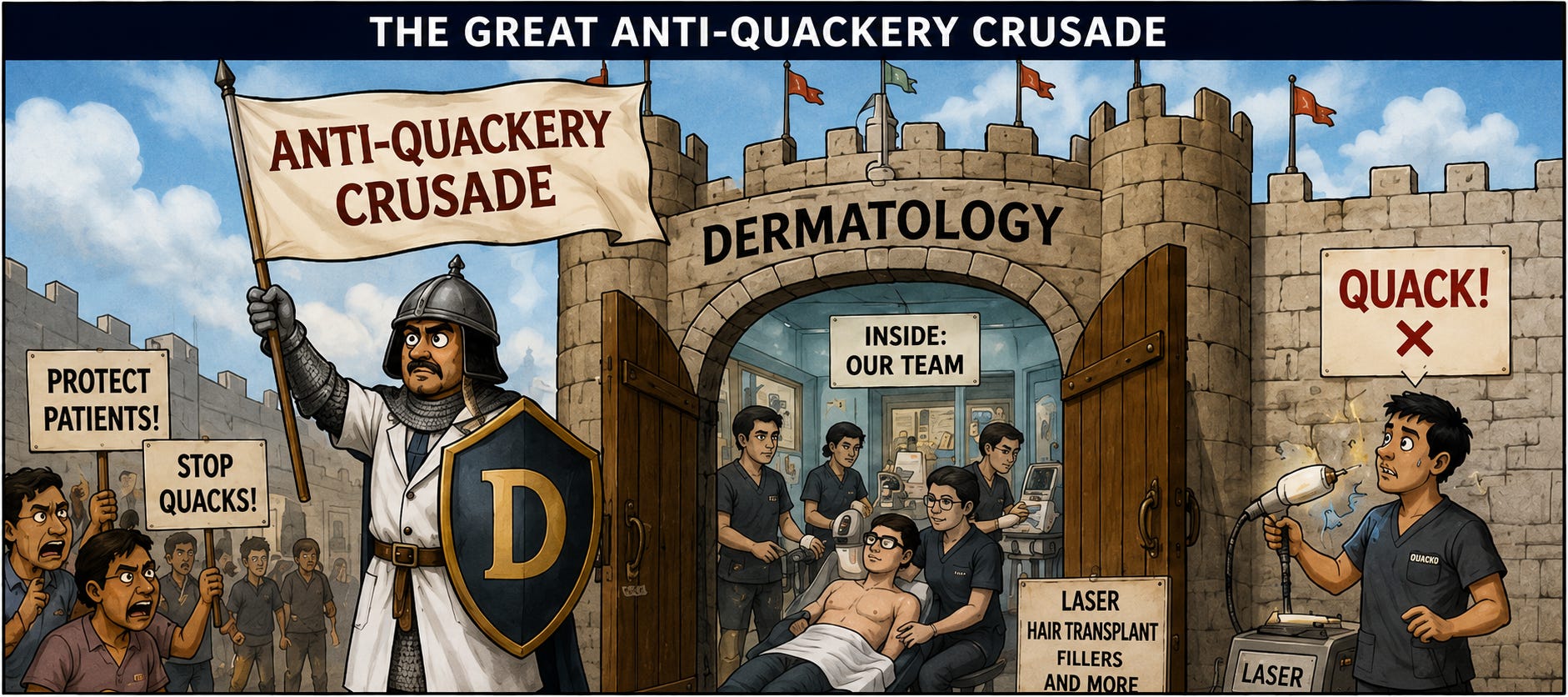
The field of dermatology has fostered a spirited and determined crusade against quackery. Much of it is entirely justified. Patients are harmed by people treating diseases they do not understand, prescribing inappropriate drugs, injecting fillers without knowing vascular anatomy, and operating lasers on lesions they cannot diagnose. Such practices certainly should be condemned.
But there is an uncomfortable question hiding inside the crusade: Are we always fighting quackery—or are we sometimes also fighting competition? The two may overlap. They are not the same thing.
A Boundary We Helped Blur
The terminology itself is revealing. Cosmetics traditionally improve appearance at the surface: makeup, creams, grooming and facials. Modern aesthetic dermatology does rather more: Lasers remodel collagen. Energy-based devices destroy vessels and pigment. Chemical peels deliberately injure skin. Botulinum toxin alters muscle activity. Fillers alter tissue volume and facial contours. These are interventions on living tissue.
Nearly two decades ago, Verma and Draelos made exactly this distinction in the Indian Journal of Dermatology, Venereology and Leprology. They argued that dermatologists calling themselves cosmetologists were misusing the term and, rather unflatteringly, downgrading their own professional identity. Their preferred term was cosmetic dermatologist.
Twenty years later, the nomenclature has become considerably more imaginative. We now have cosmetologists, cosmetic dermatologists, aesthetic dermatologists, aesthetic physicians, aesthetic practitioners, skin therapists and laser technicians, often offering remarkably similar services on remarkably similar social-media pages.
How is the patient is expected to know who trained in what?
Good luck with that!
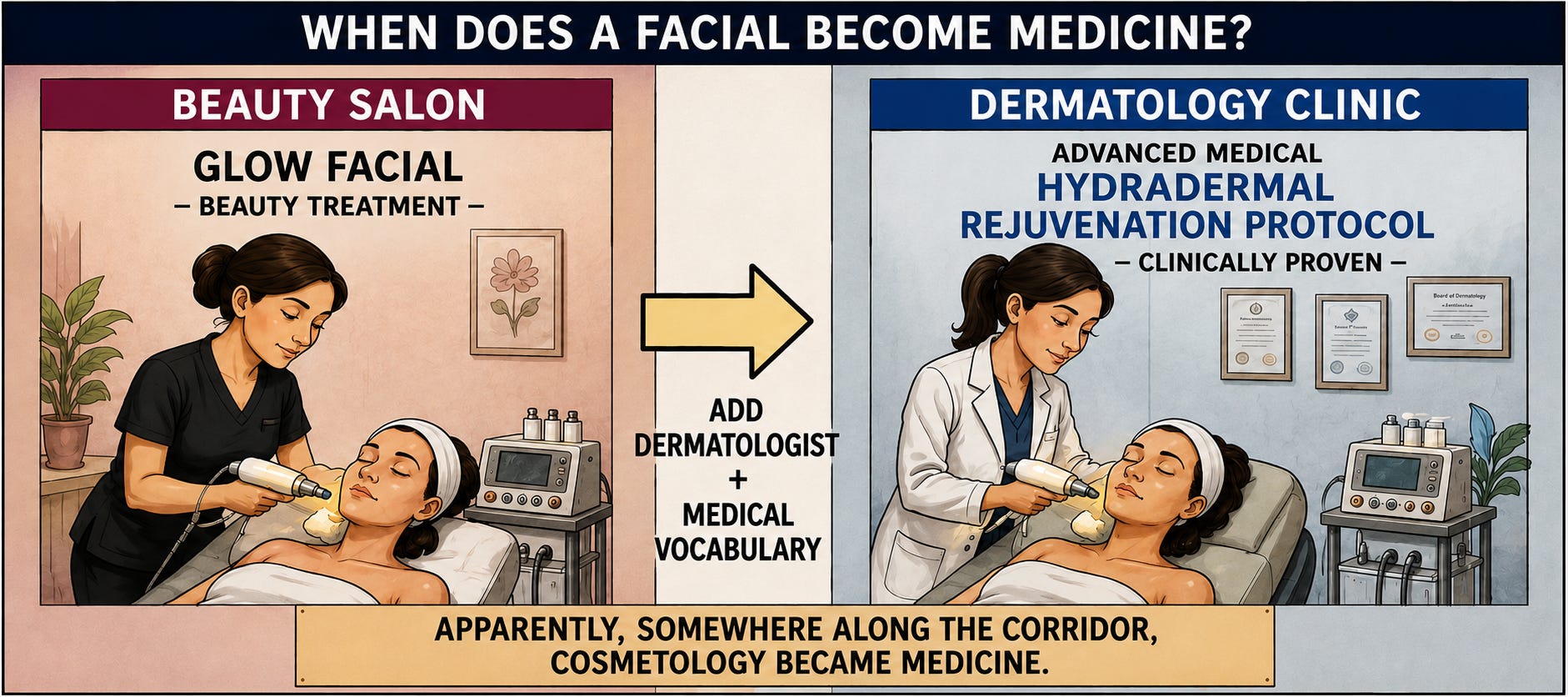
And dermatologists have not exactly helped. Many dermatology clinics now advertise Hydrafacials, skin polishing, “glow” treatments, LED masks and assorted combinations of cleansing, suction, exfoliation and serums. There is nothing inherently wrong with offering them. But we cannot blur the boundary commercially and then be astonished that patients cannot see the boundary professionally.
Apparently, a facial becomes more medical simply by travelling from the salon into the dermatology clinic.
The boundary problem is compounded by Influencer-Dermatologists doing paid promotions (covertly or overtly) for cosmetics, including moisturisers and sunscreens. Is that what they have spent years studying for?
So What Exactly Is Quackery?
If quack simply means “someone who is not a dermatologist treating skin”, the definition rapidly becomes absurd. A general practitioner treating acne becomes a quack. A paediatrician treating childhood eczema becomes a quack. A physician managing uncomplicated psoriasis becomes a quack. Medicine has never worked that way.
A more useful definition of quackery would focus on competence, misrepresentation, inappropriate treatment, inadequate supervision, lack of transparency and practising beyond one’s limits.
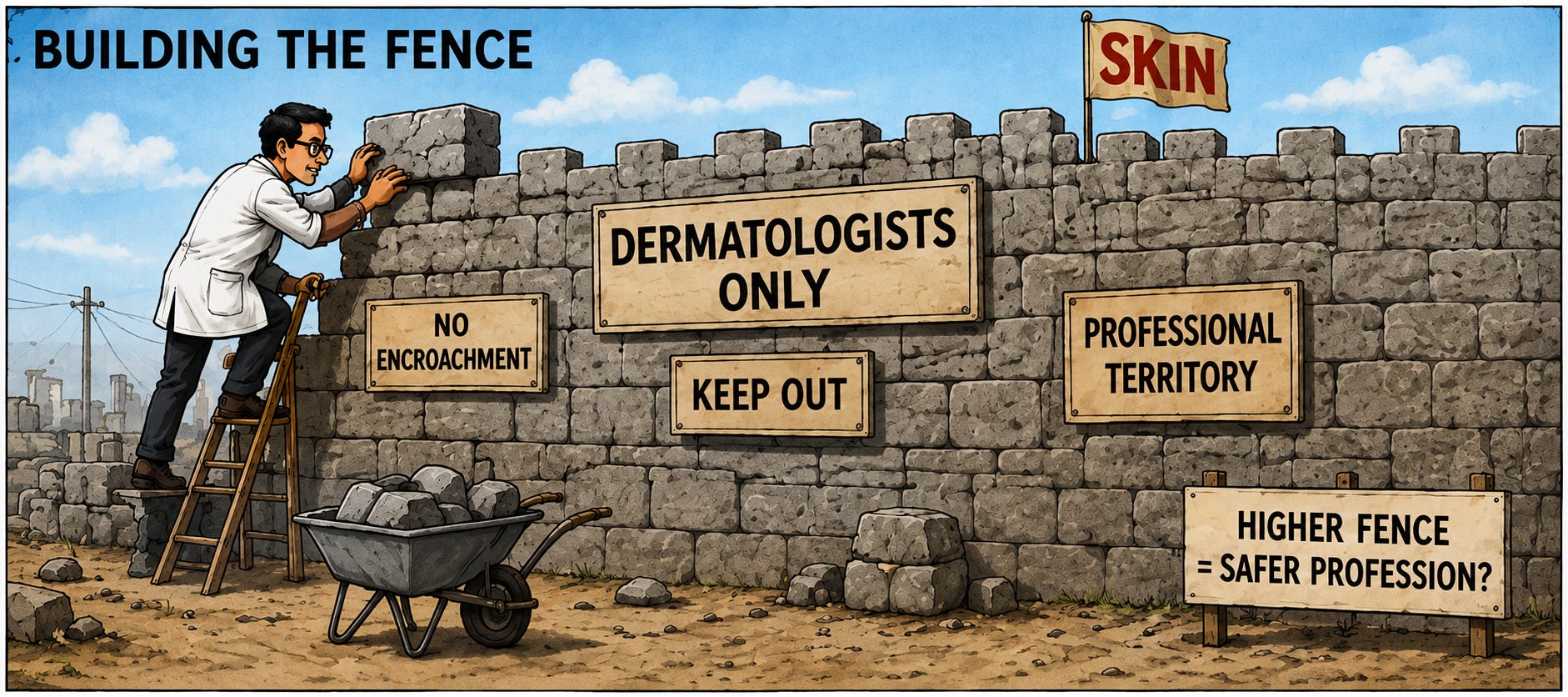
Perhaps the more useful distinction is not cosmetic versus medical, but surface care versus intervention in living tissue. Applying makeup is cosmetic. Performing a facial is cosmetology. Injecting filler beside a major blood vessel is something else. Such interventions require appropriate diagnosis, anatomy, patient selection and the ability to recognise and manage complications. That is considerably more persuasive than: “Skin belongs to dermatologists.” Skin, inconveniently, has never signed an exclusivity agreement with us.
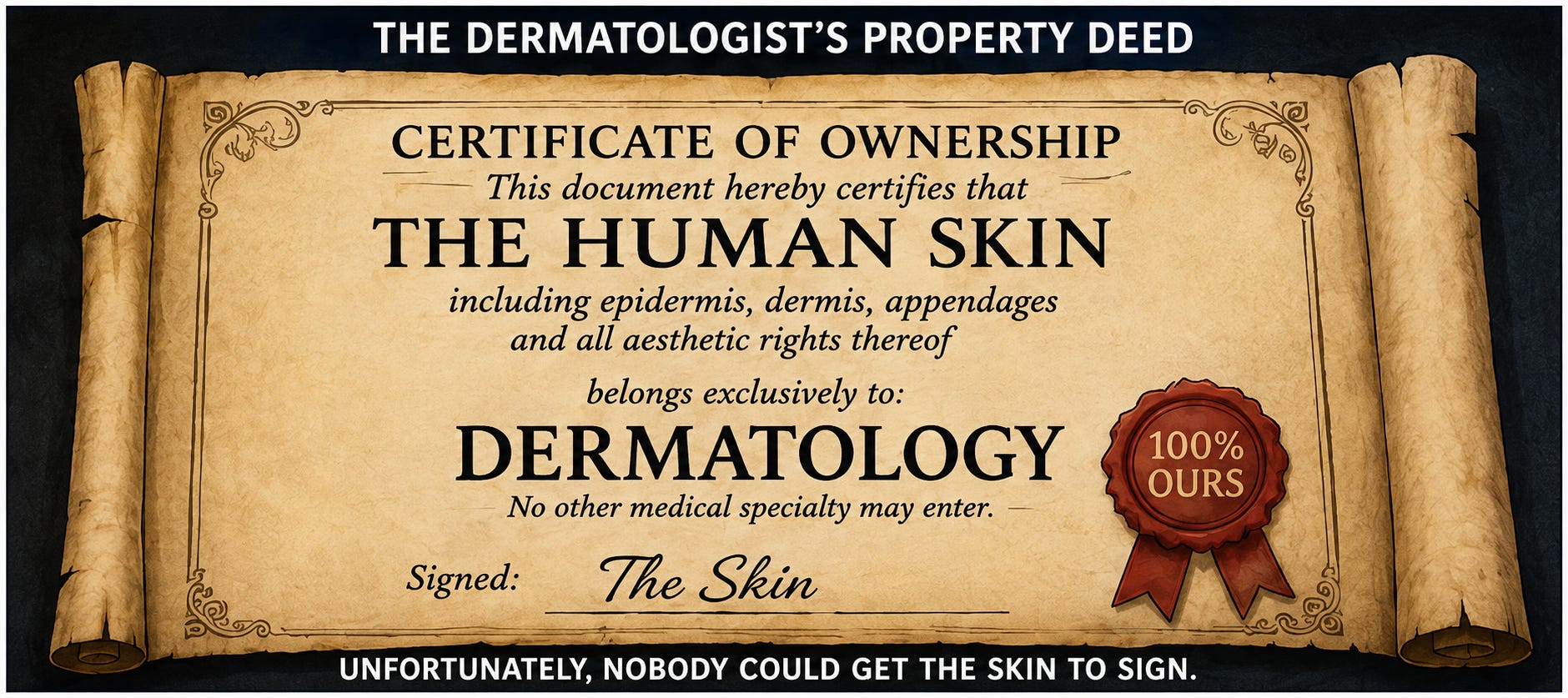
Someone falsely presenting themselves as a dermatologist is a problem. Someone injecting fillers without understanding vascular anatomy is a problem. Someone operating a laser without being able to recognise the disease being treated is a problem. Someone unable to manage the complication they create is a problem. Credentials are important evidence of specialised training. They are not a claim of ownership over human tissue.
The original anti-quackery argument in dermatology was powerful precisely because the patient harm was obvious. Patients with tinea, acne and other common disorders were repeatedly given inappropriate steroid-containing combination creams. We saw tinea incognito, steroid-damaged skin, worsening acne and delayed diagnosis. That was clearly patient protection.
The logic becomes less straightforward when the same language of quackery is applied to aesthetic practice primarily on the basis of who is doing it, rather than their competence, supervision, transparency and the actual risk of the intervention.
The Awkward Delegation Problem
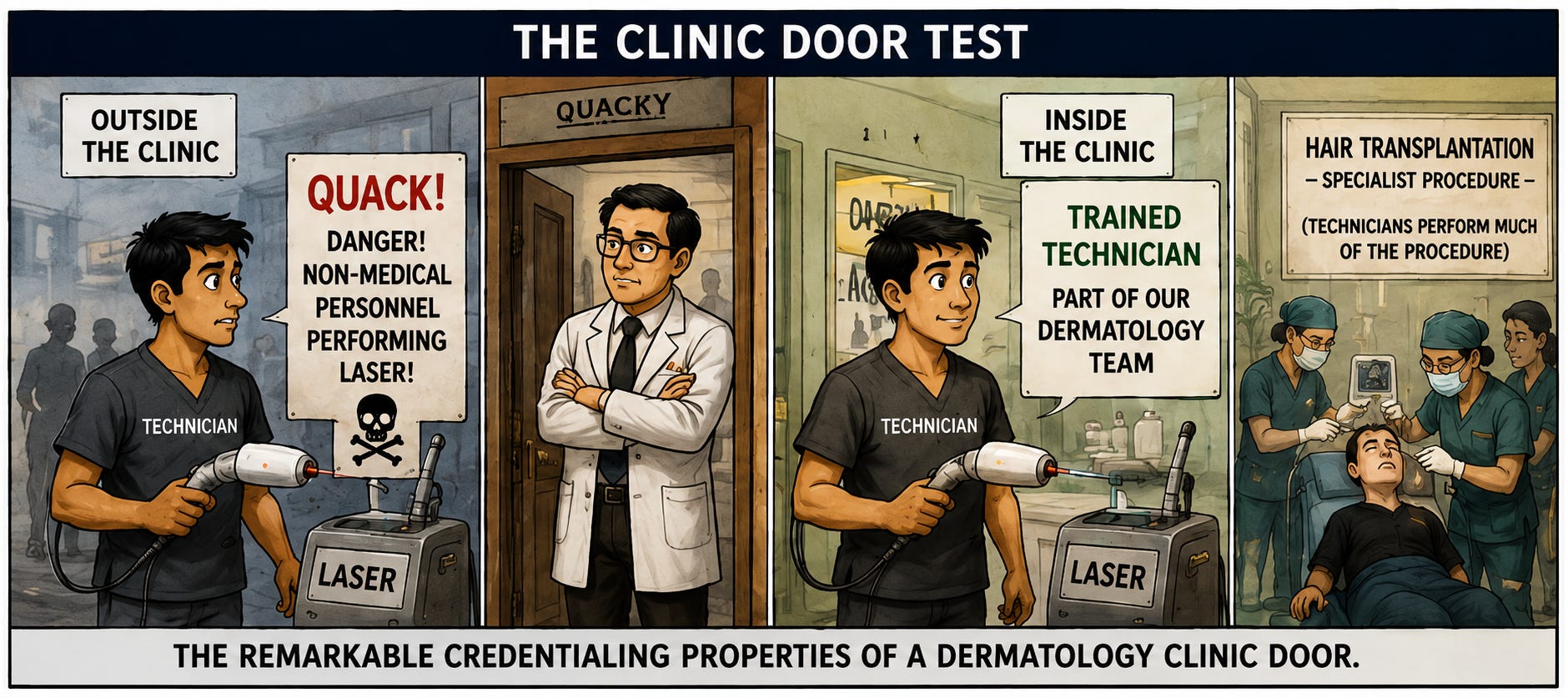
Consider a familiar scenario. A patient attends a dermatology clinic for a laser procedure. The dermatologist assesses the patient and prescribes the treatment, but a technician or therapist performs much—or sometimes all—of the procedure. Hair transplantation makes the contradiction even clearer. Patient selection, donor assessment, hairline design and complication management are presented as requiring specialist expertise. Yet in some centres, technicians perform much of the extraction, graft handling and implantation—sometimes accounting for most of the actual operative time.
The profession may simultaneously warn patients against lasers or hair transplantation performed by non-medical personnel. There is an obvious tension here. Delegation itself is not the problem. Properly trained personnel can perform defined technical tasks under genuine medical supervision. But if we argue that these procedures require specialist judgment, then specialist involvement must be meaningful at the points where that judgment matters.
Otherwise, something rather magical happens…..The technician performing the procedure outside our clinic is a quack. The same technician performing it inside our clinic is part of the dermatology team.
Apparently competence can occasionally be acquired by walking through the correct clinic door.
There may, of course, be a legitimate distinction: proper diagnosis, physician-directed planning, defined protocols, genuine supervision and immediate complication management. If so, those are the distinctions we should defend.
But if technicians are trained within specialist clinics to perform most of a procedure and later reproduce those same skills independently, we should perhaps acknowledge another irony: our own clinics may sometimes become the training grounds for the technician-led practice we subsequently condemn as quackery.
The logical problem is difficult to escape. If these procedural steps inherently require specialist expertise, routinely delegating them is hard to defend. If they can safely be delegated after appropriate training and supervision, then the argument against similar practice elsewhere cannot rest simply on professional title.
And the patient should know who is actually performing the procedure. “You will be treated by our trained technician under my supervision” is transparent. Allowing a patient to assume that the dermatologist will perform the laser—or most of the hair transplant—when that is not what happens is rather less so. A profession demanding competence, supervision and transparency from others should probably apply the same standards to itself.
Patient Safety or Professional Territory?
Three things often get bundled together in the anti-quackery debate: patient safety, professional standards and professional territory. The first two are unquestionably legitimate. The third is understandable too. Dermatologists train for years, and aesthetic practice has become an important part of the specialty. But professional self-interest does not invalidate a patient-safety argument. It simply means we should acknowledge that patient safety and professional interest can sometimes point in the same direction. That makes consistency especially important.
I was struck by this recently at an endocrinology meeting where general practitioners and doctors from other specialties were openly encouraged to learn. Nobody seemed particularly worried that someone might hear a thyroid lecture on Saturday and open an endocrine centre on Monday.
Dermatology sometimes appears more anxious about non-dermatologists simply learning dermatology. Yet much of common dermatology can obviously be learnt by non-specialists. That does not make dermatologists redundant. Specialist expertise becomes more valuable precisely when diagnosis is difficult, disease is severe, treatment is complex, or the consequences of error are greater. Medicine is not a collection of sovereign states separated by barbed-wire fencing.
I Have Tried Publishing This Before
I should disclose that versions of this argument have already had a small tour of Indian dermatology journals. None accepted them. Perhaps the manuscripts simply were not good enough. That remains entirely possible.
But I suspect the argument also creates discomfort because questioning whether anti-quackery advocacy sometimes overlaps with professional protectionism can sound suspiciously like being anti-dermatology. It isn’t.
Criticism of one’s own profession is not hostility towards it. A specialty confident in the strength of its expertise should be able to examine the places where its public arguments and its private practices do not quite match. We are, after all, enthusiastic advocates of critical appraisal, usually of other people’s papers.
The Best Defence of Dermatology
Perhaps we have been using the wrong argument.
“Only dermatologists should do this because dermatologists own skin” is unlikely to remain persuasive indefinitely
.
A much stronger position is:
Procedures carrying meaningful risk should be performed within a system that ensures appropriate knowledge, training, supervision, transparency and the ability to manage complications.
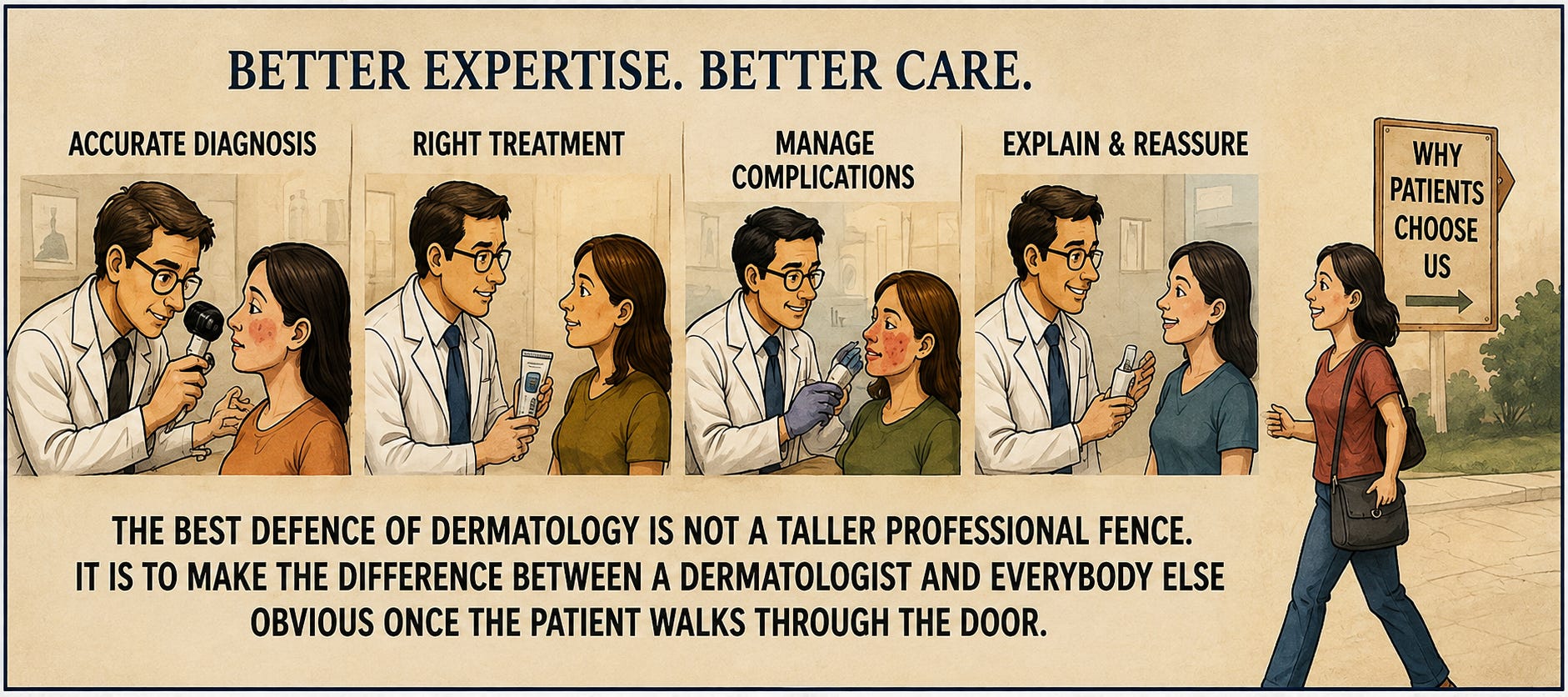
That argument is harder to dismiss because it is about competence rather than territory. It also places obligations on us. If we delegate procedures, patients should know. If we insist specialist judgment is essential, specialist involvement should be genuine. If we criticise inadequate supervision outside dermatology clinics, we should not practise it inside them. And if specialist training really produces better care, that difference should be visible.
Diagnose better. Choose treatments better. Recognise when not to treat. Understand complications. Manage them properly. Remain evidence-based while the surrounding market sells glow, detoxification and the occasional miracle serum.
Perhaps the real irony of the anti-quackery crusade is this: The more energy we spend telling patients whom not to visit, the less attention we may pay to demonstrating why they should visit us.
Reference
Verma SB, Draelos ZD. Cosmetic dermatology versus cosmetology: A misnomer in need of urgent correction. Indian J Dermatol Venereol Leprol. 2008;74:92–93. doi:10.4103/0378-6323.39687.
Postscript
One point that emerged from the WhatsApp discussion is worth adding: proportionality.
From a broader patient-safety perspective, the consequences of poorly managed diabetes, cardiac disease or renal disease are potentially far more serious than most examples of inappropriate aesthetic or dermatological practice. That does not make unsafe aesthetic practice acceptable, but it does put the scale of the problem in perspective.
There is also a larger Indian reality. Ayurveda and homeopathy have been formally legitimised within our healthcare system and are used, and at times promoted, even for serious medical illnesses despite major limitations in their evidence base. In that sense, quackery is not a dermatology-specific problem; it is embedded within the wider socioeconomic and healthcare ecosystem.
So perhaps the uncomfortable reality is that quackery, in one form or another, is here to stay. The more useful response may be to keep raising our own standards—remaining evidence-based, well trained and clinically better—rather than imagining that every form of questionable practice around us can realistically be eliminated.