

Certain contextual details have been withheld or generalised to protect the survivor’s identity.
Some consultations stay with you long after the prescription is forgotten.
Several years ago, a child was brought to me with a persistent skin problem. On examination, I found multiple warts around the anus — perianal condylomata acuminata, or genital warts.
The diagnosis itself was easy.
The important question was not:
What are these lesions?
It was:
Why does this child have them?
That question changed everything.

Genital warts in a child are different
Genital warts are caused by human papillomavirus (HPV).
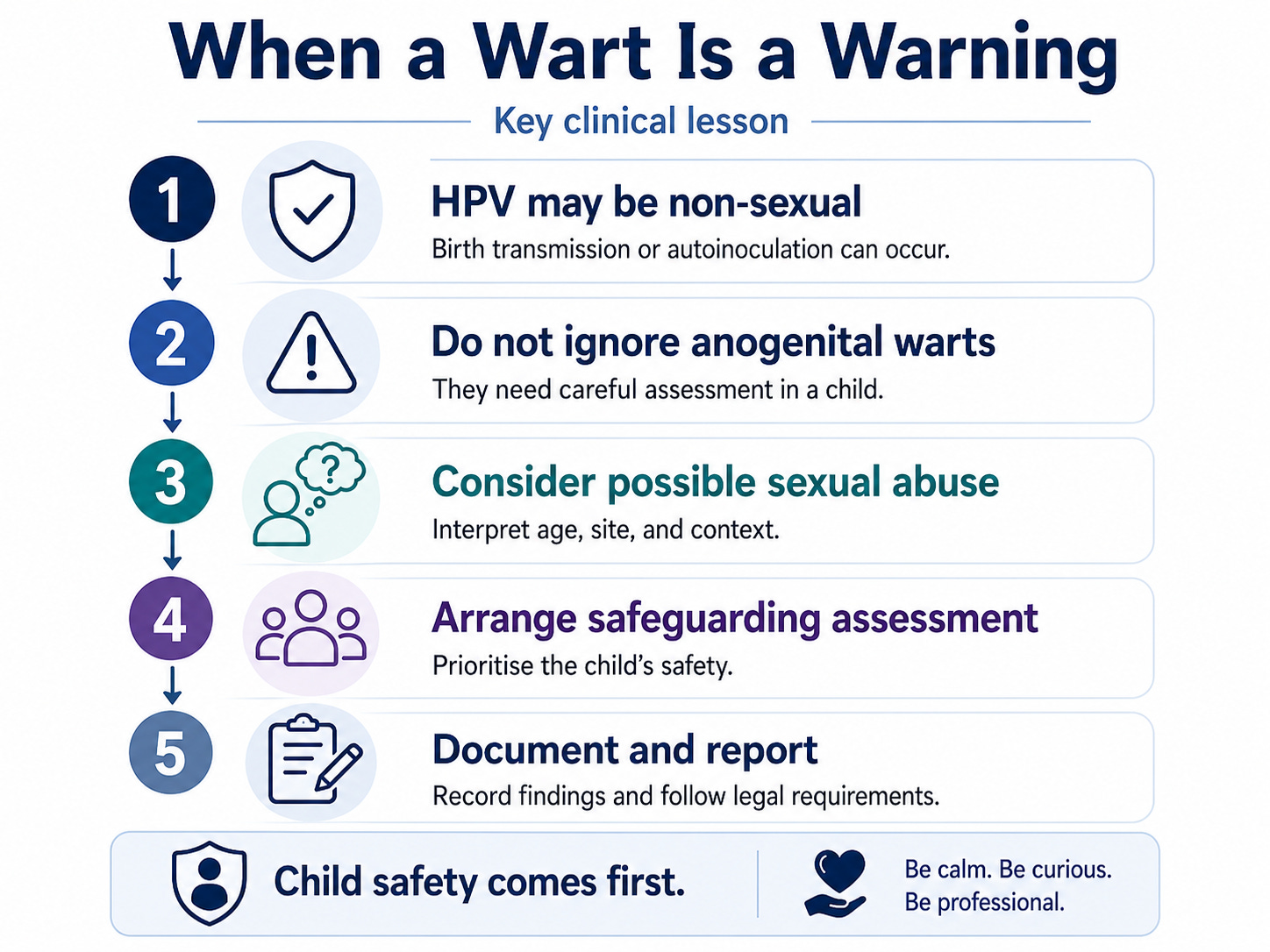
In adults, HPV is usually sexually transmitted. In children, the situation is more complicated. HPV may occasionally be acquired during birth, transferred from warts elsewhere on the child’s body, or transmitted by other non-sexual routes.
So genital warts in a child do not prove sexual abuse.
But neither can they simply be treated as “just warts.”
International guidance regards anogenital warts in a child as a finding that should raise the possibility of sexual abuse and prompt appropriate assessment. Age matters too: warts appearing for the first time in an older child are more concerning for sexual transmission, although there is no magic age at which the diagnosis suddenly becomes certain.
In this child, the age, location and circumstances concerned me enough to tell the parents that sexual contact had to be considered.
They spoke to their child.
The child disclosed abuse by an adult in a position of trust.
The matter was reported and entered the criminal justice system.
Much later, I was called to court to explain what I had seen and why those findings had raised concern.
What if I had simply treated the warts?
That is the question I still remember.
Imagine the consultation ending like this:
Perianal warts. Diagnosis made. Treatment prescribed. Next patient.
Dermatologically, that diagnosis would have been perfectly correct.
Clinically, it could have been a serious failure.
If the significance of those lesions had been overlooked, recognition of the abuse might have been delayed and the child potentially exposed to further harm.
That is an important distinction in medicine.
Sometimes naming the disease is only half the diagnosis.
Why can experienced doctors miss something this important?
The child had received medical attention before reaching me.
Knowing what happened afterwards, it is tempting to wonder how such an important clue could have been missed.
But that is hindsight bias.
The lesions may have been less obvious earlier. The clinical picture may have evolved. The child may have said nothing. The parents may have had absolutely no reason to suspect abuse.
And even experienced clinicians can miss a diagnosis when the possibility itself has not entered their mental frame.
There is another bias worth recognising.
Most of us carry an unconscious picture of where child sexual abuse happens.
A troubled household perhaps. An obviously vulnerable child. An unsafe environment.
But abuse does not respect those boundaries.
A child may come from an educated, caring family. Attend a respected school. Appear well looked after. Have attentive parents.
None of that protects a child from abuse.
And it should not lower a doctor’s index of suspicion when the clinical findings suggest otherwise.
The lesson is therefore not that somebody else missed something that I recognised.
The lesson is that any of us can miss it if we never consider it.
Suspicion is not proof — but it requires action
This distinction is crucial.
A doctor should never conclude that a child has been sexually abused merely because anogenital warts are present. Such an accusation, made without proper assessment, could itself cause enormous harm.
But uncertainty cannot become an excuse to do nothing.
The doctor’s role is not to interrogate the child or conduct a criminal investigation.
It is to recognise the possibility, document the findings objectively, avoid suggestive questioning, arrange appropriate safeguarding assessment and fulfil the legal reporting requirements.
In India, Section 19 of the Protection of Children from Sexual Offences Act (POCSO) creates a duty to report suspected sexual offences against children.
And sometimes the responsibility does not end when the child leaves the consulting room.
When I was later summoned to court, I went and explained the medical findings and why they had concerned me.
That was simply part of the responsibility that followed from recognising the warning sign.
Sometimes the skin speaks first
Children being sexually abused do not always disclose it spontaneously.
They may be frightened.
Threatened.
Confused.
Or simply too young to understand what is happening to them.
Sometimes the first clue is therefore not a disclosure.
It may be pain.
Discharge.
An injury.
A sexually transmitted infection.
Or, as in this case, a few warts around the anus.
That is why safeguarding is not solely the responsibility of paediatricians, forensic doctors or the police.
Sometimes the first clue appears in a dermatology clinic.
I have treated thousands of warts during my career.
I remember very few of them.
I remember this child.
Not because recognising the wart was difficult.
Because recognising what the wart might mean mattered far more.
And that consultation left me with a question that applies well beyond dermatology:
Once you know what something is, don’t stop thinking.
Sometimes the more important question is:
Why is it here?