

The Article in 30 Seconds
The Hype: Early industry research explored tapinarof replacing corticosteroids as first-line psoriasis treatment. Subsequent expert opinion supports its use as an initial option.
The Evidence: Tapinarof convincingly outperforms vehicle and shows promising treatment-free outcomes. Indirect comparisons favour it over calcipotriol but report more adverse events. Superiority over established steroid-based treatments remains unproven.
My Verdict: A valuable steroid-free treatment for selected patients. But a reasonable initial option is not necessarily the preferred treatment. Advisory boards should make that distinction explicit and document their conclusions.
Disclosure: I received an honorarium for participating in an industry-sponsored advisory-board discussion concerning tapinarof. The sponsor is not identified here. This commentary is based on publicly available evidence.
It works. But better than what?
When a new psoriasis cream arrives, the important question is rarely whether it works. Regulatory approval has usually addressed that. The more interesting question is whether it deserves to replace what we already prescribe.
For a patient requiring repeated treatment at sensitive sites, particularly after steroid-related adverse effects or intolerance to established alternatives, tapinarof may be a reasonable steroid-sparing option.
But is it better than existing steroid-free options including Tacrolimus/ Pimecrolimus or Calcipotriol?
Is the Evidence worth the hype?
The pivotal PSOARING 1 and 2 trials established convincing efficacy: 35.4% and 40.2% achieved treatment success at 12 weeks versus 6.0% and 6.3% with vehicle.
Importantly, direct comparative evidence does exist. A 2020 Phase III trial involving 686 patients found that benvitimod (the same active molecule as tapinarof) outperformed calcipotriol in PASI75 response (50.4% vs 38.5%), but caused more adverse events (57.3% vs 36.1%). However, the US Veterans Affairs review graded this evidence as very low certainty, partly because of methodological limitations and differences from the marketed tapinarof formulation.
A subsequent network meta-analysis also favoured tapinarof over calcipotriol, with more adverse events. Despite these limitations, an expert letter advocated earlier nonsteroidal treatment, while a 2026 consensus endorsed initial tapinarof use. Both carried disclosed industry relationships, including with Dermavant or Organon..
On the evidence-based medicine hierarchy, tapinarof has Level I evidence for efficacy against vehicle, while comparative superiority rests on very-low-certainty direct evidence and indirect analyses.
Expert consensus cannot elevate the certainty of that evidence. Tapinarof’s efficacy is established; its routine preference over existing first-line therapies is not.
Steroid-free does not mean risk-free
India has a genuine topical corticosteroid-misuse problem. Yet inappropriate use of potent steroids should not be confused with supervised treatment.
A systematic review by Castela and colleagues examined 22 randomised corticosteroid trials in adult plaque psoriasis. Thirteen assessed skin atrophy, reporting clinically assessed rates of 0–5%. The authors acknowledged limitations in long-term safety evidence.
Tapinarof has different adverse effects. The pooled pivotal trials reported folliculitis in 20% versus 1% with vehicle and contact dermatitis in 7% versus 1%. Most events were mild or moderate, and discontinuation attributable to these reactions was relatively uncommon.
The Indian question: Is it worth the cost?
Tapinarof has entered the Indian market, with Eris Lifesciences announcing PSORITUF in October 2026.
An Indian study involving 213 patients has also been reported by Optimus Pharma, demonstrating superiority over vehicle. Detailed peer-reviewed results remain necessary for independent appraisal. Importantly, this study does not establish superiority over existing topical treatments.
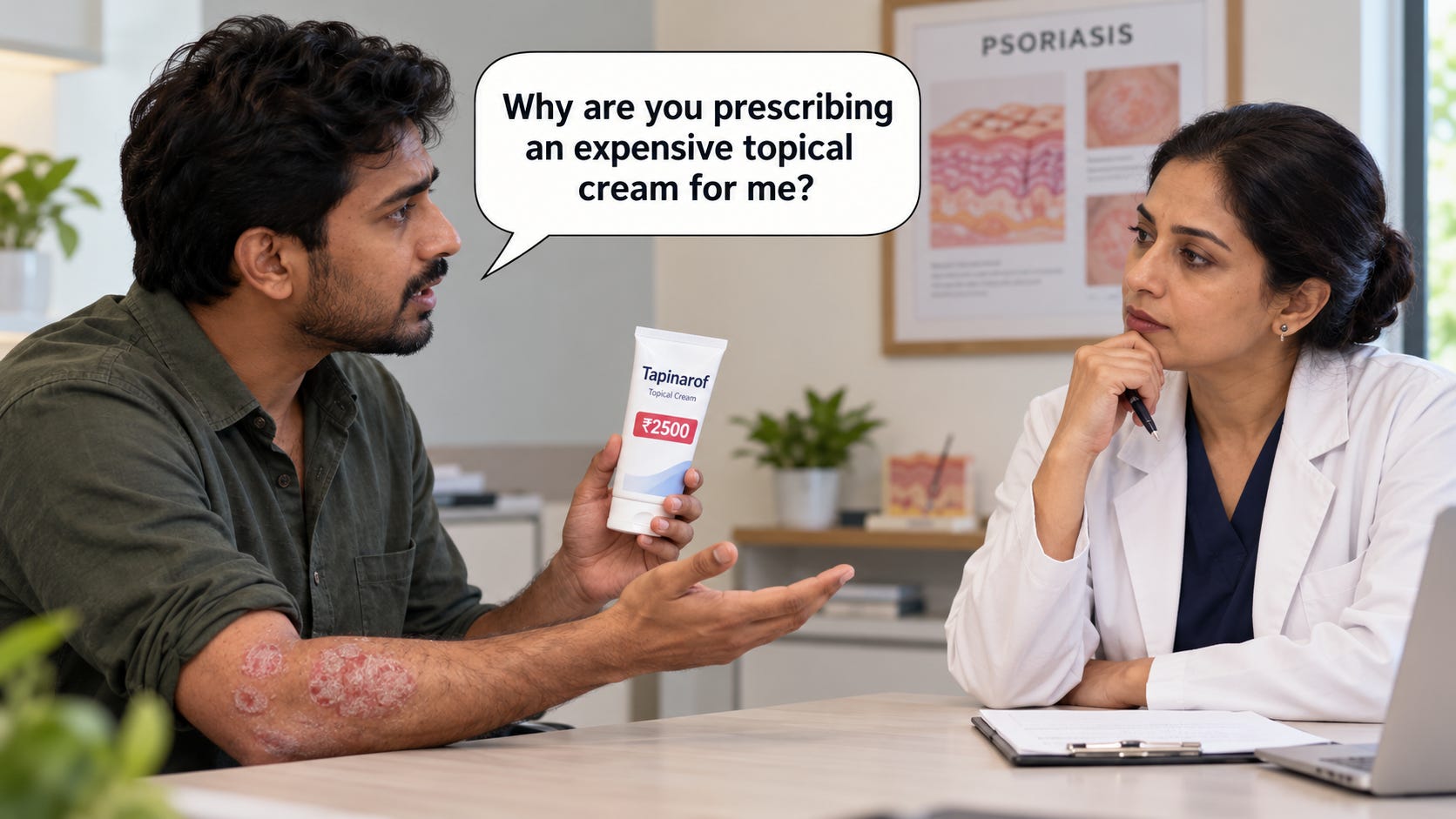
Pricing makes that distinction particularly relevant. A distributor catalogue lists PSORITUF at ₹950 for 20 g and ₹2,500 for 60 g, approximately ₹42–48 per gram. For comparison, calcipotriol 0.005% ointment (Calpsor), an established nonsteroidal treatment for psoriasis, has a listed MRP of approximately ₹24/g—roughly half that of tapinarof. Tacrolimus 0.1%, another steroid-free option used off-label for facial and flexural psoriasis, is also available at substantially lower prices from some manufacturers.
For Indian patients paying out of pocket, the relevant question is the total expenditure required to achieve and maintain satisfactory disease control. Without comparative efficacy, treatment-duration and relapse data, that value remains uncertain.
Tapinarof is a useful addition to our therapeutic options. But being a reasonable initial treatment does not establish that it should be preferred over existing alternatives.
Pharmaceutical advisory boards have a responsibility to examine this distinction critically rather than simply endorse a proposed clinical position.
What is tapinarof better than?
for whom?, and
At what additional cost?
References and Further Reading
Clinical evidence
Lebwohl MG, et al. Phase 3 trials of tapinarof cream for plaque psoriasis. N Engl J Med. 2021;385:2219–2229. DOI.
Strober B, et al. One-year safety and efficacy of tapinarof cream for the treatment of plaque psoriasis: PSOARING 3. J Am Acad Dermatol. 2022;87:800–806. DOI.
Yan J, Chen S, Shi J. 1% Tapinarof cream for the treatment of psoriasis: A network meta-analysis. Arch Dermatol Res. 2024;316:31. DOI.
Castela E, et al. Topical corticosteroids in plaque psoriasis: A systematic review of adrenal axis suppression and skin atrophy. J Eur Acad Dermatol Venereol. 2012;26(Suppl 3):47–51. DOI.
Engel PV, Smith B, Javadi SS, Wu JJ. It is time to consider a new topical algorithm for psoriasis. J Am Acad Dermatol. 2024;90–e85. DOI.
DeBusk L, et al. The role of aryl hydrocarbon receptor agonists in the management of inflammatory skin diseases: An expert consensus panel. Dermatol Online J. 2026;32(3). DOI. Author disclosures.
Cai L, et al. A double-blind, randomized, placebo- and positive-controlled phase III trial of 1% benvitimod cream in mild-to-moderate plaque psoriasis. Chinese Medical Journal. 2020;133(24):2905–2909. DOI.
Regulatory, industry and policy sources
US FDA. VTAMA (tapinarof) cream: Prescribing Information. Revised May 2025. DailyMed.
Roivant Sciences. R&D Day Investor Presentation, 28 September 2021, slide 88. SEC filing.
Organon. Organon Completes Acquisition of Dermavant. 28 October 2024. Company announcement.
Express Pharma. Optimus Pharma gets DCGI permission for Tapinarof Cream 1% w/w. August 2026. Industry report.
Medical Dialogues Brand Connect. Eris Lifesciences launches PSORITUF. 27 October 2026. Sponsored announcement.
Department of Pharmaceuticals, Government of India. Uniform Code for Pharmaceutical Marketing Practices 2024. Official document.
Indian pricing — non-peer-reviewed commercial listings, 28 October 2026
Meher Lifecare. PSORITUF 20 g and 60 g. Distributor MRP catalogue.
Tata 1mg. Daivobet ointment, 15 g. Retail MRP listing.
Tata 1mg. Soria D ointment, 20 g. Retail MRP listing.