

A few days ago, I saw a young girl who had travelled from a distant village for treatment of white patches on her leg.
She had segmental vitiligo.
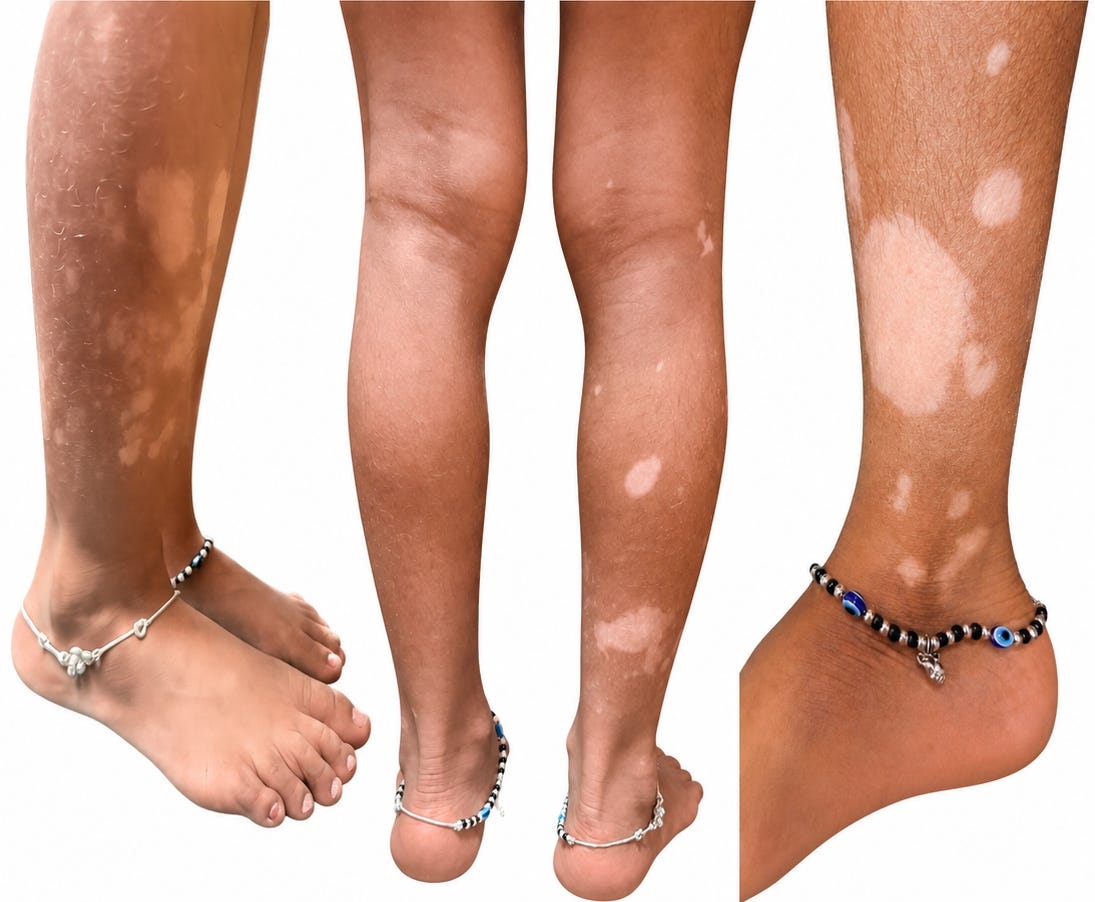
The clinical picture was not obscure: active, visible segmental vitiligo in a child.
The diagnosis was not difficult. This was not a rare dermatological puzzle. It was not an obscure syndrome requiring a specialist panel. It was a clinically obvious case of vitiligo — active, visible, stigmatising, and treatable.
What disturbed me was not the disease. It was what had happened before she reached me.
She had first gone to one of the largest regional teaching hospitals in Andhra Pradesh, situated only a few hundred metres from my clinic. It is also the hospital where I trained as an MBBS student.
I name the hospital not to shame individual doctors, but because I know the institution, its role, and its importance to this region. A hospital of that scale must be discussed honestly when patients are failed by systemic gaps rather than individual negligence.
At her first visit, she appears to have been diagnosed as having post-inflammatory hypopigmentation.
That distinction matters. Post-inflammatory hypopigmentation is often a residual change after inflammation. Vitiligo, particularly when active, is a progressive depigmenting disorder that requires counselling, monitoring, and treatment. Calling progressive vitiligo “post-inflammatory hypopigmentation” is not a harmless semantic error. It changes what the family understands, what the doctor does, and how urgently the disease is taken. She was sent home with a simple moisturiser!

When the disease progressed, she returned. This time, the diagnosis appears to have been corrected to vitiligo.
But the treatment given was essentially irrelevant: vitamin C.
Vitamin C is not a meaningful treatment for progressive segmental vitiligo. At best, it can be loosely defended as an antioxidant supplement. But to send away a child with active vitiligo with vitamin C as the practical therapeutic response is not treatment. It is a token gesture.

In India, visible vitiligo in a child is not merely a pigmentary disorder; it often becomes a source of social anxiety for the entire family.
And that is where the real issue begins.
This is not a story about one careless postgraduate. That would be too easy, and probably unfair. It is a story of what happens when doctors are expected to practise medicine inside a system that denies them the tools to practise it properly.
If a dermatology department does not have basic medicines for vitiligo — appropriate topical corticosteroids, topical calcineurin inhibitors such as tacrolimus, access to phototherapy, or at least clear protocols for practical alternatives — then what exactly is the doctor expected to do?
And if government policy prevents doctors from prescribing medicines from outside pharmacies when those medicines are not available in-house, then the problem is no longer just clinical. It becomes administrative harm.
A poor patient is not helped by receiving a free but useless prescription.
A child with vitiligo is not helped by being given vitamin C because the appropriate medicines are unavailable.
A family that has travelled from a village is not protected by being denied the option of buying an evidence-based topical medicine outside.
This is the cruelty of a policy that may look equitable on paper but becomes harmful in practice. “Prescribe only what is available in the hospital” sounds like a safeguard against exploitation. But when the hospital does not stock what is needed, the same rule becomes a barrier to care.
Either the government must ensure that essential dermatology medicines are available in public hospitals, or it must allow doctors to prescribe evidence-based medicines from outside pharmacies when the hospital cannot supply them.
The present middle path — diagnose the disease, fail to provide the treatment, and send the patient away with something symbolic — is indefensible.
Vitiligo is not a cosmetic inconvenience
Vitiligo is often dismissed because it does not cause fever, pain, ulceration, or death. But that is a narrow way to understand disease.
In India, vitiligo carries deep stigma. A child with visible vitiligo may be mocked, hidden, pitied, taken to faith healers, or quietly marked by her family as someone whose future has been damaged.
Every dermatologist practising in India knows this.
Parents do not see vitiligo as “just a white patch”. They see marriage anxiety, social shame, school ridicule, and a future they fear they cannot control.
That is why early, sensible treatment matters.
This child did not need an expensive biological drug. She did not need a rare imported medicine. She needed basic dermatological care.
She needed the system to work.
A teaching hospital must teach treatment, not just diagnosis
There is another uncomfortable issue here.
King George Hospital is not merely a service hospital. It is a teaching hospital. Dermatology postgraduates train there. Every year, young doctors pass through the department and go on to practise as specialists.
So the question is unavoidable.
If postgraduates are trained in an environment where basic treatments are unavailable, what exactly are they learning?
Are they learning how to manage vitiligo, or merely how to identify it for examinations?
Are they learning evidence-based dermatology, or how to adjust prescriptions to pharmacy shortages?
Are they learning clinical medicine, or bureaucratic survival?
Dermatology cannot be learnt from theory alone. A trainee must see disease, diagnose it, treat it, follow it up, modify treatment, counsel families, and understand what happens when care is delayed or inadequate.
A postgraduate who has read about tacrolimus but never used it meaningfully is not fully trained. A postgraduate who knows the indication for phototherapy but has no practical access to it is not fully trained. A postgraduate who sees common diseases every day but cannot treat them properly is not being trained in real-world medicine.
This connects to a broader concern I have written about before: that we continue to confuse certification with competence. Medical education does not become functional merely because colleges exist, seats are filled, exams are conducted, and degrees are awarded. Competence requires functioning clinical systems. (Read: We Are Lying to Ourselves About Medical Education)
A broken hospital does not merely fail today’s patients.
It trains tomorrow’s doctors badly.
I have seen this pattern before
This episode took me back more than two decades. As a medical intern in 2001, I saw how public health facilities could exist in name but fail in function — the building was there, the designation was there, the system existed on paper, but the ability to deliver meaningful care was compromised. I was angry enough then to complain directly to Chief Minister N. Chandrababu Naidu about the lack of basic facilities. (Read: My Experience as a Medical Intern in 2001)
The details are different now. The disease is different. The patient is different. The hospital is bigger.
But the underlying problem is painfully familiar.
We build systems that look functional from the outside. There is a building. There is a department. There is a registration slip. There is a queue. There is a prescription. There are postgraduates. There are professors. There are statistics.
But when a real patient arrives with a real disease, the only question that matters is simple: Can the system actually treat her?
If the answer is no, then the rest is decoration.
This is how quackery wins
Doctors often complain that patients go to homeopaths, faith healers, beauticians, influencers, and self-proclaimed skin experts.
We are right to complain.
But we must also be honest.
When a poor family travels to a major government hospital and receives either the wrong diagnosis or a meaningless prescription, what do we expect them to do next?
They will go to whoever listens.
They will go to whoever explains confidently.
They will go to whoever offers hope.
And if that person is a quack, the family may not know the difference. From the patient’s point of view, the formal medical system has already failed.
This is part of the broader credibility crisis I have written about before in dermatology — where unethical promotion, influencer medicine, and commercialised pseudo-expertise thrive because legitimate medical systems often fail to communicate clearly, treat properly, or remain accessible. (Read: Paid to Promote: Why Dermatology Needs Better Ethical Boundaries)
Quackery does not flourish only because patients are ignorant.
It flourishes because scientific medicine sometimes makes itself unavailable.
A child with vitiligo should not have to choose between a government hospital that gives her vitamin C and a quack who gives her false confidence.
Do not blame the junior doctor alone
It is tempting to blame the postgraduate who first saw the child.
But that would be incomplete.
Young doctors in government hospitals often work in extremely difficult conditions. They face overcrowded OPDs, limited drug availability, inconsistent supervision, administrative pressure, and rules that may prevent them from prescribing what they know is needed.
Many are sincere. Many are overworked. Many are trying to do their best inside a compromised system.
So this is not a call to punish a junior doctor.
It is a call to stop creating conditions in which junior doctors are forced to practise compromised medicine.
A doctor who knows the correct treatment but is not allowed to prescribe it is not practising medicine freely. He or she is participating in rationed helplessness.
That should trouble us.
What must change
This does not require new science. It requires administrative honesty.
First, government teaching hospitals must maintain a realistic essential dermatology formulary. For common outpatient diseases, this should include rational topical corticosteroids, topical calcineurin inhibitors, antifungals, scabicides, keratolytics, emollients, and other basic drugs required for everyday dermatological practice.
Second, when an evidence-based medicine is not available in-house, doctors must be allowed to prescribe it from outside pharmacies, with clear documentation that the hospital could not provide it.
Third, postgraduate training must be judged by actual treatment exposure, not just case numbers and theory. A trainee should not merely know what the textbook says about vitiligo. They should know how to treat it, monitor it, counsel families, and recognise when early intervention matters.
Fourth, public hospitals should not be judged only by patient footfall. Seeing hundreds of patients a day is not an achievement if common diseases are not treated properly.
To the Government of Andhra Pradesh, the Department of Health, and the administrators responsible for public medical colleges: please do not make government doctors choose between obeying pharmacy restrictions and practising evidence-based medicine.
Please do not make poor patients pay the price for administrative rigidity.
If medicines are unavailable, fund them. If funding is limited, prioritise essential medicines. If a required medicine is unavailable in-house, allow external prescriptions. If a department is training specialists, make sure those specialists are trained in real treatment, not just theoretical diagnosis.
Throughput is not healthcare.
A prescription is not treatment.
A department is not functional merely because it exists.
This is not about one child.
It is about what that child reveals.
She did not need a miracle. She needed a hospital that could write a real prescription.
And when our institutions cannot do that, they do not merely fail one patient.
They hand her — trust intact, hope exhausted — to whoever promises that they can.
About the author
Dr. Sasi Kiran Attili is a Consultant Dermatologist and Dermatopathologist based in Visakhapatnam. He trained in dermatology in the United Kingdom and is MRCP-qualified, with international board certification in dermatopathology. He runs the Visakha Institute of Skin & Allergy and writes on dermatology, dermatopathology, medical education, public healthcare, and ethical medical practice.
His writing often focuses on the gap between what healthcare systems claim to provide and what patients actually receive.