

Myths and Questions This Article Answers
Role of serum IgE testing in the diagnosis and management of a patient with atopy/ urticaria/ skin rash.
Role of specific IgE (RAST) tests in the diagnosis and management of a patient with atopy/ urticaria/ skin rash.
How accurately does skin-prick testing predict true food allergy?
The patient has high specific IgE levels to pollen and house-dust-mite! What next?

One of the most common investigations requested in patients with eczema, urticaria and suspected allergy is an total serum IgE, followed increasingly by large panels of allergen-specific IgE tests or skin-prick testing. The logic seems simple: Type I allergy is driven by IgE, so check the IgE. If it is high, test for specific foods or airborne allergens to find out what the patient is allergic to and then avoid or treat the cause.
The problem is that this approach often creates more confusion than clarity. A high total IgE does not prove that the patient’s symptoms are due to allergy, and a positive specific IgE test does not necessarily mean that allergen is actually causing the problem. Let us look into this in a bit more detail….
Sensitisation and clinical allergy are not the same
A person may have IgE antibodies against an allergen, such as pollen, but have no symptoms at all when exposed to it. In that situation, the person is sensitised to pollen, but is not clinically allergic to it. The positive test is simply showing that the immune system recognises pollen; it does not prove that pollen is causing disease.
Clinical allergy means that exposure to that allergen actually produces symptoms, for example repeated sneezing, nasal blockage and watering of the eyes after pollen exposure.
The reverse is also important. A low or even negative blood specific-IgE result does not always exclude a clinically relevant reaction. Blood tests are not perfectly sensitive, and in some conditions the allergic response may occur mainly within the affected tissue rather than being clearly detectable in the blood. In addition, not every reaction that patients call an “allergy” is driven by IgE at all.
The key question is therefore not simply, “Is the test positive?” but “Does exposure to this allergen actually reproduce the patient’s symptoms?”
The Total IgE Trap
A patient with atopic dermatitis gets a total IgE test. The result is 800, 2,000 or even several thousand IU/mL. The next question is almost inevitable:
“Doctor, how do I bring my IgE down?”
The patient may subsequently improve considerably, but the IgE remains high. Another test is done. It is still abnormal. Soon, the patient (and sometimes the doctor too) starts chasing the IgE number rather than the eczema.
Total IgE is frequently elevated in atopic dermatitis, but it is not a reliable measure of disease activity in an individual patient. Population studies may show associations between higher IgE and more severe atopic disease, but the relationship is inconsistent. Severe eczema can occur with normal IgE, while someone with very high IgE may have little active disease.[1,2]
For this reason, I hardly ever request total IgE simply to diagnose or monitor atopic dermatitis. I believe in treating the patient, rather than a lab number (IgE).
Then Comes the “Allergy Panel”
Once a high IgE is discovered, the next temptation is to test against everything available: milk, egg, wheat, nuts, prawns, dust mite, pollen, fungi, pets and numerous other allergens. Several may come back positive. The patient then receives a long list of foods and environmental exposures to avoid.
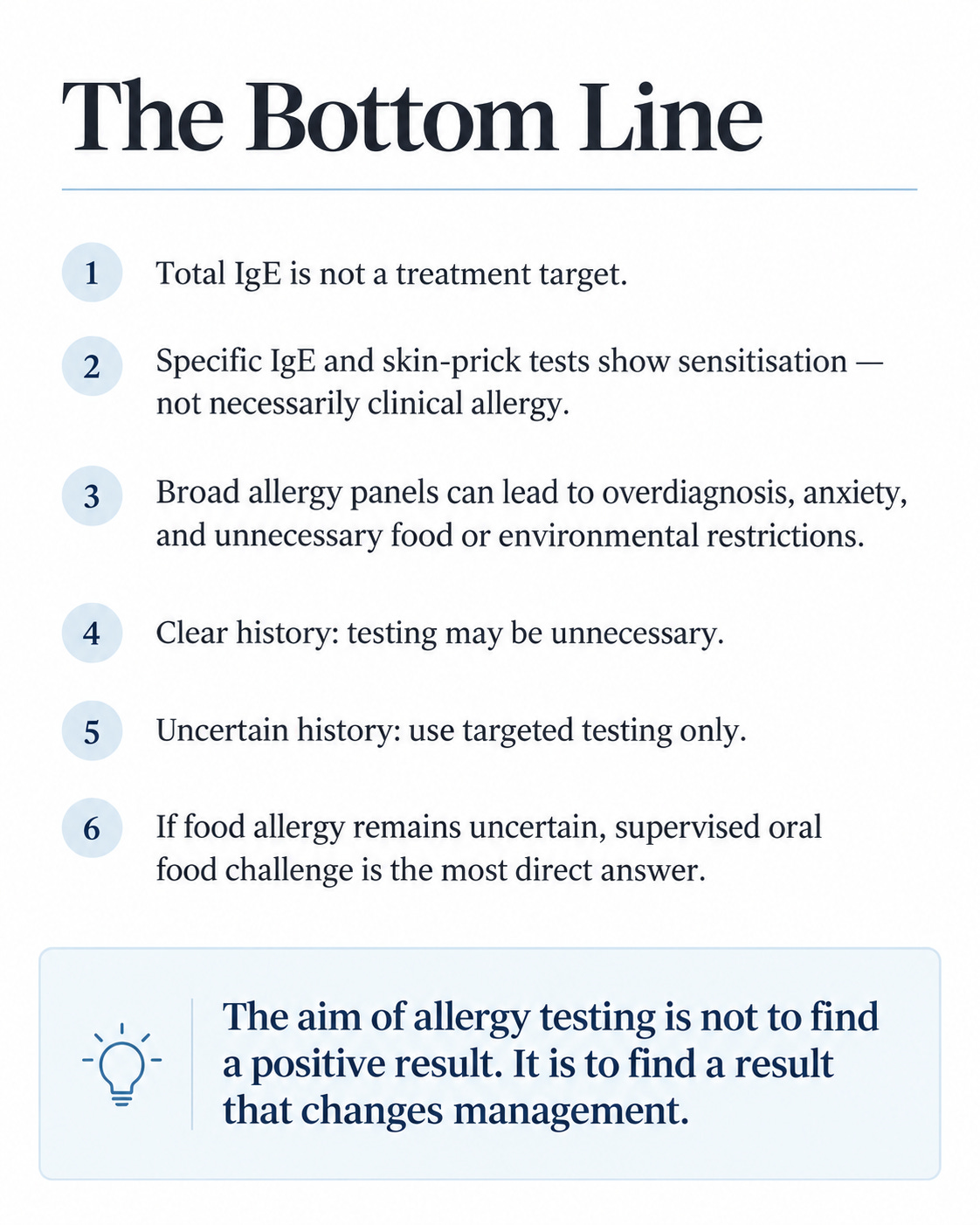
But specific IgE, historically called “RAST”, and skin-prick testing primarily detect sensitisation. Highly atopic patients commonly show multiple sensitizations, many of which may have little or no clinical relevance.[3,4]
The Angry Person Analogy
I sometimes explain this using a simple analogy. Imagine somebody who is already extremely irritable. Ten people approach him during the day and he snaps at almost everyone. It would be unreasonable to conclude that all ten people had done something wrong. The common factor may simply be that the person was already angry.
Now imagine somebody who is calm with everyone but repeatedly becomes angry whenever one particular person appears. That particular relationship deserves much closer attention.
This is only an analogy, not a description of immunology. But it illustrates why a highly atopic patient with weak positivity to numerous allergens should make us more cautious, not more convinced that every positive result represents disease.
A laboratory can therefore produce a technically correct positive result while telling us very little about what is actually causing the patient’s symptoms.
When Do I Use Specific IgE?
Almost never as a routine test.
Suppose a patient tells me: “Every time I eat prawns, within 20 minutes I develop urticaria and swelling.” That is a very convincing history of an immediate allergic reaction. If it is clear, reproducible and the patient is already avoiding prawns, what exactly will a prawn-specific IgE test add?
If the test comes back negative, am I going to tell the patient to eat prawns again? Of course not.
At the other extreme, suppose the patient is regularly eating prawns without any symptoms at all. Then finding a positive prawn-specific IgE is also unlikely to help. It may simply show sensitisation, not clinical allergy.
True IgE-mediated, or Type I, food allergy usually produces symptoms within minutes to about 1–2 hours of eating the food. These may include urticaria, angioedema, itching, vomiting, abdominal pain, wheeze, breathlessness or, in severe cases, anaphylaxis. The same principle applies to inhaled allergens: there should be a believable relationship between exposure and symptoms.
So if a patient eats a particular food repeatedly without any such reaction, a positive blood test should not suddenly make us label that food as the cause of unrelated chronic symptoms.
A test should answer an unresolved clinical question. If the history has already established the diagnosis, or clearly argues against it, testing adds little and may actually create unnecessary dietary restrictions, anxiety and confusion.
Skin-Prick Testing Has the Same Problem
A skin-prick test demonstrates that the skin reacts to an allergen extract. That is not identical to eating the food. Foods may be cooked, processed, digested and absorbed. Commercial extracts do not perfectly reproduce every relevant exposure, and cross-reactive proteins can produce positive results without clinically important food allergy.[5]
Therefore, a patient may have a positive prick test yet eat the food without symptoms. Conversely, no sensitisation test is sufficiently perfect to replace the clinical history.
Also read:
The Myth of the Perfect Drug Allergy Test

The most dangerous drug allergy report is not always the positive one!
A Food Diary Often Tells Me More
In routine dermatology practice, I often find a careful food and symptom diary more useful than an indiscriminate allergy panel.“I think milk worsens my eczema” is weak evidence.
But repeatedly documenting the same reaction following the same food, with an appropriate temporal relationship, deserves attention. This is particularly useful for immediate reactions such as urticaria, angioedema, vomiting or wheezing.
Eczema is more difficult because atopic dermatitis naturally waxes and wanes. Patients can easily attribute a flare to something they ate earlier that day when the association is coincidental. This is one reason broad food panels and unnecessary elimination diets in atopic dermatitis are discouraged.[4]
The diary is not itself a definitive allergy test. Its value is that it helps identify whether there is actually a plausible allergen worth investigating.
When There Is Genuine Doubt, Challenge the Food
When food allergy remains genuinely uncertain, the medically supervised oral food challenge remains the reference diagnostic procedure for IgE-mediated food allergy.[5]
It asks the clinically important question directly: Does eating this food actually produce symptoms?
Specific IgE and skin-prick testing can sometimes help decide which food deserves further evaluation when several possibilities exist. But when the history and laboratory results disagree, repeatedly ordering more allergy tests does not necessarily resolve the problem. A properly supervised food challenge often can. It is, of course, not something to be attempted casually or at home when a significant immediate reaction is possible.
Chronic Urticaria: Stop Hunting for the Mystery Allergen
Chronic spontaneous urticaria (CSU) is probably one of the most over-investigated conditions in this area.Patients naturally assume that recurrent wheals must mean they are allergic to something they are eating, inhaling or touching. Usually, that is not the explanation.
The 2026 international urticaria guideline recognises CSU as a mast-cell-driven disease with important autoimmune mechanisms. IgE-mediated food allergy is extremely rarely its underlying cause, and extensive searches for foods, pollens or dust mites are not part of the routine work-up.[6]
This does not mean IgE biology is irrelevant to CSU. Autoimmune mechanisms involving IgE or its high-affinity receptor may contribute to particular CSU endotypes. But this is very different from saying that an external food, pollen or dust-mite allergen is causing the disease.
The sensible approach is to diagnose and treat the urticaria rather than spend months searching for a mystery allergen.
What About Pollen and Dust Mites?
The same question of actionability applies to airborne allergens. If pollen testing is positive in India, what practical intervention follows?
Pollen is predominantly an ambient environmental exposure. Most patients are not exposed because they keep one offending flowerpot at home. Complete avoidance is usually unrealistic.
Dust-mite testing presents a similar problem. Positive results may lead to expensive covers, mattress changes, extensive cleaning and attempts to modify the home environment.
Yet a 2025 meta-analysis of 17 randomized trials found that dust-mite avoidance measures could reduce environmental dust and Der 1 allergen levels without producing convincing improvement in asthma, allergic rhinitis or quality of life.[7]
There are selected patients with clear respiratory allergy in whom identifying a specific aeroallergen is worthwhile, particularly if allergen immunotherapy is genuinely being considered. But this is a targeted indication. It does not justify routine “airborne allergy panels”.
Is There ever Any Role for Total IgE?
Yes, but in specific situations. In severe allergic asthma, pretreatment total IgE is used together with body weight to determine whether the patient falls within the approved omalizumab dosing range and to calculate the dose. Importantly, this is a dosing convention, not evidence that IgE reflects asthma severity or predicts treatment response. Inface baseline IgE does not predict the likelihood of response once a patient is eligible for omalizumab.[8]
In chronic spontaneous urticaria, omalizumab dosing does not depend on total IgE. Baseline IgE may provide some information about disease endotype and probability of treatment response, but its predictive accuracy for an individual patient remains limited.[6]
These are specialised uses of IgE as a biomarker. They are completely different from trying to “bring the IgE down” to treat eczema.
What I Actually Do
In routine dermatology practice, I hardly ever request total IgE to monitor eczema.
I do not routinely send patients with chronic spontaneous urticaria for specific-IgE panels or skin-prick testing.
If a patient has a clear, reproducible reaction to a particular food and is already avoiding it, I generally do not test simply to confirm what the history has already established.
I consider targeted specific-IgE or skin-prick testing mainly when there is genuine diagnostic uncertainty, especially when several potential allergens are involved.
And when it genuinely matters to establish whether a suspected food causes clinical allergy, the medically supervised oral food challenge remains the reference test.
That is very different from: “Let us test everything and see what comes back positive.”
References
Dhar S, De A, Rajgopalan M, et al. Skin Allergy Research Society and Society for Eczema Studies Joint Task Force Guidelines of Care for Management of Atopic Dermatitis for Adults, Children, and Special Populations in India: An Evidence-Based Review and an Expert Consensus. Indian J Dermatol. 2026;71(3):204-230. doi:10.4103/ijd.ijd_421_25.
Renert-Yuval Y, Thyssen JP, Bissonnette R, et al. Biomarkers in atopic dermatitis: a review on behalf of the International Eczema Council. J Allergy Clin Immunol. 2021;147(4):1174-1190.e1. doi:10.1016/j.jaci.2021.01.013.
Ansotegui IJ, Melioli G, Canonica GW, et al. IgE allergy diagnostics and other relevant tests in allergy: a World Allergy Organization position paper. World Allergy Organ J. 2020;13(2):100080. doi:10.1016/j.waojou.2019.100080.
Chu DK, Schneider L, Asiniwasis RN, et al. Atopic dermatitis (eczema) guidelines: 2023 American Academy of Allergy, Asthma and Immunology/American College of Allergy, Asthma and Immunology Joint Task Force on Practice Parameters GRADE- and Institute of Medicine-based recommendations. Ann Allergy Asthma Immunol. 2024;132(3):274-312. doi:10.1016/j.anai.2023.11.009.
Santos AF, Riggioni C, Agache I, et al. EAACI guidelines on the diagnosis of IgE-mediated food allergy. Allergy. 2023;78(12):3057-3076. doi:10.1111/all.15902.
Zuberbier T, Ansari ZA, Abdul Latiff AH, et al. The International Guideline for the Definition, Classification, Diagnosis and Management of Urticaria. Allergy. 2026;81(8):2582-2632. doi:10.1111/all.70210.
Sobczak M, Kowal K, Pawliczak R. Are There Effective Methods to Reduce Exposure to House Dust Mite Allergens? A Meta-Analysis of Randomized Clinical Trials. Int Forum Allergy Rhinol. 2025;15(8):792-802. doi:10.1002/alr.23565.
Global Initiative for Asthma. Global Strategy for Asthma Management and Prevention. 2026 update.n.648.
The 'Angry Person' analogy is brilliant. A careful clinical history and supervised oral food challenge will always beat an indiscriminate panel of skin-prick or specific-IgE tests.