

Hair-loss treatments have become progressively more inventive. We have tablets, lotions, injections, lasers, microneedling and PRP. Now we also have absorbable surgical threads inserted under the scalp. The theory sounds suitably scientific: polydioxanone (PDO) threads cause controlled injury, stimulate wound-healing cytokines and perhaps encourage hair follicles to enter the growth phase.
But there is a rather basic question hiding underneath all that biology: does the thread itself actually add anything?
Or are we inserting a foreign material into the scalp and then giving it credit for a wound-healing response that might have occurred simply because we punctured the skin?
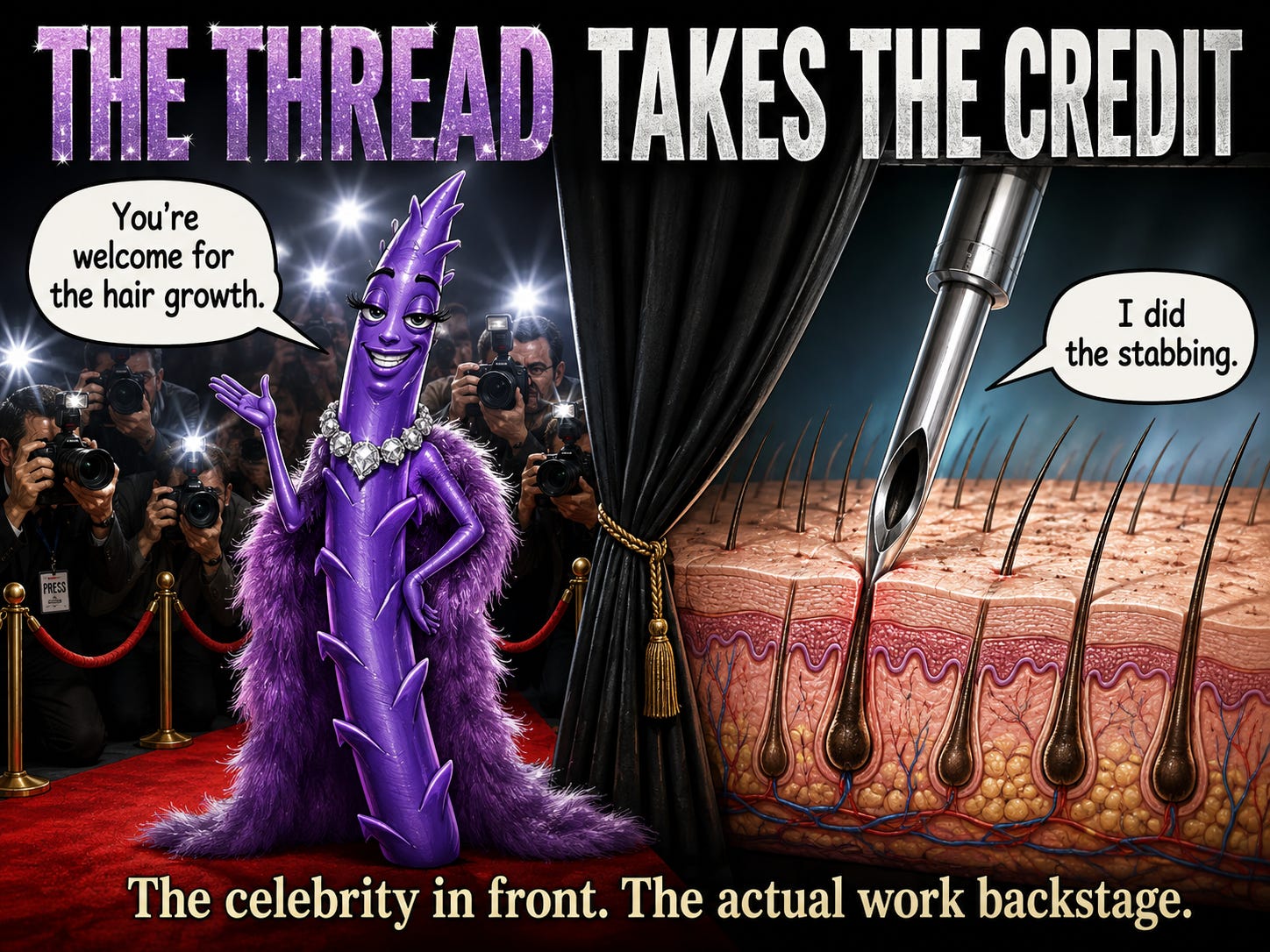
The biology is plausible. That is not the same as proof.
There is some biological basis for the idea. Shin and colleagues found increased anagen activity and changes in hair-growth-related markers after thread-embedding therapy in mice.¹ Interesting, certainly—but it was an acupuncture-derived thread-embedding technique in mice, not necessarily the PDO scalp-threading procedure now offered in aesthetic clinics. Different technique, different tissue biology and, most importantly, different species.
Animal studies are excellent for asking whether something might work. They are rather less good at deciding what humans should pay for.
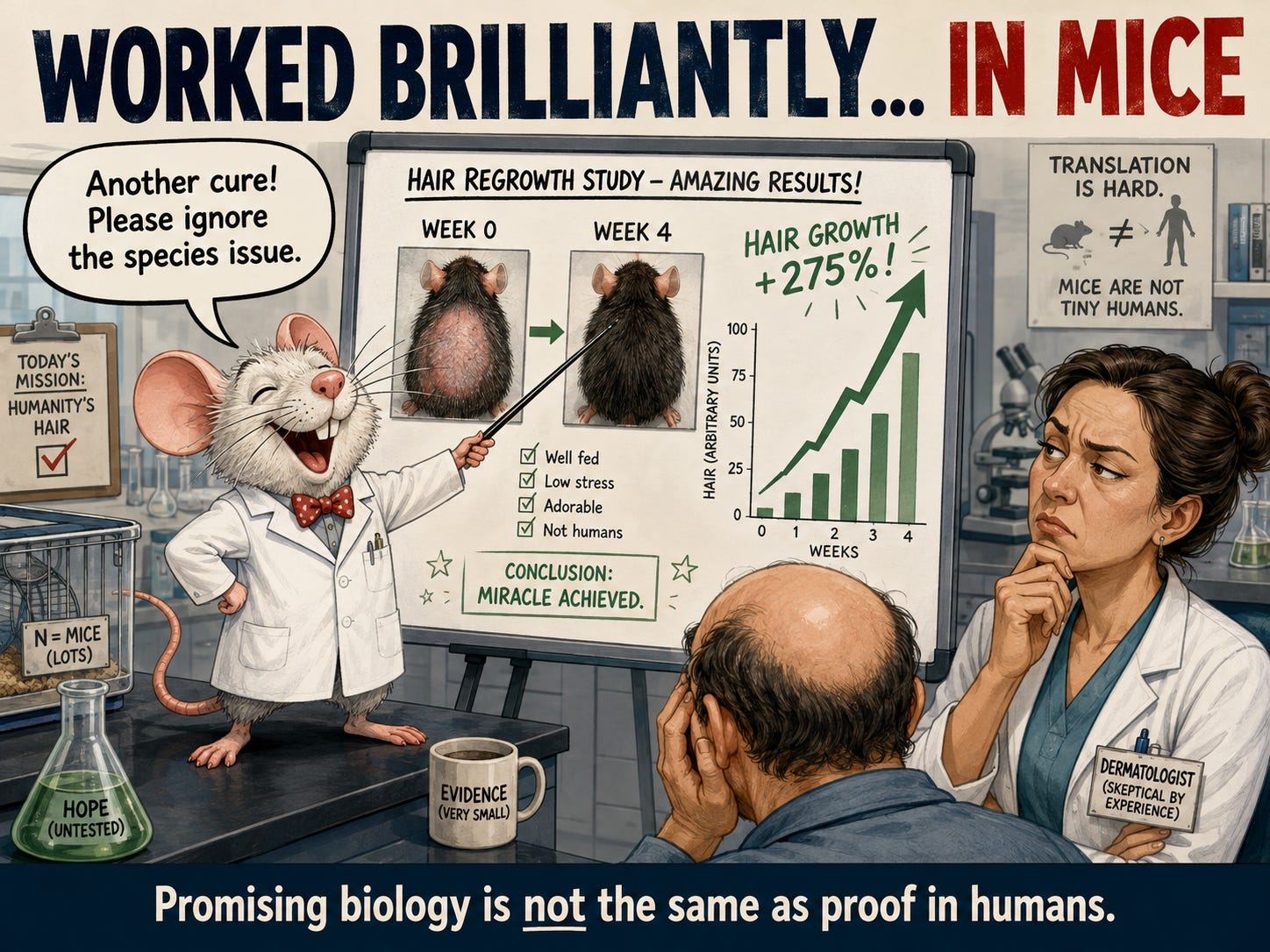
Mice have been cured of enough human diseases to deserve their own Nobel Prize.
The first human evidence: encouraging, but five men
Bharti and colleagues treated five men with androgenetic alopecia using PDO monofilament threads every two weeks for five sessions. Hair count reportedly increased from 48.5 to 93.7 hairs/cm² at 12 weeks.² That is an impressive numerical change.
Unfortunately, there was no control group. So we cannot separate the effect of the thread from the trauma of insertion, natural fluctuation, measurement variability or other influences. It was a useful proof-of-concept report, but not proof that the thread itself was responsible.
Five patients can justify a larger trial. They probably should not justify a treatment package.
The best controlled evidence is more interesting
Metwalli and colleagues conducted the most important controlled study: 30 women with female-pattern hair loss received either three monthly sessions of monofilament threads or intradermal saline injections.³ At six months, the thread-treated group showed significant improvements in hair count and Hair Mass Index, while the saline group did not.
This is genuine evidence in favour of threading and should not be dismissed. It suggests that PDO threads may produce an effect beyond ordinary saline injections.
But notice what the study actually proves. It shows that threading performed better than saline injections in women with female-pattern hair loss. It does not establish efficacy in men, nor does it establish that threading is better than an active hair-restoration procedure.

The comparator that actually matters: PRP
If a patient is considering a procedural treatment involving multiple scalp punctures, the clinically relevant question is not whether threading beats salt water. It is whether it offers an advantage over treatments we already use—particularly platelet-rich plasma (PRP).
PRP is imperfect. Protocols vary, preparation methods are poorly standardised and not every trial has been positive. But its evidence base is substantially broader. A 2023 meta-analysis included nine randomised trials involving 238 patients and found a significant improvement in hair density versus placebo at three and six months, although benefits for hair count and diameter were less consistent.⁴ So PRP should not be presented as miraculous either, but it has considerably more clinical evidence behind it than threading.
More importantly, we now have a direct comparison. Hassan and colleagues studied 30 patients with androgenetic alopecia—15 men and 15 women—using a split-scalp design, with PRP on one side and monofilament threads on the other.⁵ PRP produced significantly greater improvements in both hair density and hair diameter.
This is only one relatively small study, and its methodological limitations mean it should not be treated as the final word. But the direction of the evidence is awkward for threading. The only direct comparison we currently have favours PRP.
That raises the obvious clinical question: if PRP has a broader evidence base, avoids implantation of foreign material and may produce better results, what exactly is the advantage of putting a thread into the scalp?
At present, nobody has demonstrated one convincingly.
Perhaps it is the wounding, not the thread
This is the most interesting part of the entire story. Controlled injury itself can stimulate hair growth. Microneedling and fractional lasers activate wound-healing pathways and growth signals around follicles. Vathananai and Jimenez specifically discussed wound-induced hair growth in relation to several procedures, including scalp threading.⁶
Thread insertion inevitably produces injury. A needle or cannula passes through the scalp, inflammation occurs and wound healing follows. The PDO thread then remains behind and eventually dissolves.
If hair subsequently grows, how much came from the puncture and how much from the polymer?
We do not know.
The decisive experiment would therefore not be threads versus saline. It would be thread insertion versus identical needle or cannula passes without deploying the thread. Only then could we isolate the additional effect of leaving PDO behind.
Before debating which thread is best, it might be worth proving that we need the thread at all.
And which thread are we even talking about?
“PDO threading” is not one standardised procedure. Smooth monofilament, screw and barbed threads differ in structure, surface area and the tissue reaction they provoke. Studies have also used different numbers of threads, treatment intervals and insertion techniques.
It is therefore difficult to take a result obtained with one thread and casually apply it to every other PDO device being inserted into scalps.
This problem is hardly unique to aesthetic medicine, but aesthetic medicine does seem particularly talented at turning a heterogeneous collection of procedures into a single marketable noun.

What about safety?
Published scalp-threading studies have mainly reported short-term effects such as pain, redness, swelling and headache. That is reassuring, but the studies are small and long-term evidence is sparse.
Related facial thread-lifting literature reports inflammatory nodules, extrusion, dimpling and foreign-body reactions.⁷ Whether repeated scalp threading carries similar risks is uncertain. More relevantly for hair-loss patients, we do not know whether repeated treatments could produce subclinical fibrosis or alter tissue planes for a future hair transplant.
That does not mean these complications necessarily occur. It means we do not yet know that they do not.
“No long-term problems have been reported” and “long-term safety has been established” are two very different sentences.
So what would I tell a patient?
Scalp threading is not nonsense. There is a plausible mechanism, an encouraging uncontrolled report and a small sham-controlled study suggesting that it can improve hair parameters in women. That is enough to make it scientifically interesting.
It is not enough to make it an established treatment for androgenetic alopecia.
The central unanswered question remains whether the PDO thread provides a clinically worthwhile effect beyond the injury required to insert it. And when threading has been compared directly with PRP, albeit in only one small study, PRP performed better.
So if a patient asked me today to choose between the two purely on current evidence, I would favour PRP as the better-supported procedural option, while making clear that PRP itself has limitations and should not displace established medical treatment where appropriate. Threading could reasonably be offered as an experimental or inadequately established option—but patients should be told exactly that.
Scalp threading may ultimately prove useful. What it has not yet demonstrated is a clear reason why implanting a foreign material is preferable to simpler and better-studied approaches.
The important question is no longer “Can threading make hair grow?” It is “Does the thread contribute enough to justify being there?”
Until that question is answered, PDO scalp threading remains an interesting procedure with a plausible story, some encouraging data—and a specific advantage that is still looking for evidence.
References
Shin HJ, Lee DJ, Kwon K, Lee JY, Ha KT, Lee CH, et al. The success of thread-embedding therapy in generating hair re-growth in mice points to its possibly having a similar effect in humans. J Pharmacopuncture. 2015;18(4):20-25. doi:10.3831/KPI.2015.18.033.
Bharti J, Sonthalia S, Patil P, Dhurat R. Scalp threading with polydioxanone monofilament threads: a novel, effective and safe modality for hair restoration. J Eur Acad Dermatol Venereol. 2017;31(11):e492-e493. doi:10.1111/jdv.14336.
Metwalli M, Khattab FM, Mandour S. Monofilament threads in treatment of female hair loss. J Dermatolog Treat. 2021;32(5):521-525. doi:10.1080/09546634.2019.1682499.
Zhang XX, Ji YX, Zhou MC, Zhou XZ, Xie YJ, Zeng X, et al. Platelet-rich plasma for androgenetic alopecia: a systematic review and meta-analysis of randomized controlled trials. J Cutan Med Surg. 2023;27(5):504-508. doi:10.1177/12034754231191461.
Hassan MS, El-Taweel AEI, Gohary YM. Comparison between monofilament threads and platelet rich plasma in treatment of androgenetic alopecia. Egypt J Med Res. 2025;6(3):142-156. doi:10.21608/ejmr.2025.328433.1716.
Vathananai W, Jimenez F. What do we know about hair growth induced by wounding and its therapeutic applications? Dermatol Surg. 2023;49(11):995-1000. doi:10.1097/DSS.0000000000003901.
Niu Z, Zhang K, Yao W, Li Y, Jiang W, Zhang Q, et al. A meta-analysis and systematic review of the incidences of complications following facial thread-lifting. Aesthetic Plast Surg. 2021;45(5):2148-2158. doi:10.1007/s00266-021-02256-w.