

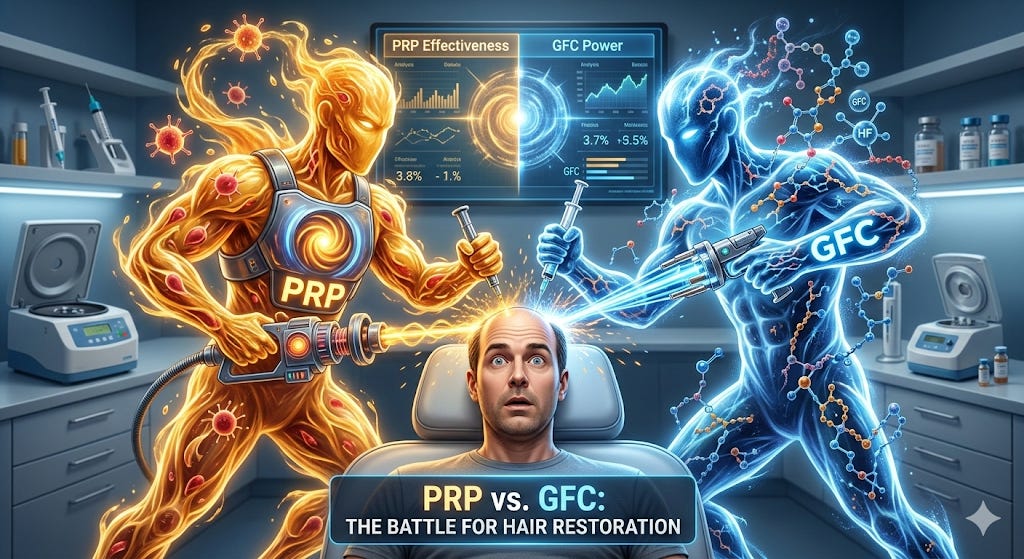
Regenerative hair therapies are evolving rapidly. Among them, Platelet-Rich Plasma (PRP) and Growth Factor Concentrate (GFC) are often presented as distinct advances.
But a closer look raises a legitimate question:
Are we witnessing a meaningful therapeutic leap — or a procedural refinement marketed as one?
This distinction matters because cost, expectation, and clinical decision-making hinge on it.
The Shared Biological Foundation
Both PRP and GFC are autologous treatments derived from a patient’s own blood. Their therapeutic premise is identical: platelets release growth factors that may support miniaturizing hair follicles in androgenetic alopecia.
PRP involves centrifugation and reinjection of plasma containing platelets, which then release growth factors in vivo. It has moderate independent evidence, including randomized trials and meta-analyses showing modest improvements in hair density and thickness in early disease.
GFC modifies this process. Platelets are isolated, activated outside the body, and the released growth factors are concentrated before injection. Conceptually, this appears more controlled and technologically refined.
However, biologically, both treatments derive their effect from platelets. The source material is the same. The difference lies in processing strategy, not in therapeutic origin.
The Evidence Question
PRP has accumulated independent clinical data over time.
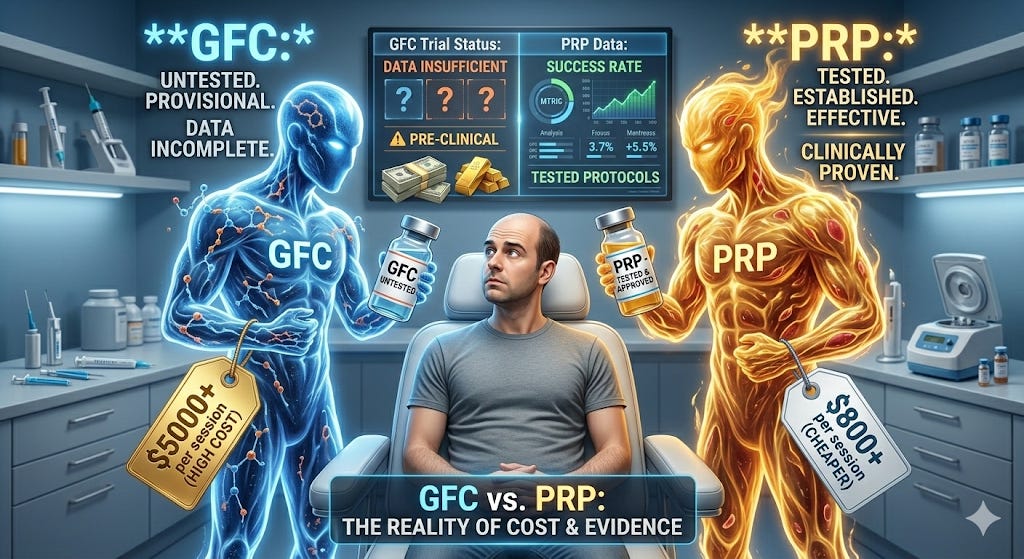
GFC, being newer and proprietary, has less published independent validation. This is not inherently suspicious — innovation often reaches clinics before large comparative trials mature. But the current literature does not demonstrate superiority of GFC over well-prepared PRP.
That absence of demonstrated superiority should temper assumptions. In medicine, refinement does not automatically equal improvement.
The Overlooked Clinical Reality
There is another layer rarely discussed.
In contemporary practice, many clinicians no longer obsess over isolating a narrowly defined “platelet-rich” fraction. Instead, the full plasma supernatant obtained after centrifugation is injected.
This broader plasma-based approach delivers:
Platelets
Released growth factors
Plasma proteins
Additional bioactive mediators
In practical terms, patients are already receiving a biologically active regenerative milieu.
If this approach produces consistent outcomes — as both published PRP data and clinical experience suggest — then the relevant question becomes narrower:
Does proprietary ex vivo activation and concentration meaningfully enhance results beyond what well-prepared plasma already achieves?
At present, robust independent evidence confirming that it does is lacking.
Transparency and Comparative Data
Most GFC systems are kit-based and patent-protected. While general mechanisms are described, standardized independent quantification of growth factor concentrations across systems is not widely available in the public domain.
This does not imply inefficacy. It does, however, limit objective comparison and reproducibility.
When cost differentials are significant, evidentiary differentials should be as well.
A Measured Perspective
GFC is not implausible. It is not pseudoscience. It is a platelet-derived modification of PRP that may ultimately prove advantageous in certain contexts.
But current data do not establish that it outperforms well-prepared PRP or plasma-based injections. Until such comparative evidence emerges, claims of superiority should be viewed as provisional rather than established.
For patients, the essential realities remain unchanged:
These treatments work best in early thinning.
They improve density modestly; they do not regenerate lost follicles.
Maintenance is necessary.
The more productive conversation is not which acronym sounds more advanced, but whether expectations, cost, and evidence are aligned.
Hair restoration is incremental biology sustained over time — not a technological shortcut.