

Nearly thirty years ago, when I was a medical student, I wrote an article titled Our Representatives. India was then consumed by discussions about Bofors, Harshad Mehta, Jayalalithaa, Lalu Prasad Yadav and a succession of scandals that seemed to confirm everything people already believed about politicians.
The language used in ordinary conversations was uncompromising:
“These politicians are traitors.”
“They are plundering the country.”
“They deserve to be punished.”
Three decades later, the names have changed.
The anger has not.
Nor, unfortunately, has the underlying problem.
But who exactly are “they”?
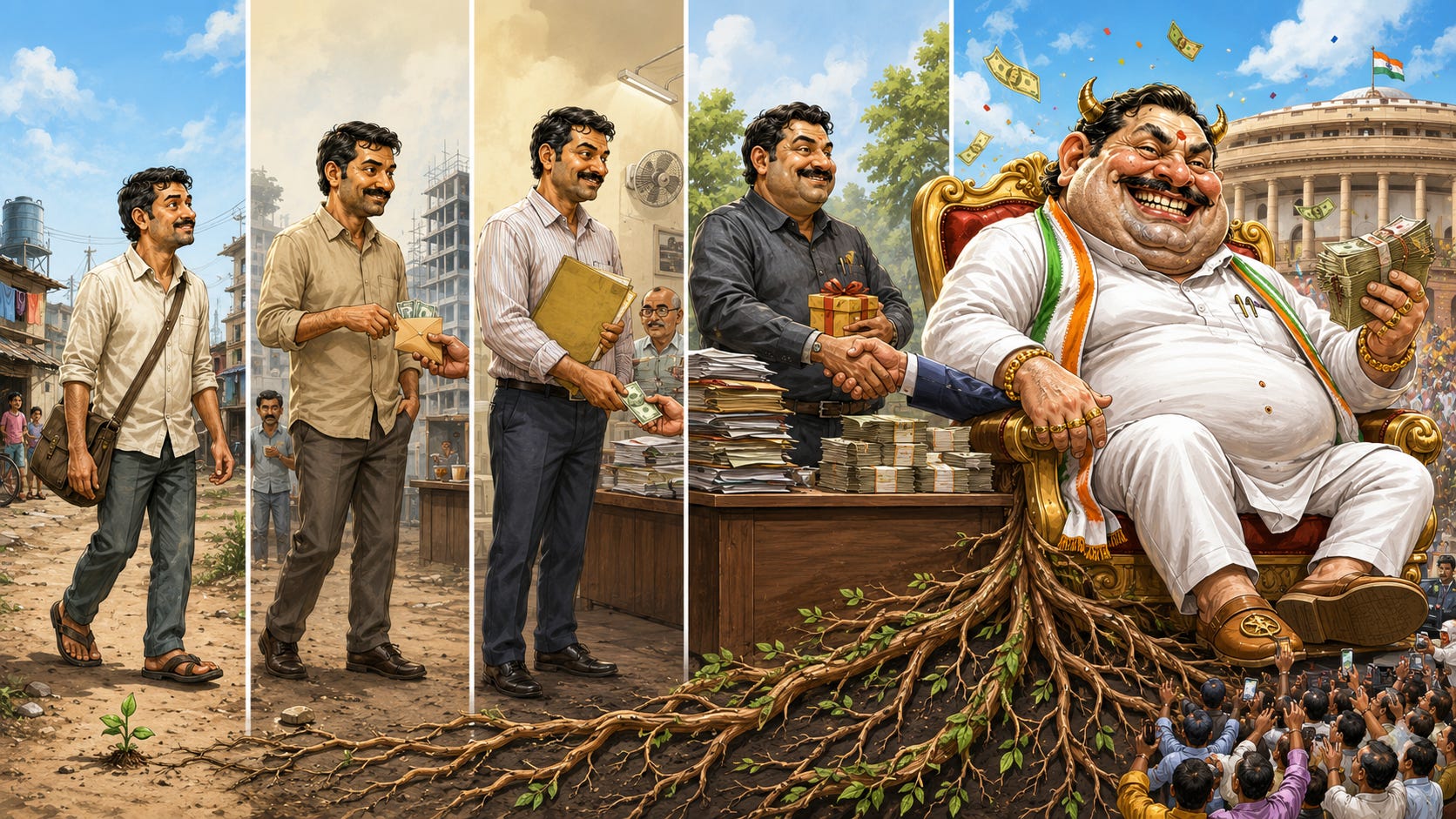
My argument then was uncomfortable: politicians do not emerge from a separate, uniquely immoral species.
They emerge from society.
They are, quite literally, our representatives—not merely because we elect them, but because they often represent, in an enlarged and more visible form, the compromises we routinely permit ourselves.
The politician may be the final, monstrous form.
But the seed is often planted much earlier.
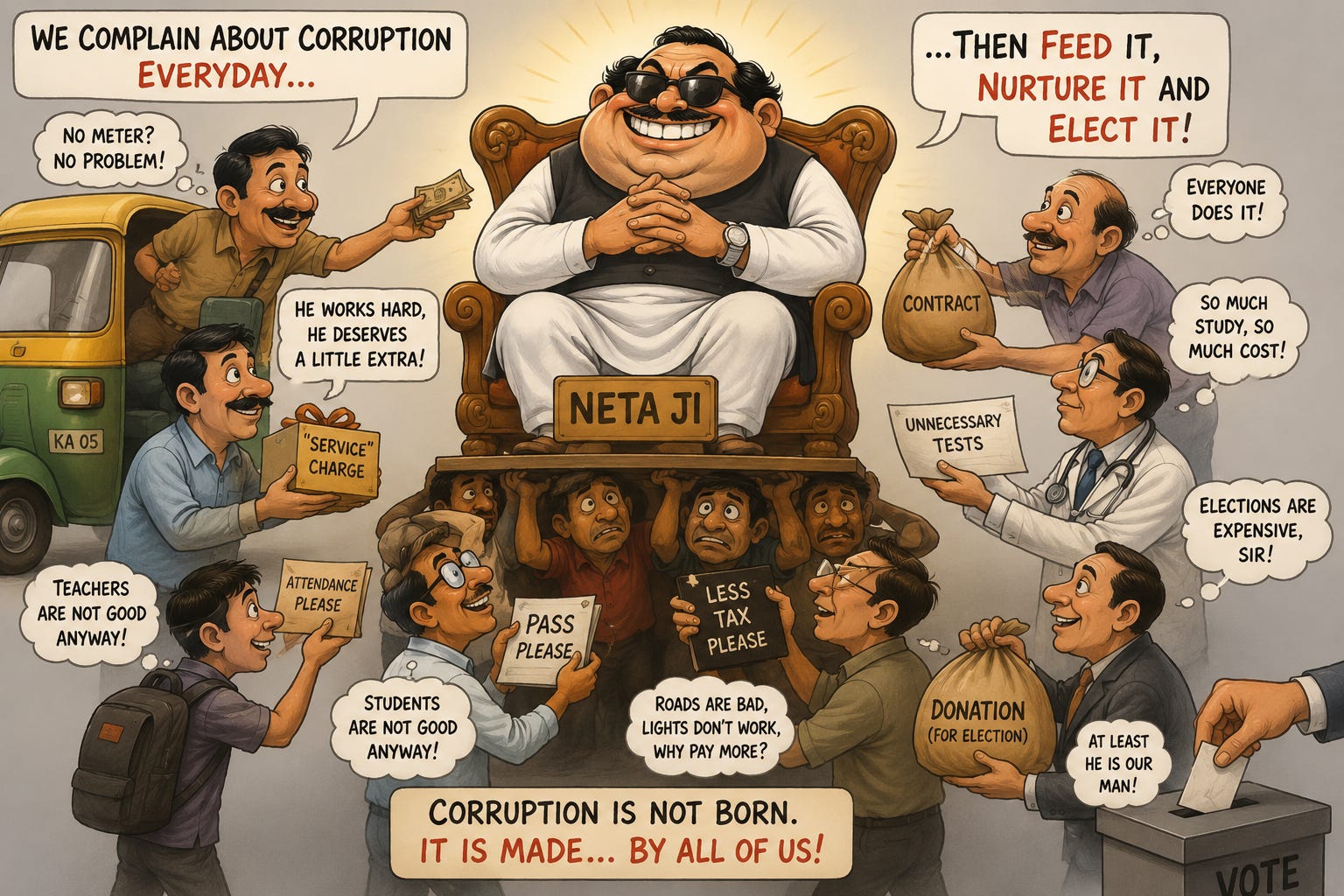
“It is not a bribe. I am doing you a favour.”
The auto driver refuses to use the meter because the official tariff is outdated.
The telephone linesman expects a small payment because the government does not pay him enough.
The licence inspector charges far more than the official fee, but does not necessarily consider it a bribe. In his mind, the applicant may not be competent enough to deserve a licence, and he is doing him a favour by issuing one.
The applicant, of course, willingly pays because he wants the licence.
The student bunks classes and pays the office peon to conceal his absence. The peon, too, can persuade himself that he is merely doing the student a favour—even though the student has not earned the attendance being recorded.
The student justifies his absence by saying that the teachers are not good.
The teacher accepts money to pass the student, saying that the students are not good and would otherwise fail.
Who is right? Probably neither….
Yet each can produce a perfectly satisfactory explanation for his own conduct.
Everyone has an explanation
The taxpayer conceals income because the roads are bad and public services are inadequate. He therefore pays only what he considers a reasonable amount.
The government official takes a bribe because promotions allegedly have to be purchased, salaries are inadequate and children have to be educated.
The doctor orders unnecessary investigations or charges excessive fees because medical education was expensive and demanding.
The stockbroker manipulates the market and surrounds the act with some suitably elaborate justification.
Finally, the politician appropriates public money because elections cost a fortune and funds must be accumulated for the next one.
Everybody has an explanation.
Nobody considers himself corrupt.
Is the payer innocent?
It takes two parties to complete many corrupt transactions.
One person demands payment.
The other provides it because the shortcut is convenient.
The applicant pays the licence inspector because he wants a licence he may not otherwise receive.
The student pays the peon because he wants attendance he did not earn.
The citizen pays an intermediary because the work gets done faster.
The recipient calls it a favour.
The payer calls it a necessity.
Neither wishes to call it corruption.
Thirty years later, what has really changed?
The forms have become more sophisticated.
The justifications remain remarkably familiar.
A cash payment without a bill is acceptable because “everyone avoids tax.”
An illegal construction is defensible because the rules are impractical.
A recommendation from an influential person is called a “small favour.”
Paying an intermediary to accelerate a government application is described as avoiding unnecessary harassment.
Inflated medical packages are justified as the cost of running a modern hospital.
Academic plagiarism becomes harmless because promotion criteria are unreasonable.
Fake attendance, manipulated certificates, undeclared commissions and preferential appointments are all excused as necessary adaptations to a defective system.
We condemn corruption in the abstract while negotiating exceptions for ourselves in practice.
Are all forms of corruption equal?
No.
Avoiding tax on a small transaction is not morally or economically equivalent to diverting thousands of crores of public money.
Political corruption can damage institutions, distort policy and deprive millions of essential services. Power increases both opportunity and responsibility.
That distinction matters.
But differences in scale should not conceal the common mental habit:
My circumstances are exceptional; therefore, ordinary rules need not apply to me.
That is the seed from which larger corruption grows.
What does corruption feel like from the inside?
Rarely like corruption.
It feels like compensation.
Survival.
Pragmatism.
Entitlement.
Necessity.
Justice.
Or simply a favour.
The official believes the system has underpaid him.
The businessman believes regulation has obstructed him.
The professional believes society has failed to reward his effort.
The politician believes election expenses, party demands and public expectations leave him no alternative.
Each person constructs a private moral accounting system in which his own conduct remains reasonable.
Do we oppose corruption—or merely resent paying for it?
This is perhaps the more uncomfortable question.
We may resent the bribe while simultaneously valuing the privilege it purchases.
We object not always to the corrupt system itself, but sometimes to being excluded from its benefits or being charged too much for access to it.
Influence is condemned when someone else uses it.
When it helps us, it becomes “a contact.”
Favouritism is offensive when another person benefits.
When we benefit, it becomes “help.”
Can technology solve the problem?
Only partly.
Digitisation, direct transfers, electronic payments, surveillance and greater transparency can reduce particular opportunities for corruption.
They are necessary and valuable.
But every new rule eventually encounters the extraordinary human ability to discover a workaround.
Systems can constrain behaviour.
They cannot, by themselves, create integrity.
Was Vedanta right after all?
My original article ended with a Vedantic idea: the world is, to some extent, a reflection of the mind that perceives and creates it.
There is a Telugu saying that a jaundiced person sees everything in yellow and concludes that the whole world has been painted yellow.
Thirty years later, I would state the conclusion somewhat differently.
Changing oneself will not automatically eliminate institutional corruption.
That requires enforceable laws, transparent systems, independent institutions, political accountability and credible punishment.
Personal virtue is not a substitute for structural reform.
But structural reform will also remain incomplete if every citizen approaches the system looking for the exception, contact, shortcut or loophole that benefits him personally.
So, do we have the right to judge politicians?
Certainly.
People in power must be judged more strictly, not less.
We have both the right and the duty to hold them accountable.
But accountability becomes more credible when it is accompanied by self-examination.
We cannot demand absolute honesty from our representatives while admiring clever dishonesty among ourselves.
We cannot celebrate influence when it helps us and condemn favouritism when it helps somebody else.
We cannot expect politicians to respect rules that society routinely treats as obstacles meant only for the less connected.
Thirty years ago, I asked whether we had the right to point fingers at politicians when we so readily justified our own smaller transgressions.
Today, I would ask a slightly different question:
Are our politicians an aberration—or are they merely the most visible expression of what we have gradually normalised?
Our politicians may not always represent the best among us.
But perhaps they represent us more accurately than we would like to admit.
Beatufiul article. I have been echoing the same thoughts past 10 years. Politicans are mere reflection of our society. The jugaad mentality and scarcity mindset inculcated since childhood mainly drives the rampant institutionalised corruption over time. Moreover, despite all the apparent concepts of 'society' 'oneness' and 'Indian social values', me over others is core Indianess and makes us step over everyone around to get the piece of a cake.