

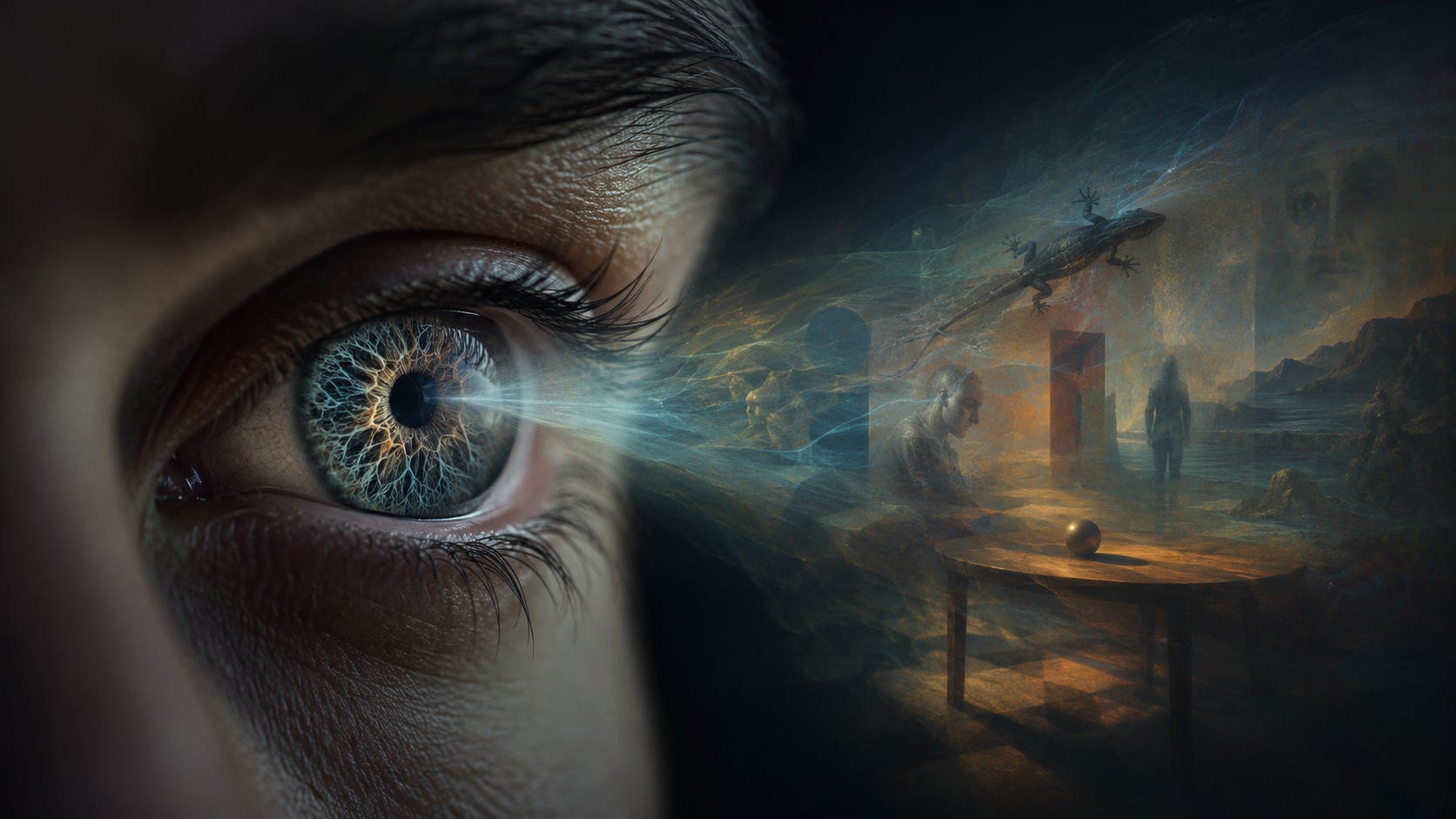
There is a disturbing case from an American true crime documentary that has stayed with me for years. A rape victim, suffering from severe post-traumatic stress, struggled to identify her attacker. Under repeated, insistent questioning by an investigating officer who kept returning to the same suspect, she eventually identified that person as her aggressor. The case moved forward. A conviction followed.
Then a local newspaper editor looked deeper. A similar assault had occurred just days before. When the victim was shown photographs of the person convicted in that earlier case, she recognised him immediately — as her actual rapist. What had happened was not a lie, not a conspiracy, but something far stranger: the officer’s repeated suggestions had caused the image of the wrong man to be overlaid onto the victim’s genuine memory of her attacker. The two had merged. Her sincere recollection was, in the most literal sense, fabricated.
This raises an uncomfortable question. If memory — the very record our minds keep of what we experience — can be altered, created, or erased by outside suggestion, can we trust our senses at all?
The Body as an Electrical Instrument
To understand why the answer may be no, we need to step inside the mechanism first.
The human body is, in essence, a biological instrument in which different parts communicate through electrical impulses. Consider something as simple as colour. When light that we perceive as blue enters the eye, it stimulates retinal photoreceptors and generates electrical signals that travel through the visual pathway. For the sake of this thought experiment, imagine that these signals eventually activate what we may loosely call a “blue-perception centre” — not a literal anatomical spot, but a functional brain network whose activity gives rise to the experience we call “blue.” If that network were stimulated directly, the person might experience blue even without blue light entering the eye. The experience would be real, even if the external stimulus were absent. Those signals are then relayed onward to whatever we call the mind, which registers the sensation we know as blue.
So far, familiar. But here is where it gets unsettling.
Laboratory studies have demonstrated that artificial electrical stimulation of specific brain centres — by implanted electrodes — can induce the perception of colour, sound, or sensation when the person is, in reality, experiencing no external stimulus whatsoever. The input is fabricated. The experience is real.
Now consider a thought experiment. If stimulating the blue perception centre produces the experience of blue regardless of what light is entering the eye, what would happen if the neural pathway from the yellow receptor were — through some quirk of genetics or development — routed to the blue centre? The person would look at yellow light and experience blue. They would never know. They have never experienced their own nervous system any other way. This is not established neurobiology; the precise mapping of sensory pathways varies between individuals, and whether such a systematic difference could arise is an open question. But the principle it illustrates is not in doubt: the experience of a colour is not the colour itself. It is a neural event.
Tom, Jim, and the Chicken
Extend this to something less abstract. Consider two people, Tom and Jim, who differ in their response to chicken. Tom relishes it. Jim cannot stand it. The obvious explanation is subjective taste preference. But how do we know that both of them are having the same gustatory experience in the first place?
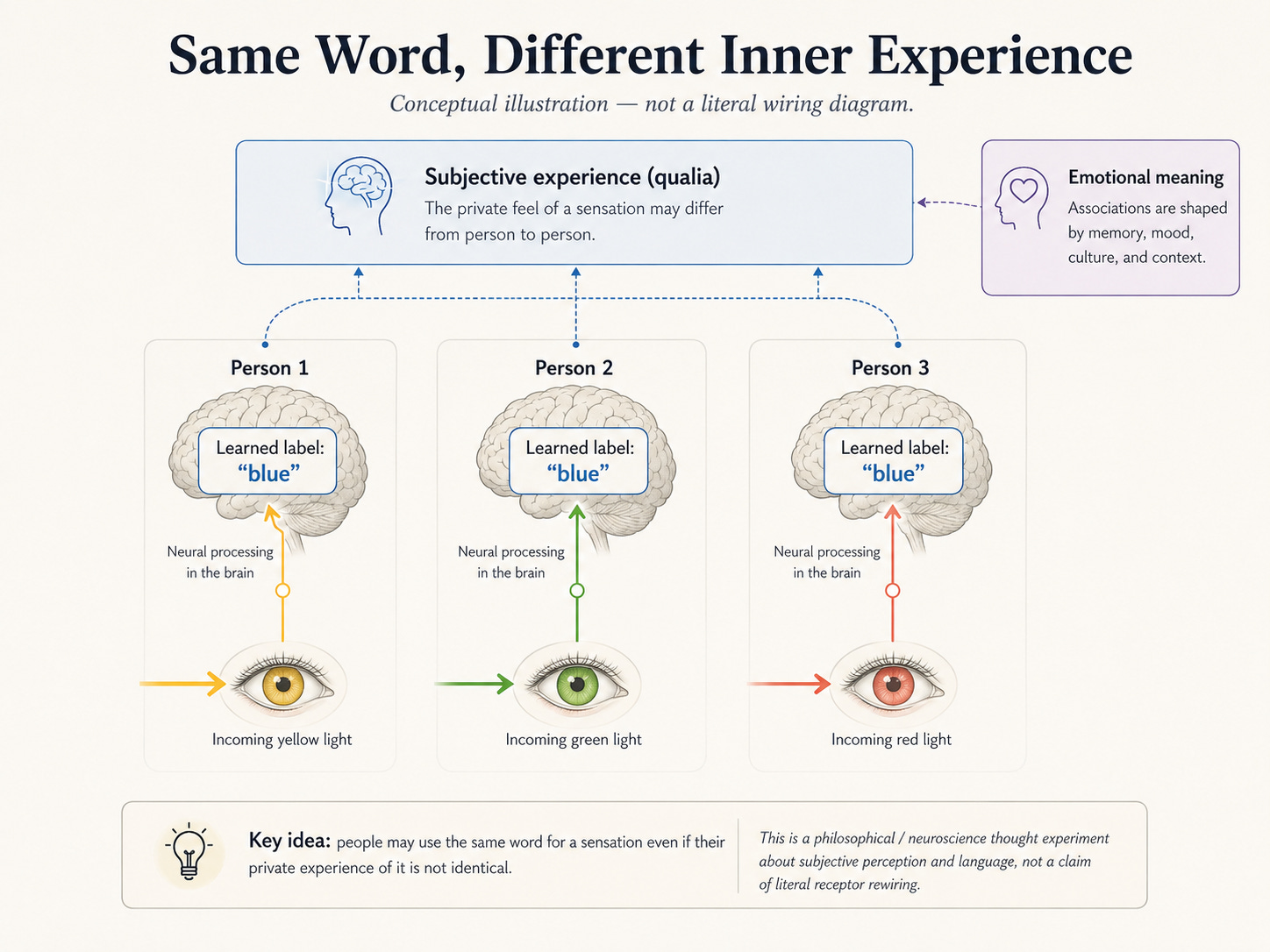
Before dismissing this, consider a simpler analogy. Imagine three people who, without their knowledge, have worn faintly tinted contact lenses since birth — one with a yellow tint, one with orange, one with pale green. Each has grown up experiencing a slightly different world of colour. Each believes their version to be normal. They have never compared eyes, never seen through each other’s vision. And since they were taught the same names for the same objects, each uses the word ‘blue’ for what may, experientially, be three entirely distinct inner events.
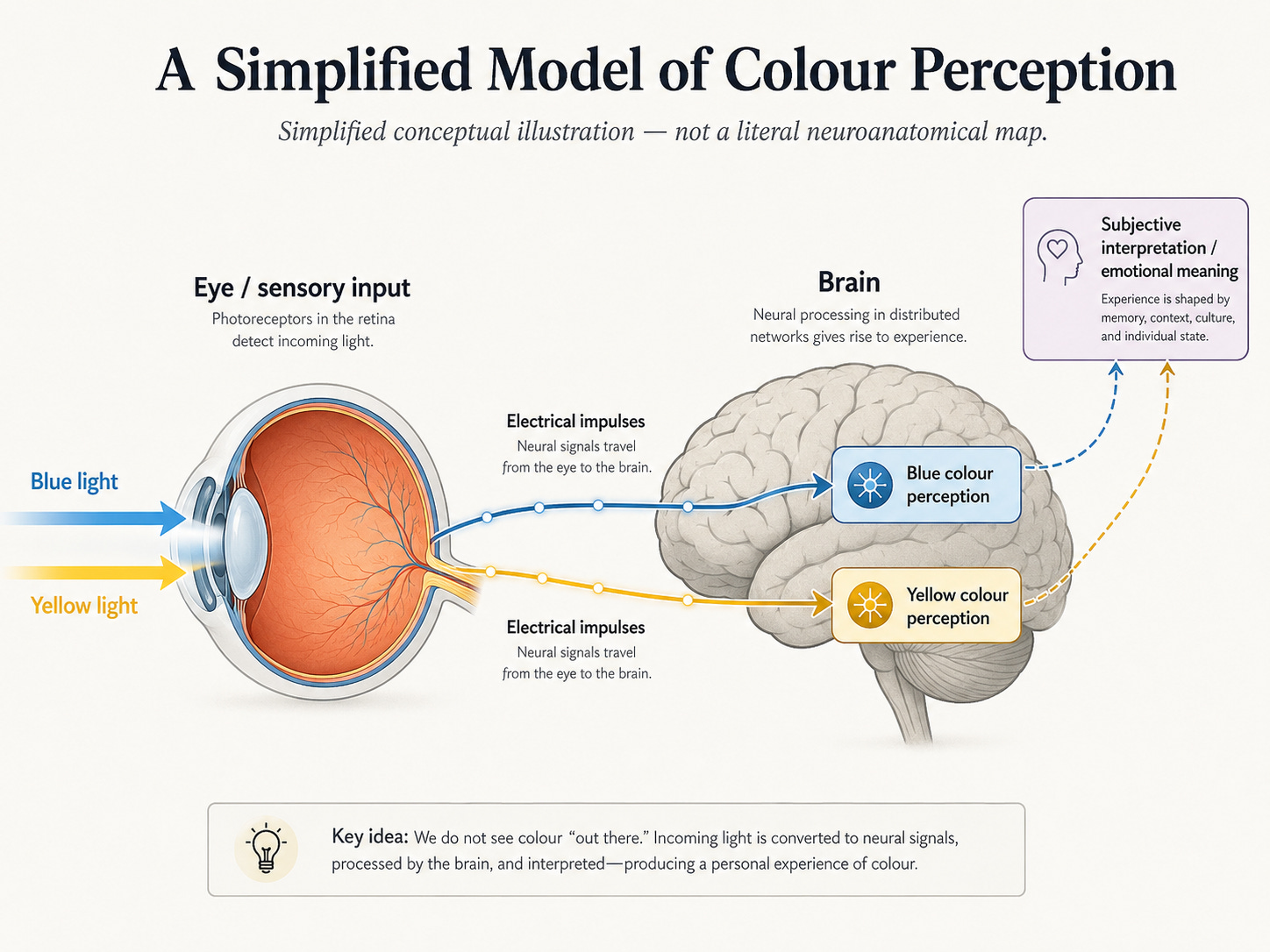
This is not fantasy. It is a thought experiment that illustrates something real: the connections between sensory organs and their corresponding processing centres in the brain have not been mapped to minute detail across individuals. We have no established basis to assume that the neural substrate for tasting chicken — whatever and wherever it is — is identical in every person. For all we know, Jim’s experience of chicken may bear no resemblance to Tom’s. His revulsion would then be entirely coherent. The chicken has not changed. The nervous system receiving it has.
The philosophical term for the subjective quality of experience — the ‘what it is like’ of seeing red, tasting mint, or hearing a minor chord — is qualia. No experiment yet devised can establish whether the qualia of one person’s experience of chicken correspond to those of another’s. This is not a gap in current knowledge that technology will close; it is a structural problem. We cannot step outside our own subjective experience to compare it directly with someone else’s.
Into the Psyche — Beyond the Brain
The story does not end at the neuron.
Neuroscience maps the journey from stimulus to neural firing with remarkable precision. But the question of how that neural signal becomes conscious experience — how electrical activity in grey matter becomes the redness of red, the taste of mint, or the ache of grief — remains entirely unanswered. This is the ‘hard problem of consciousness,’ and it is called hard not because it is merely difficult, but because it is unclear what a scientific answer would even look like. Where the mind is, how the brain communicates with it, what generates the felt quality of experience: these are questions at which neuroscience currently stops.
We can, however, observe what happens at the boundaries. Consider mood. On some days, a particular colour energises you; on others, the same colour feels flat or oppressive. Nothing has changed in the external world. Something has shifted in the relationship between the brain’s perceptual output and the emotional register that receives it. That bridge — between neural event and felt experience — is not fixed. It fluctuates within the same person, and almost certainly differs between individuals.
We are each, in other words, not passively receiving a world that exists independently of our perception. We are actively constructing our experience of that world — in real time, through the particular wiring of a nervous system that no other person on earth shares exactly. What we call the external world is, in the most precise sense, a model: a biologically generated representation that is constantly updated, but is never identical to whatever it represents.
So, Are Our Senses Actually Deceiving Us?
The way in which any object is perceived depends not on the object itself, but on the structure of the perceiving system. This is not a philosophical flourish; it is the mechanistic implication of everything described above.
Consider what would happen if humans could perceive the world at the resolution of an electron microscope — if we could see at the scale of individual atoms and the vast empty space between them. The solid table in front of you would dissolve into a sparse cloud of particles in rapid motion. Its solidity, its surface, its colour: none of these properties exist at that scale. They are emergent features of the interaction between matter and our particular sensory apparatus. They are, in a precise sense, properties of the encounter — not of the object alone.
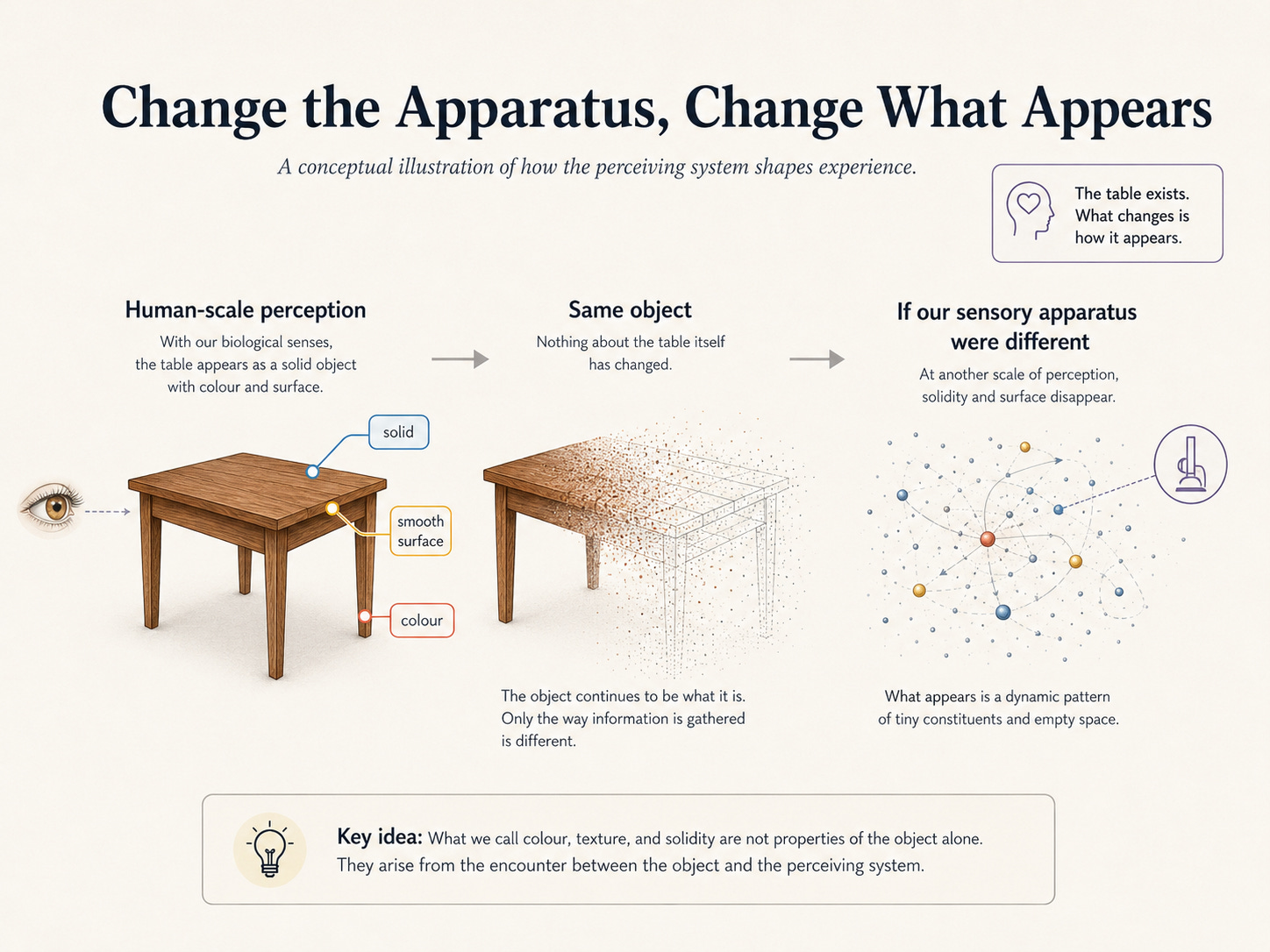
Change the apparatus, and you change what appears. The question this raises is not whether the table exists — it does, in the sense that it produces consistent and predictable effects on every observer who approaches it. The question is whether our experience of the table in any way resembles what the table actually is, independent of our perception of it. The honest answer is: we have no way of knowing.
The Dream Parallel — and Its Limits
Here is perhaps the most unsettling comparison.
While dreaming, you inhabit a world that feels entirely real. Other people speak to you. Events unfold with consequence. Emotions register as genuine — fear, relief, grief, joy. The physics of the dream world make everything within it appear coherent. It is only upon waking that you recognise the dream as a projection of your own mind, sustained from within. Every character in it was, in some sense, you. The whole elaborate world was the production of a single consciousness — and while you were inside it, you had no way of knowing.
The dream comparison has limits. The waking world is not like an ordinary private dream. Its rules are stable. The table you see is also seen by others. It can be measured, touched, photographed, and returned to tomorrow. Dreams usually do not have this consistency.
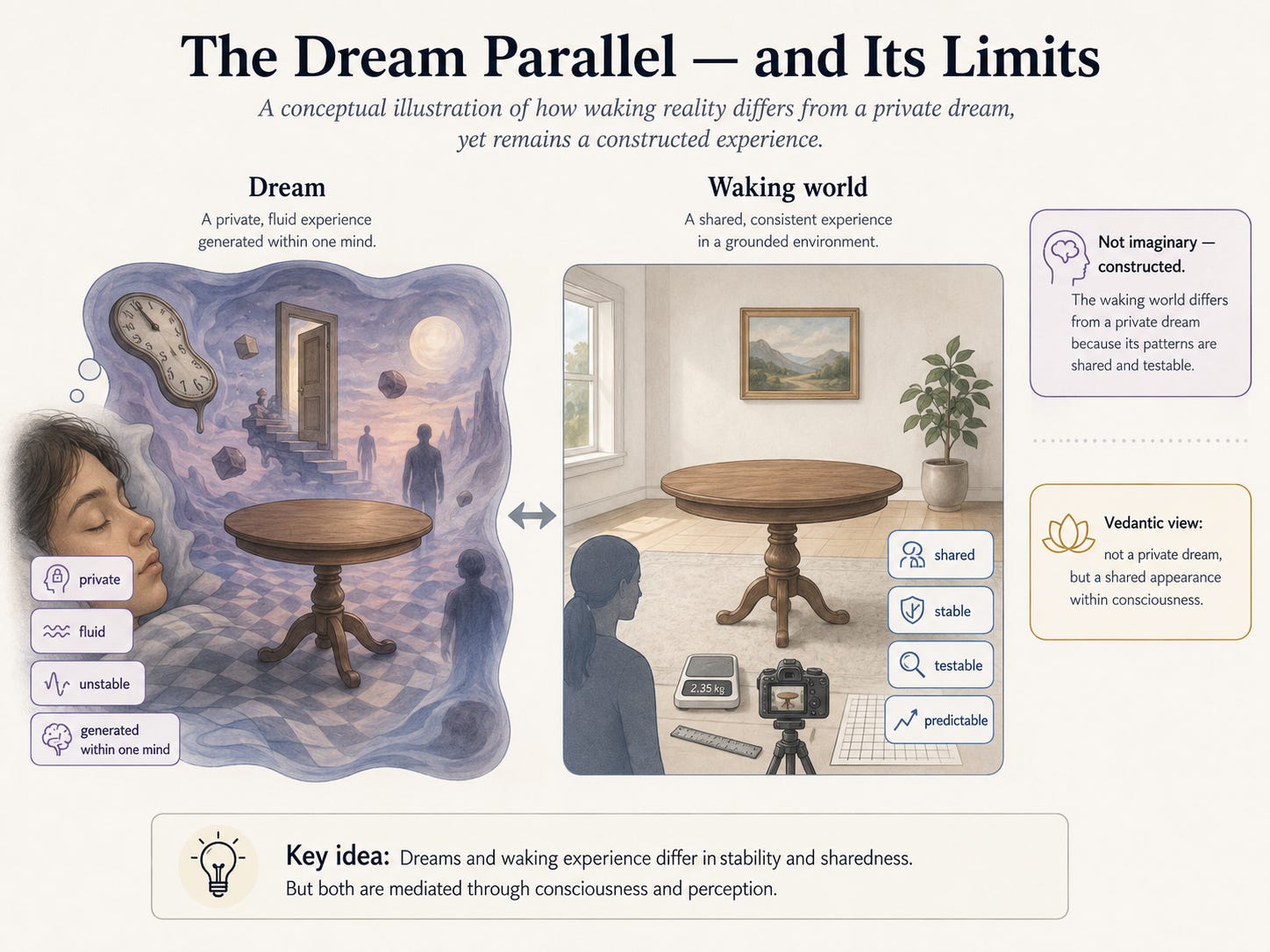
But Vedanta pushes the question deeper. It asks whether shared consistency is enough to prove ultimate reality. A dream is private; the waking world may be a shared dream — not in the casual sense of fantasy, but in the sense that the whole experience of world, body, other people, time, and space arises within consciousness. The “other person” in front of me may not be outside consciousness at all, but another appearance within the same field of consciousness.
So the point is not that the waking world is imaginary in a childish sense. It is real enough for ordinary life. But it may still be constructed, projected, and experienced through consciousness — just as a dream is. The difference may be one of order, stability, and sharedness; not necessarily one of absolute reality.
Ancient Indian philosophy captured this with the concept of Maya — often translated as ‘illusion,’ though the term is more precisely understood as ‘constructed appearance.’ This is not solipsism, which is the claim that only one mind exists. Advaita Vedanta, from which the concept derives, holds that the external world is real at the empirical level; what is illusory is our ordinary assumption that we are experiencing it directly, rather than through an elaborate biological construction. The mechanism is something like a cinema projector: the mind is the film negative, energy is the light beam, the world is the screen. The image is real. But it originates in the projector, not the screen. Most of us forget this.
What, Then, Is Real?
So where does all this leave us?
The world is not imaginary. The table exists. The tree exists. The person in front of us exists. They affect us in predictable ways, and other people can also see, touch, measure, and respond to them.
But we do not experience these things directly. We experience the version of them that our nervous system creates.
Colour, smell, taste, texture, and solidity feel as if they belong to the object. But they do not belong to the object alone. They arise when the object meets a particular kind of sensory system. A flower has no “redness” in itself unless there is an eye and a brain capable of turning reflected light into the experience of red. A table is not “solid” in the way it feels to the hand if it is viewed at the level of atoms. Its solidity is real at our scale, but it is still a scale-dependent experience.
So our senses are not useless. They are remarkably reliable. They help us survive, move, recognise danger, enjoy beauty, and live in the world. But they are not perfect windows onto reality. They are instruments. They translate reality into a form we can use.
Science has explained much of this translation. It has mapped receptors, nerves, synapses, and brain pathways. But one mystery remains. Why should any of this feel like something? Why should electrical activity in the brain become the experience of blue, the smell of jasmine, the pain of loss, or the warmth of love?
That is the gap between the measurable world and the experienced world.
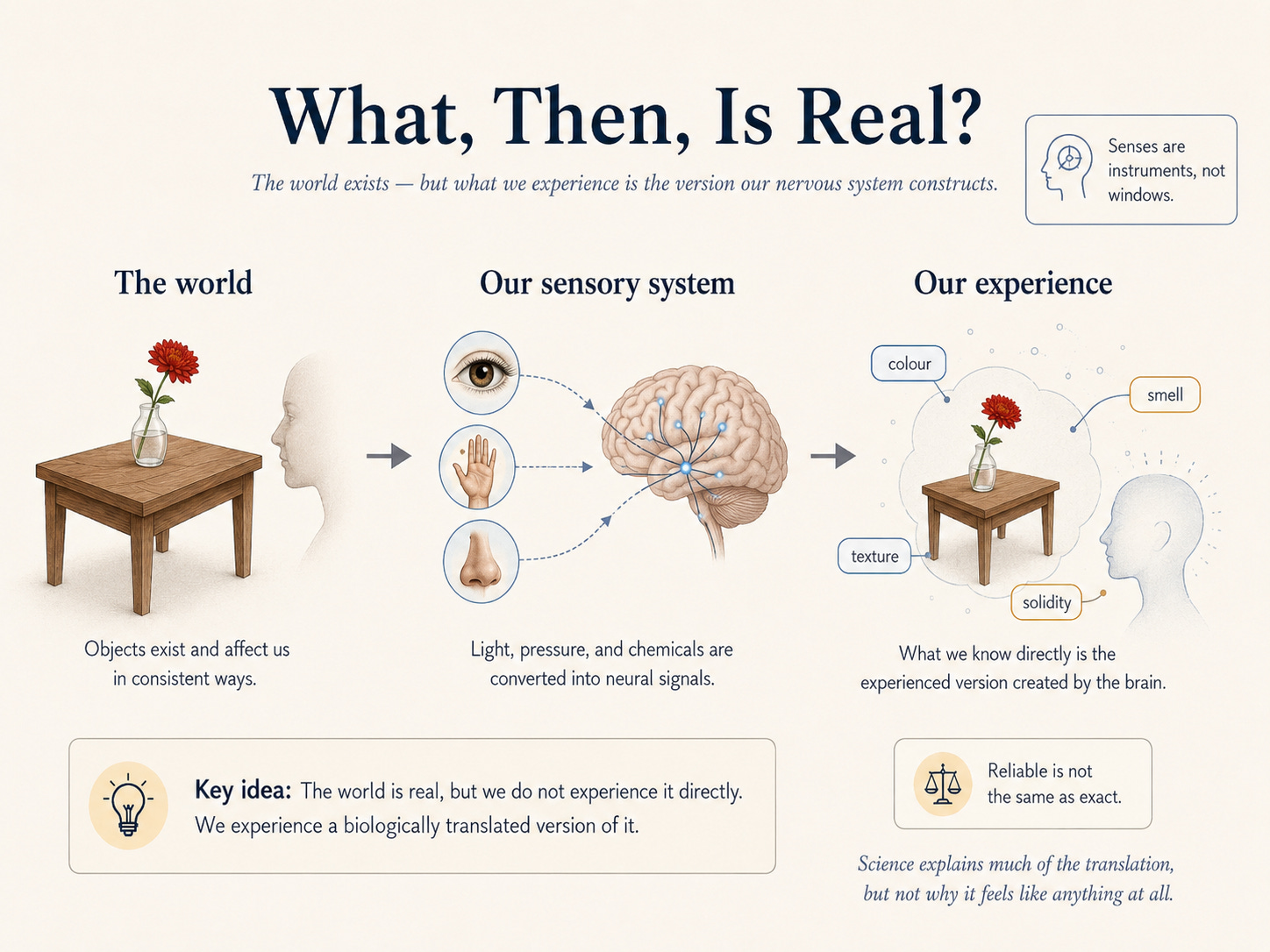
And perhaps that is the real point: we do not live in reality as it is. We live in reality as it appears to us — shaped by our senses, organised by the brain, and finally illuminated by consciousness.