

Medical advertising needs strict regulation. But ethical rules should distinguish education from inducement, commerce from exploitation, and visibility from deception.
The NMC’s new Guidelines on Ethical Advertising and Public Communication begin from an entirely sensible premise. Medicine is not an ordinary marketplace. Patients may be frightened, vulnerable and unable to judge competing claims. Even a technically truthful advertisement can create unrealistic expectations or encourage treatment that was never really necessary.
So guaranteed cures, fake reviews, manipulated testimonials, dubious “No.1” claims, manufactured urgency and advertising designed to create unnecessary demand deserve strict regulation. The NMC is right about that.
The difficult question is where patient protection ends and legitimate professional visibility begins.
The guidelines certainly do not tell doctors to disappear from the internet. Clause 8.2(iii) expressly permits public-health talks through television, radio and electronic media in the doctor’s own name and designation. Explanation III to clause 3.2 requires doctors posting electronically to disclose their identity, qualifications and registration details. [1]
Explanation I to clause 3.2 says that information shared in the normal course, including information given to the public at large, falls outside the definition of “advertisement” only when it is non-promotional and carries no intent for commercial benefit. Clause 5.1 similarly permits health education provided it does not solicit patients and is not monetised through promotional marketing. Clause 8.1(ii) prohibits self-promotion, indirect solicitation and campaigns giving an impression of commercialisation.
This is where things become unclear.
Suppose a doctor writes a useful article on hair loss and patients find it through Google. That is education. But what if the doctor also links to the clinic, or pays to promote the article? At what point does education become advertising?
The rules should not depend on guessing the doctor’s intention. They should look at clear signs of promotion—discounts, guaranteed results, “limited slots”, paid referrals, fear-based marketing or pushing unnecessary treatment.
The rules should clearly say where education ends and advertising begins.
Commercialisation is a fair concern. Money can influence medical decisions. But earning from medical practice is not the same as exploiting patients. Charging fees and telling people about your services are normal parts of private practice. The problem starts when money leads to unnecessary treatment, exaggerated claims or fear-based selling.
That is what the rules should target
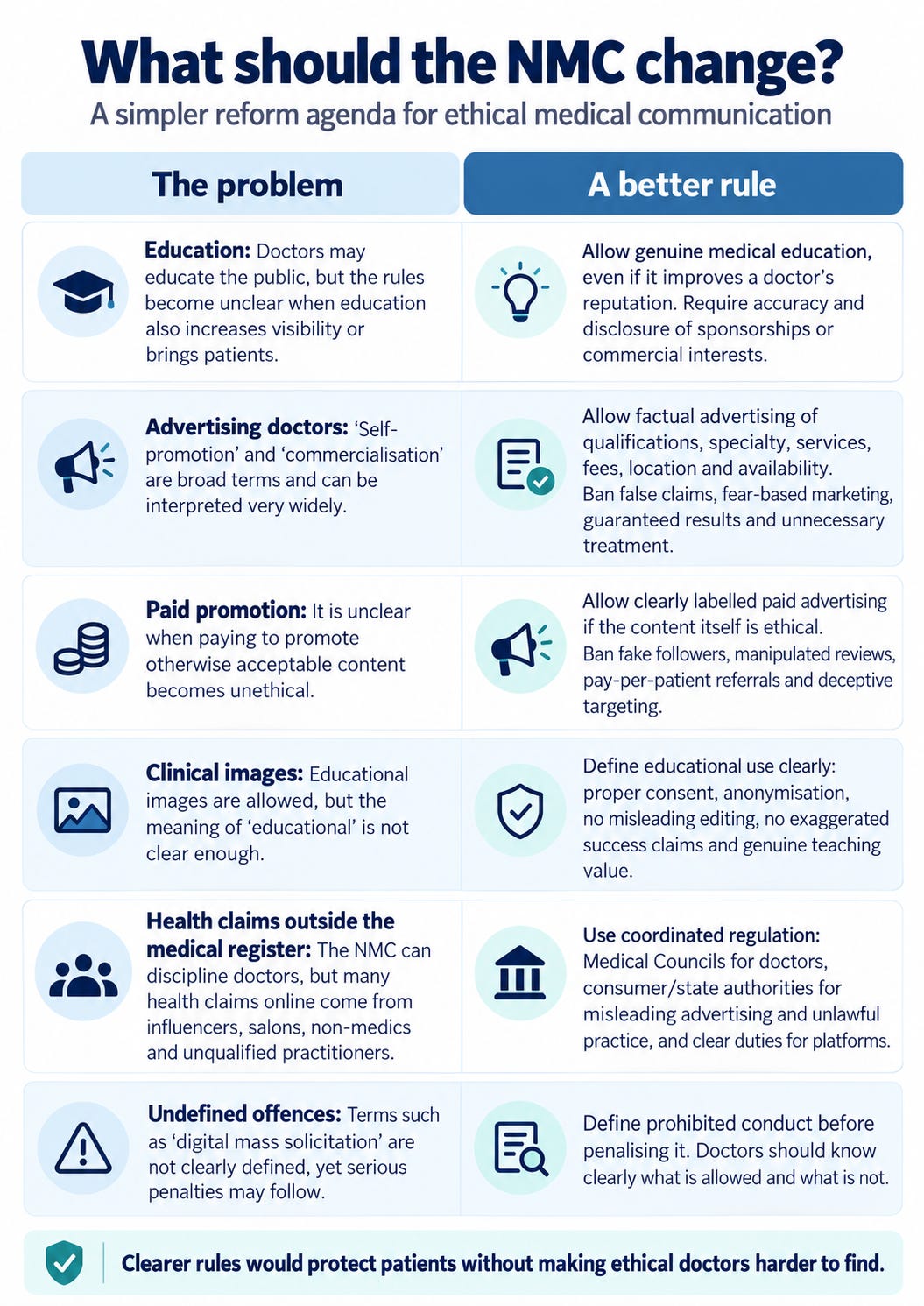
.There is another issue. The guidelines allow clinics and hospitals to share factual information, but they remain much stricter about promoting an individual doctor.
And these new rules still sit on top of the 2002 ethics regulations, which broadly discourage doctors from advertising their skills, qualifications or achievements.
So the real problem may be simple:
We are trying to regulate social media in 2026 using an advertising mindset written in 2002.
And this is where the real-world problem becomes uncomfortable. Qualified doctors do not communicate in a separate internet reserved for registered practitioners. They compete for the same patient’s attention with salons, wellness influencers, non-medics and outright quacks. If legitimate medical communication is tightly constrained while those voices remain far less effectively regulated, we risk giving greater visibility to precisely the people from whom patients may need the most protection- quacks. Surely cannot be the purpose of an ethics code?
Can NMC police the quacks?
The NMC cannot discipline somebody who was never registered with it, but other mechanisms exist. Under sections 19 and 21 of the Consumer Protection Act, the CCPA can investigate false or misleading advertisements and direct their discontinuation or modification, with penalties available in defined circumstances. [6] India Code Health-and-wellness influencer guidance also exists, while ASCI requires relevant qualifications to be disclosed when influencers provide technical health advice in commercial communications—although ASCI is self-regulatory, not a substitute for statutory enforcement. [7,8] Consumer Affairs
So the answer is not that the NMC should regulate everyone. It cannot. The answer is different regulators working together against the same harmful conduct.
They need rules that clearly distinguish education from inducement, commerce from exploitation and visibility from deception.
Patient protection should follow harmful conduct—not merely the registration number.
In an era in which patients increasingly find healthcare through search engines, Instagram and YouTube, professional obscurity should not accidentally become a measure of ethical virtue.
The aim should not merely be to ensure that doctors behave ethically online. It should be to ensure that patients encounter ethical healthcare information online—whoever is providing it.
What Next?
The NMC should revise these guidelines before vague wording becomes restrictive practice. The aim should not be to make doctors less visible. It should be to stop misleading, exploitative and harmful medical promotion—whoever is doing it.
Doctors should be free to educate, communicate their qualifications and services, and remain visible to patients, provided they do so honestly and without inducing unnecessary care.
At the same time, misleading health claims by influencers, salons, non-medics and unqualified practitioners need equally serious attention through the appropriate regulators.
A modern ethics code should protect patients from harmful communication, not protect them from seeing qualified doctors online.
The NMC has started an important conversation. It should now refine the rules—clearly, urgently, and with the realities of modern medical practice in mind.
Disclosure: I run a private dermatology practice and OnlineSkinSpecialist.com, an online dermatology consultation service using AI-assisted communication. The NMC provisions on AI-generated promotional material, patient data used as AI input, and potentially healthcare platforms therefore directly affect my professional interests.
References
1. National Medical Commission. Guidelines on Ethical Advertising and Public Communication by Hospitals/Medical Institutions and Registered Medical Practitioners. Public Notice No. R-13014/01/2024-Ethics, 6 October 2026; especially cls. 3.2–3.4, 4.4, 5.1, 6.2–6.4, 7.2–7.4, 8.1–8.3, 9.1–9.4 and 10–11. 20261006154257-publicnotice-eth…
2. Medical Council of India. Indian Medical Council (Professional Conduct, Etiquette and Ethics) Regulations, 2002, reg. 6.1.1. NMC-hosted regulations
3. National Medical Commission. Registered Medical Practitioners (Professional Conduct) (Amendment) Regulations, 2023, 23 August 2023, regs. 3–6, holding the 2023 regulations in abeyance and making the 2002 regulations effective with immediate effect. National Medical Commission
4. General Medical Council. Using social media as a medical professional, effective 30 January 2024; especially paras 10–12, read with Good medical practice, paras 89–91. GMC UK
5. Australian Health Practitioner Regulation Agency. Guidelines for advertising a regulated health service, especially sections 4.3–4.4 and guidance on testimonials, unnecessary healthcare and images/before-and-after photographs. AHPRA
6. Government of India. Consumer Protection Act, 2019, ss. 19 and 21. India Code
7. Department of Consumer Affairs, Government of India. Additional Influencer Guidelines for Health and Wellness Celebrities, Influencers and Virtual Influencers, 2023. Consumer Affairs
8. Advertising Standards Council of India. Influencer Advertising Guidelines, Addendum II—Health and Financial Influencers, current guidance. Asci Online