

A patient walks in with a rash. They expect a diagnosis — a name, a label, certainty.
But the first step is not to identify what it is.
It is to exclude what it cannot be — especially what would be dangerous to miss.
Is this skin cancer? Unlikely.
Is this tuberculosis? No supporting features.
Is this a drug reaction? Possible.
Is this viral? Likely, if acute.
This is how most clinical decisions are made: not by instant recognition, but by structured elimination.
Medicine is closer to solving an MCQ than writing an essay.
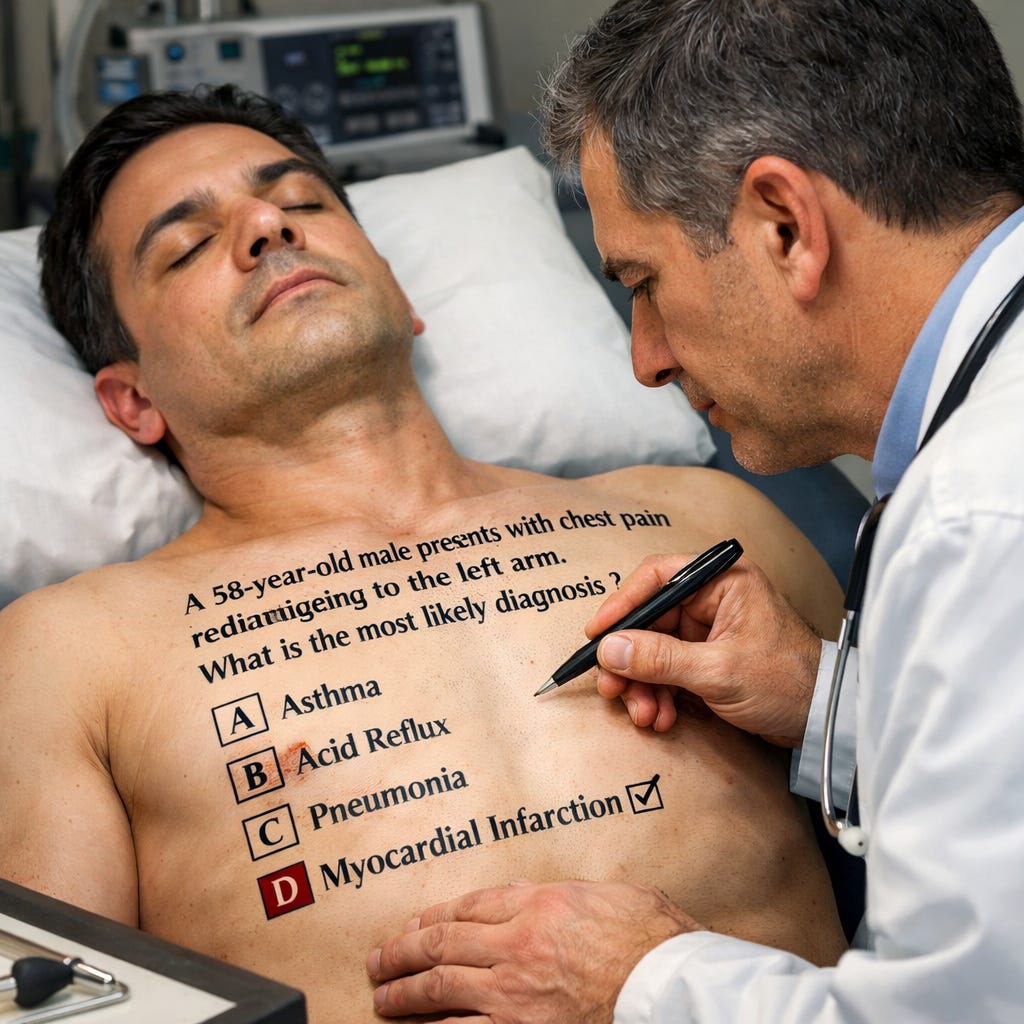
You narrow the field. You remove the wrong answers. What remains is not always perfect — but it is the most probable, and more importantly, the safest.
Time changes the diagnosis
Take something as simple as fever for two days.
We usually do not know the exact cause.
But we know what it almost certainly is not — not chronic infection, not autoimmune disease, not something evolving over weeks.
So we classify it probabilistically: most likely viral.
If the fever persists beyond 5–7 days, the probability landscape shifts. Now bacterial, inflammatory, and other causes move up the list.
Dermatology follows the same logic.
An acute rash is often a viral exanthem or hypersensitivity reaction.
A chronic, relapsing eruption shifts the balance toward psoriasis, eczema, or autoimmune disease.
Time is not just a passive variable. It is a diagnostic tool.
Experience is calibration under uncertainty
The difference between an experienced physician and an inexperienced one is not simply knowledge.
It is calibration.
An experienced physician knows what they do not know — and, more importantly, which uncertainties are acceptable.
An inexperienced physician, at the edge of their knowledge, often reaches for certainty — overdiagnoses, over-investigates, or treats prematurely to close the gap.

An experienced physician is comfortable holding that uncertainty — while ensuring that nothing dangerous is missed.
And if you cannot see the limits of your knowledge, you cannot eliminate correctly.
The real exam
The cognitive skill behind MCQs — holding multiple possibilities in mind and eliminating them systematically — is not an exam trick. It is the backbone of clinical reasoning.
But exams are only a proxy.
A patient is not a question with five options and one correct answer.
At any given moment, multiple diagnoses may coexist in probability. Good doctors do not collapse this too early. They keep alternatives alive, even while acting on the most likely one.

That is the real skill — not choosing an answer, but managing competing possibilities without making dangerous errors.
Medicine is not guesswork. It is disciplined reasoning under uncertainty.
The goal is not to be right every time.
It is to be wrong in ways that are safe.