

AI can help you create a beautifully formatted textbook page and project it onto a screen. But is that what the audience want?
At almost every major medical conference now, one can recognise the AI-assisted slide. Beautifully structured, neatly boxed, grammatically perfect and extraordinarily comprehensive. Pathogenesis, clinical features, investigations, histology and treatment somehow coexist on the same screen. Increasingly, even experienced and otherwise excellent speakers are using Claude, ChatGPT and similar tools to prepare presentations. There is absolutely nothing wrong with that. AI should be encouraged. It can organise our thoughts, identify gaps, simplify complicated concepts and produce excellent illustrations.
The problem begins when we assume that everything AI produces deserves to appear on the slide.
When we prepared presentations manually, adding information required effort and there was a natural tendency to stop. AI has made generating more content almost effortless.
That is not a defect of AI; it is an editing failure by the speaker.
For an ordinary live conference presentation, a slide usually needs only a few important points, perhaps two to five. If the renal manifestations deserve discussion, give them another slide. If the histology matters, show it separately. You are not removing information. You are controlling when the audience receives it.
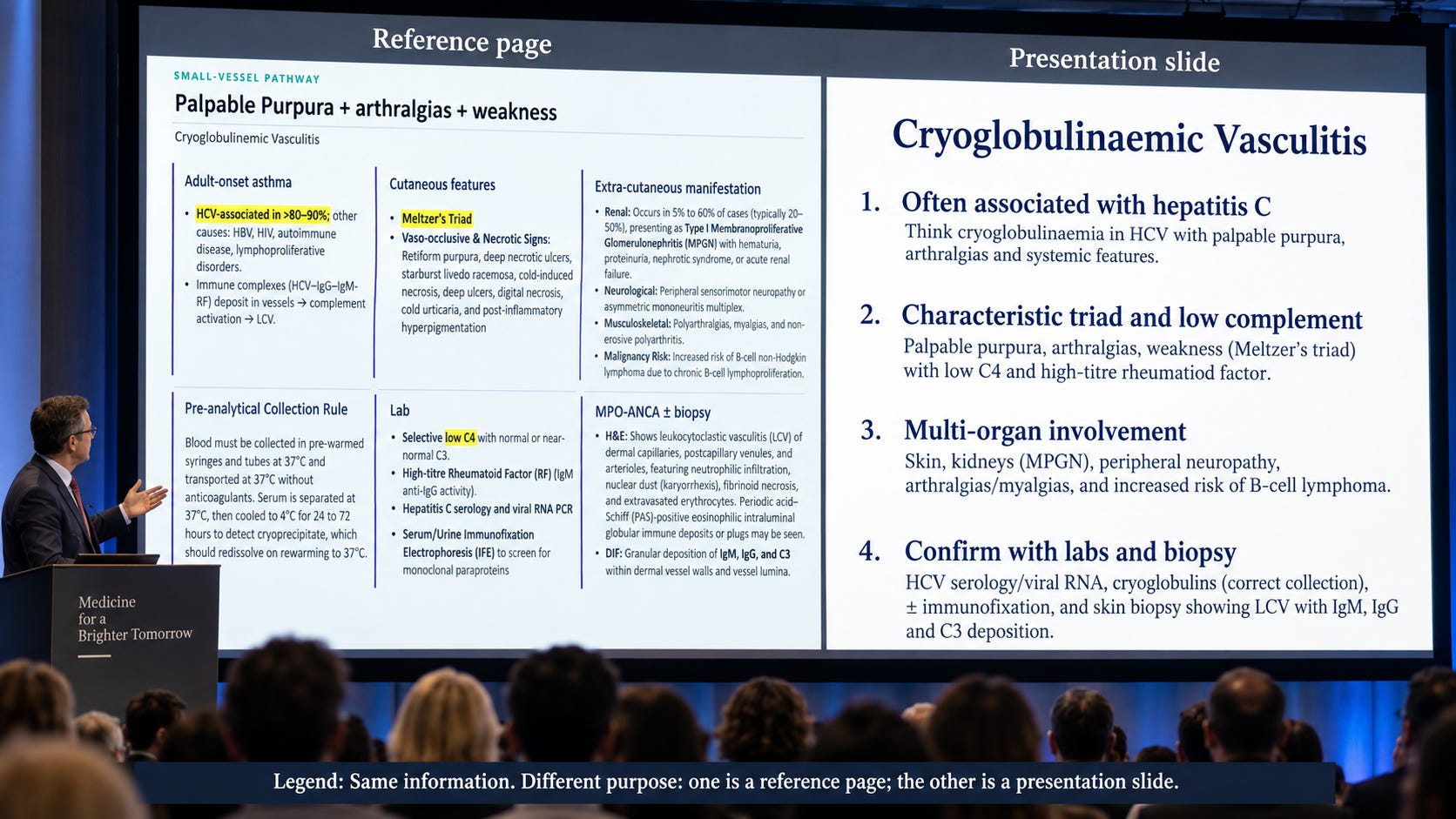
Same information. Different purpose: one is a reference page; the other is a presentation slide.
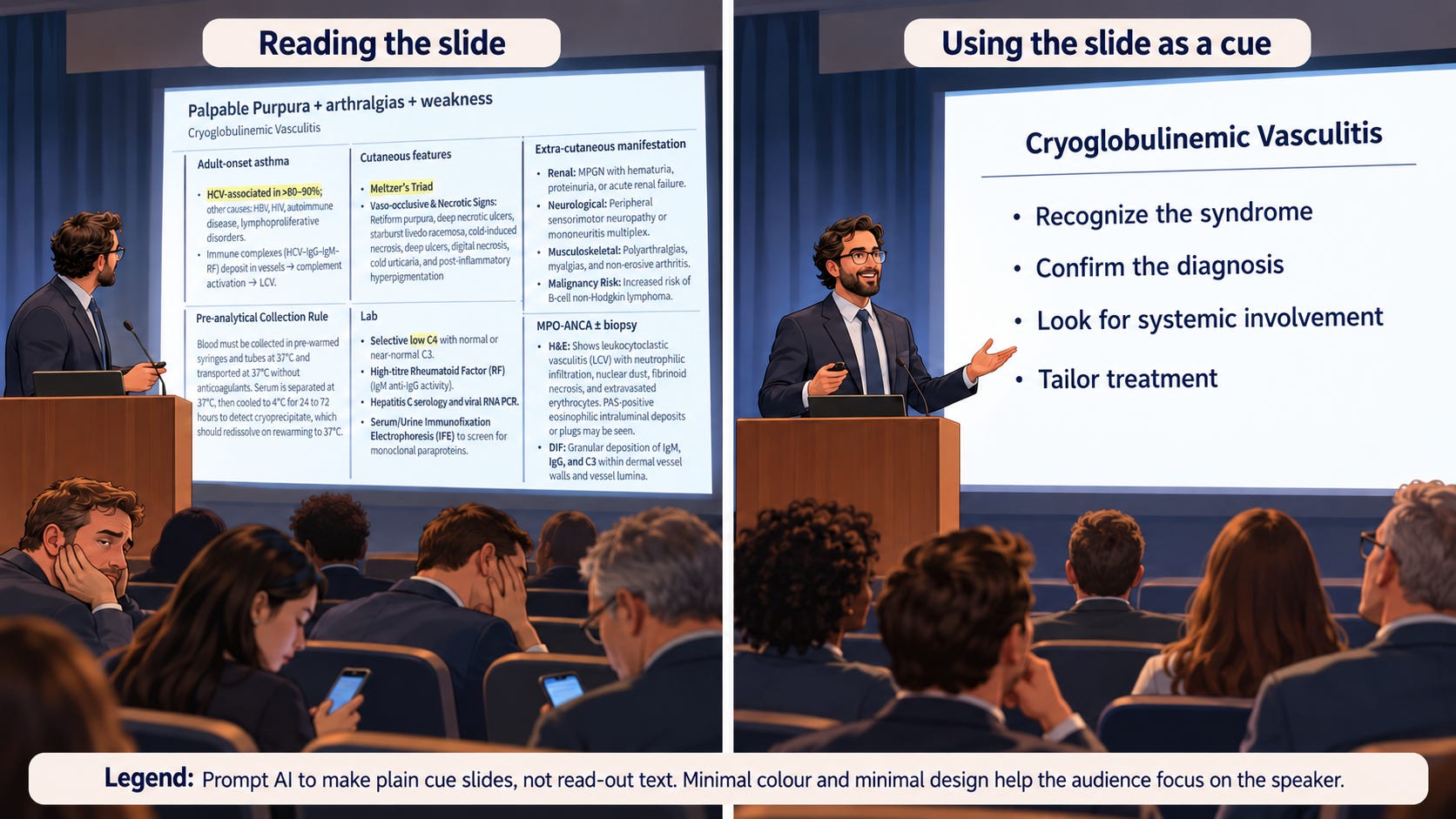
Dense slides are only half the problem. The other half has nothing to do with AI and existed long before it: speakers reading the text on their slides aloud. If the audience can see the sentence, they do not need us to read it to them. They can read a textbook themselves. Today, they can also ask an AI model for a perfectly competent summary before the session has even started.
They came to hear what the speaker adds: interpretation, experience, disagreement, emphasis, humour and judgement.
The slide should largely be a cue for what you want to discuss, not a teleprompter containing everything you intend to say.
AI-generated illustrations need the same restraint. A beautiful diagram can quickly become useless when every structure, pathway and arrow is labelled. If an image contains several important ideas, divide it across several slides and reveal them sequentially. Minimal labelling usually works better because the explanation should come from the speaker.
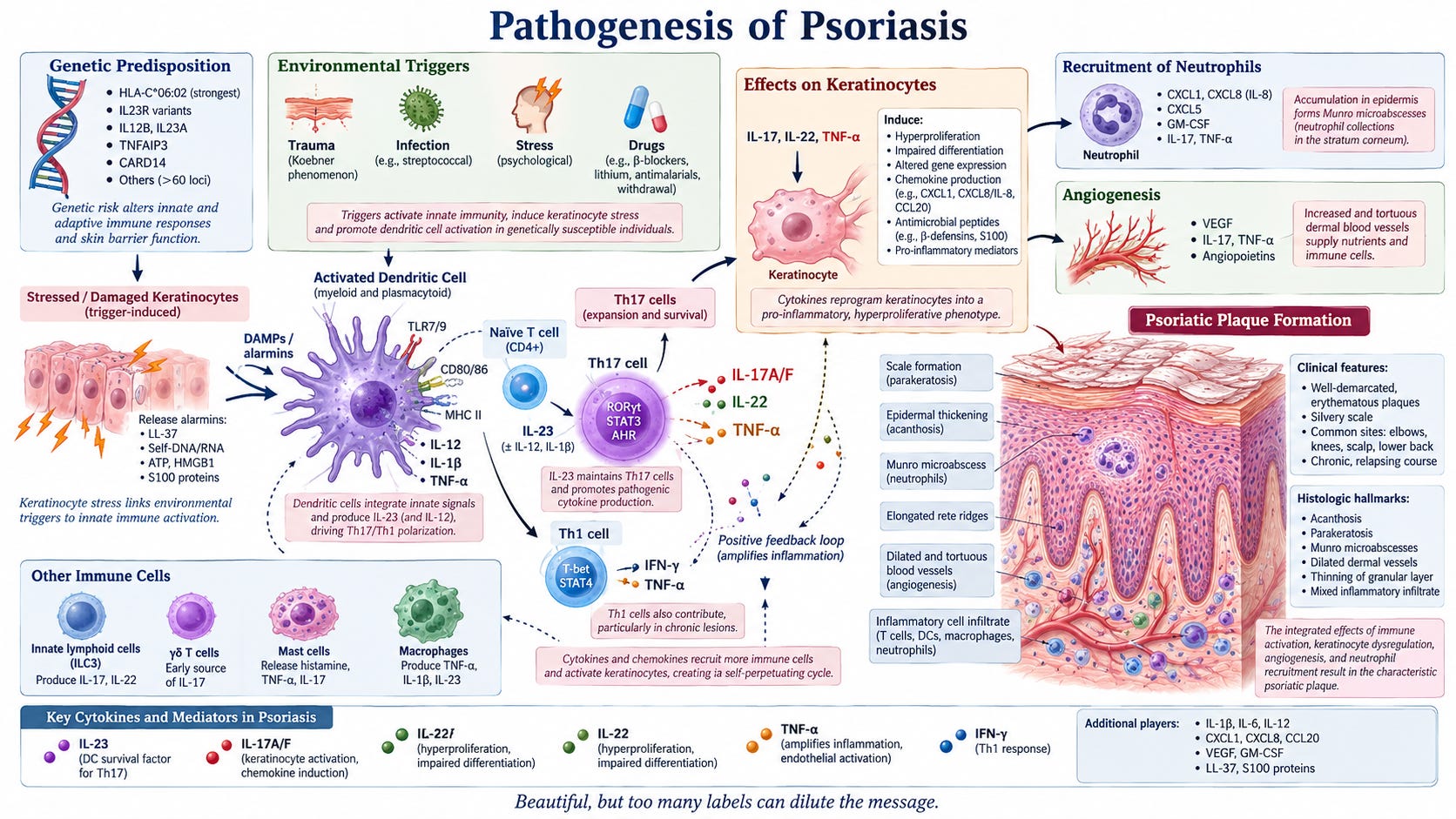
This is a beautiful slide. But how much can the audience take in?
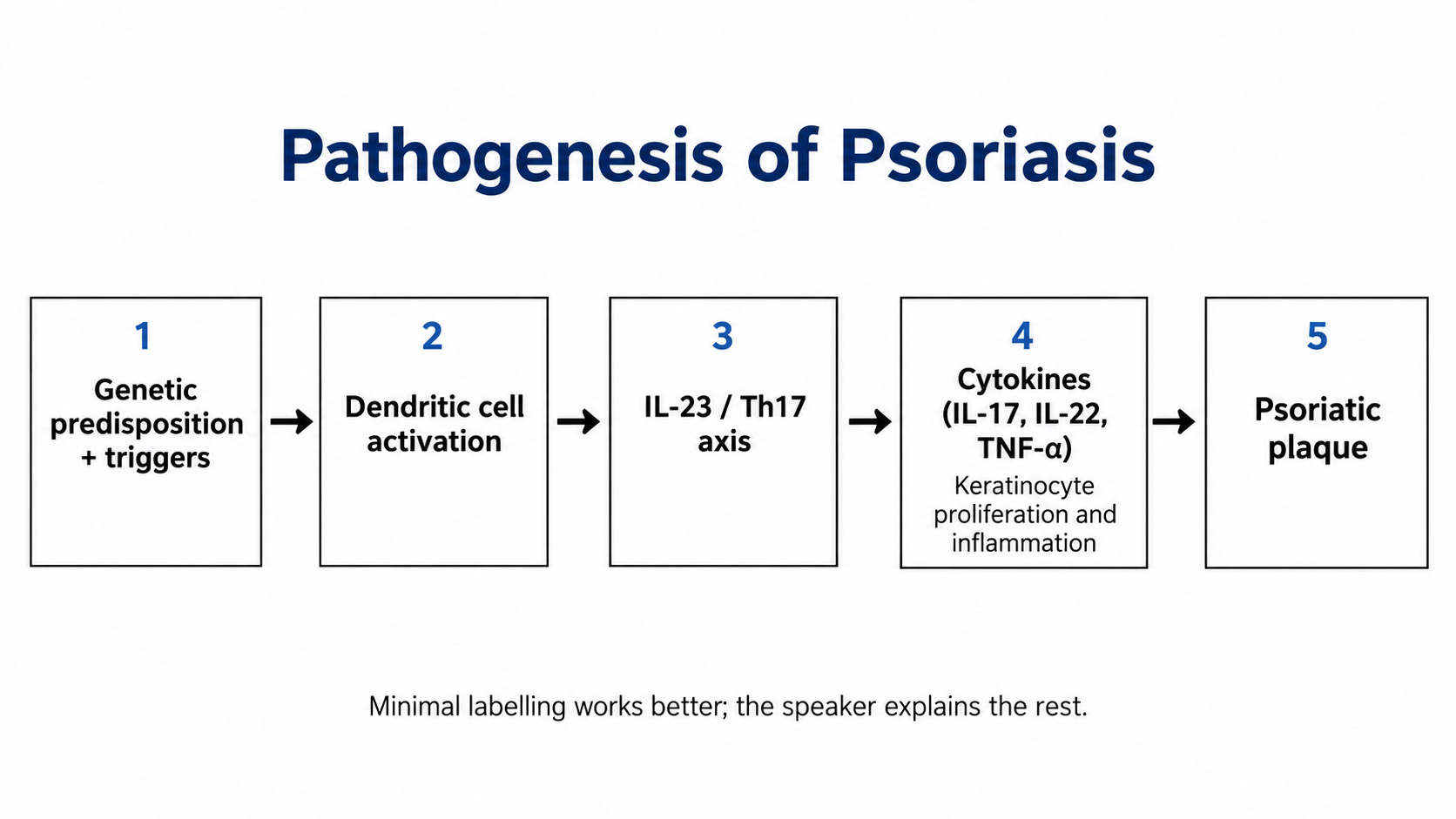
The same pathway, presented two ways. AI can generate a beautiful, information-rich diagram, but for a live talk, minimal labelling and a simple sequential pathway make the message easier to follow.
When generating text slides, Instead of asking, “Make a slide on cryoglobulinaemic vasculitis,” try asking, “What are the four things I want a dermatologist to remember six months after this talk?” Or paste a crowded slide back into the AI and ask it what can safely be removed and explained verbally. The technology is very good at producing information. The increasingly important human skill is deciding what not to show.
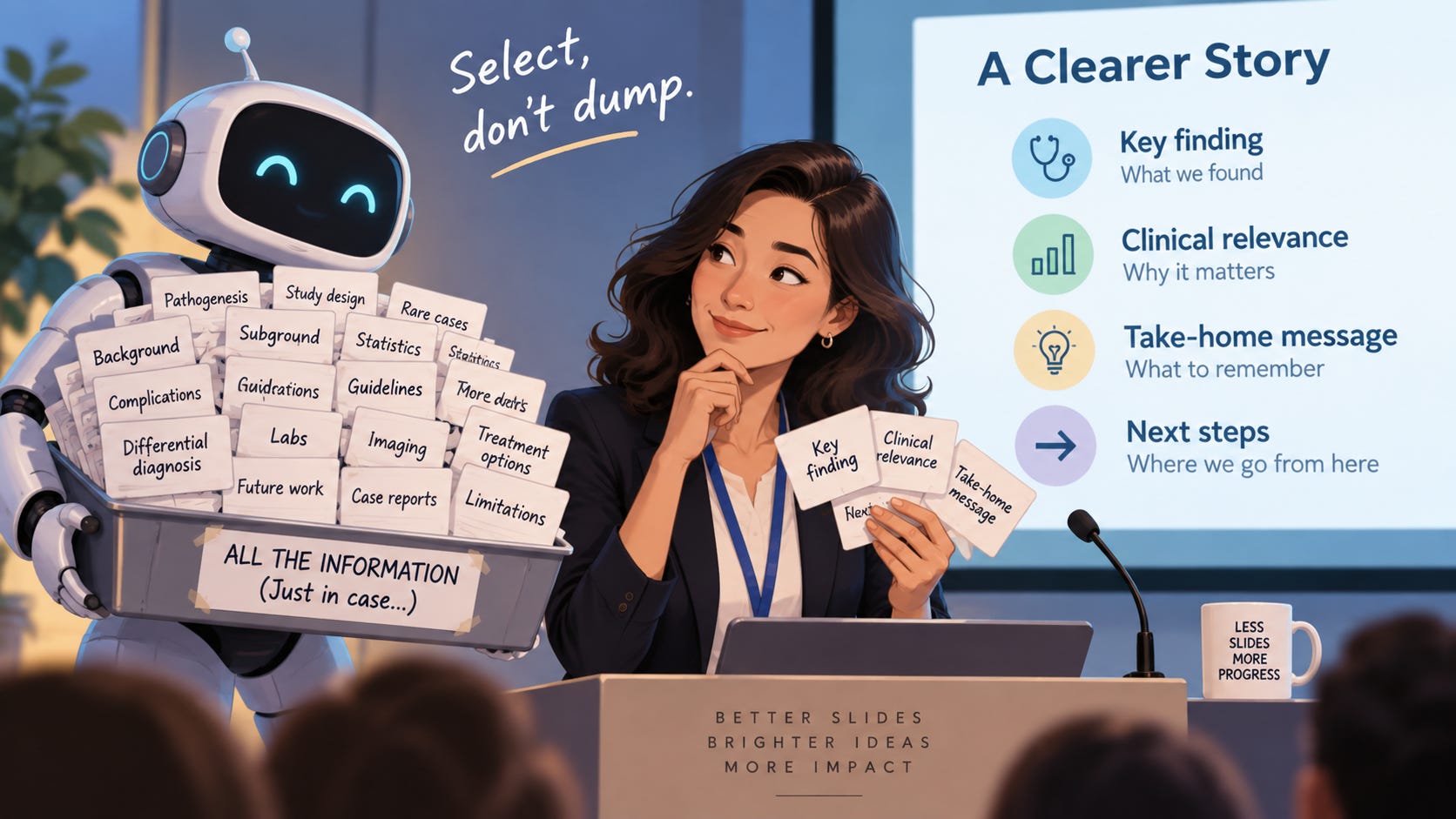
AI can generate the material. Selection remains the speaker’s job.
“The audience has not come to see what you asked Claude. They have come to hear what you think about the answer.”
Indeed sir
Very relevant.
It is very easy to realise what is AI generated and what is original.
Why to go to conference/CME to see AI generated slides?