

HydraFacial is everywhere.
Aesthetic clinics advertise it. Influencers film it. Machines gurgle satisfyingly while little reservoirs fill with what appears to be the debris of one’s past sins.
And afterwards, quite often, the skin looks good.
Cleaner. Smoother. Plumper. Brighter.
A glow, as they say.
I have no quarrel with glow.
The question is whether HydraFacial is a scientifically established treatment for skin disease—or primarily a cosmetic procedure that makes skin look better for a while.
These are not the same thing.
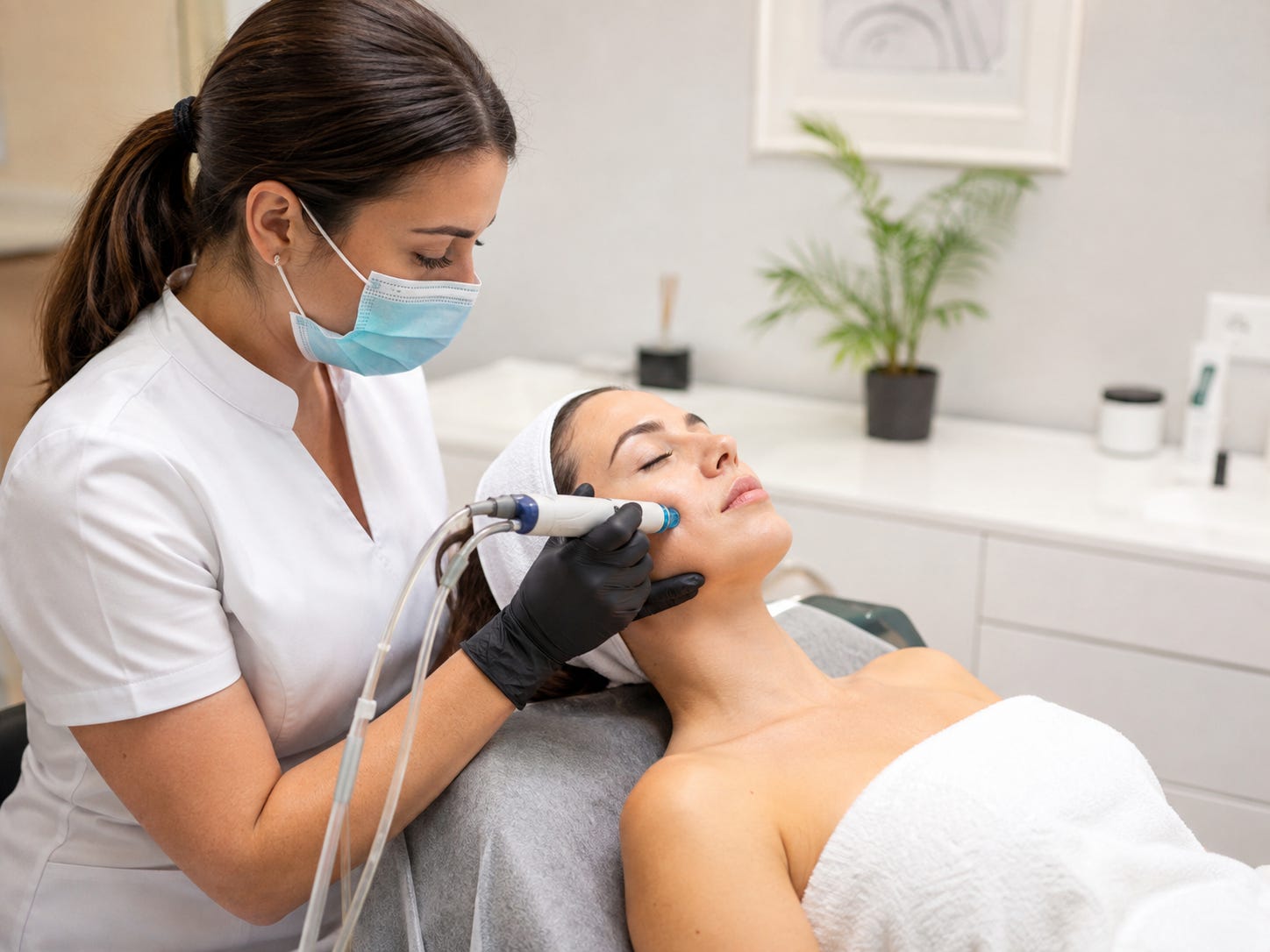
Why the white coat matters
A facial in a beauty salon is judged simply: did you enjoy it, and did your skin look better?
But place the same machine inside a dermatologist’s clinic and it acquires something extra: medical credibility.
Patients may reasonably assume that if a procedure is offered for acne, pigmentation, rosacea or ageing, it must have convincing clinical evidence behind it.
That assumption deserves scrutiny.
There is a fundamental difference between:
“My skin looked better afterwards.”
and
“This treatment has been shown to meaningfully improve my disease.”
HydraFacial fits the first statement rather comfortably.
The second is where things become interesting.
What exactly does it do?
HydraFacial is a proprietary form of hydradermabrasion, combining cleansing, exfoliation, suction and application of solutions containing acids, humectants and antioxidants.
Many of those ingredients are biologically active. Salicylic acid works. Glycolic acid works. Hyaluronic acid hydrates.
But that does not answer the more important question:
Does delivering them through a HydraFacial produce better or longer-lasting results than using appropriate topical products?
Evidence for an ingredient is not automatically evidence for the machine delivering it.
Otherwise, putting paracetamol in a gold-plated dispenser would constitute pharmaceutical innovation.
What does the evidence show?
The literature is surprisingly small.
The 2008 study
Twenty women were randomised to receive either six hydradermabrasion treatments with an antioxidant serum or manual application of the serum.
The hydradermabrasion group showed improvements in fine lines and pigmentation, with histological changes including increased epidermal and papillary dermal thickness and fibroblast density.
Interesting? Yes.
Definitive? No.
There were only about ten patients per group, and the comparator was weak. Manual serum application does not tell us whether hydradermabrasion is superior to good skincare, microdermabrasion, a superficial peel or another reasonable cosmetic intervention.
Nearly two decades later, robust independent replication remains lacking.
Science has an annoying habit.
It likes repetition.
Preferably by people who did not manufacture the machine.
The acne study
A 2022 study treated twenty adults with mild-to-moderate acne using six HydraFacial Clarifying treatments.
Acne improved.
But there was no untreated control group and no comparison with established acne treatment.
Worse, the protocol also included blue LED therapy.
So which component deserves the applause?
The suction?
The acids?
The LED?
Existing acne treatment?
The combination?
Nobody knows.
One of the authors was also an employee of the HydraFacial company. That does not invalidate the study.
It simply makes independent replication more important.
The 2024 imaging study
Eight volunteers were examined using line-field confocal optical coherence tomography (LC-OCT) after hydradermabrasion.
The study showed measurable changes in the stratum corneum and superficial dermis.
So yes, hydradermabrasion clearly does something.
But by two weeks, much of the superficial dermal change had returned towards baseline, and there was no visible improvement in collagen quantity or quality.
That is worth remembering when the procedure is promoted as “rejuvenation”.
The glow arrives loudly.
Collagen remains rather more reserved.
What is still missing?
We still lack good comparative evidence answering basic questions:
Is HydraFacial better than appropriate skincare?
Does it improve acne beyond standard treatment?
Does it meaningfully improve melasma or rosacea?
Does repeated treatment produce durable improvement in photoageing?
How long does the visible benefit last?
Do expensive boosters genuinely improve outcomes?
These are not academic details.
They are exactly what patients are paying to know.
“But my skin looked better”
I believe you.
That is not sarcasm.
Cleansing, exfoliating and hydrating the stratum corneum can genuinely make skin appear smoother and brighter. Fine lines may look softer. Light reflects differently from a smooth hydrated surface.
But aesthetic medicine often performs a little linguistic magic:
Looking better is not automatically the same as becoming biologically younger.
A wet road looks darker after rain.
The asphalt has not undergone rejuvenation.
Glow is not disease modification
Acne is not simply dirty pores waiting to be vacuumed.
Melasma is not pigment sitting on the surface waiting for a nozzle.
Rosacea is not dry skin needing hydration.
And ageing is certainly not merely a shortage of serum.
A temporary cosmetic improvement can coexist perfectly well with persistence of the underlying disease.
Both things can be true.
So is HydraFacial useless?
No.
That would be equally unscientific.
The evidence suggests that it is biologically active, generally well tolerated and capable of producing short-term cosmetic improvement.
The problem is not evidence of failure.
It is insufficient evidence of durable therapeutic success.
HydraFacial may therefore be a perfectly reasonable cosmetic procedure for someone who understands what they are buying:
cleaner-feeling skin, exfoliation, hydration and perhaps a pleasant glow.
Nothing wrong with that.
People buy haircuts and massages without demanding randomised controlled trials.
Cosmetic pleasure does not require medical justification.
The problem begins when pleasure is repackaged as therapy.
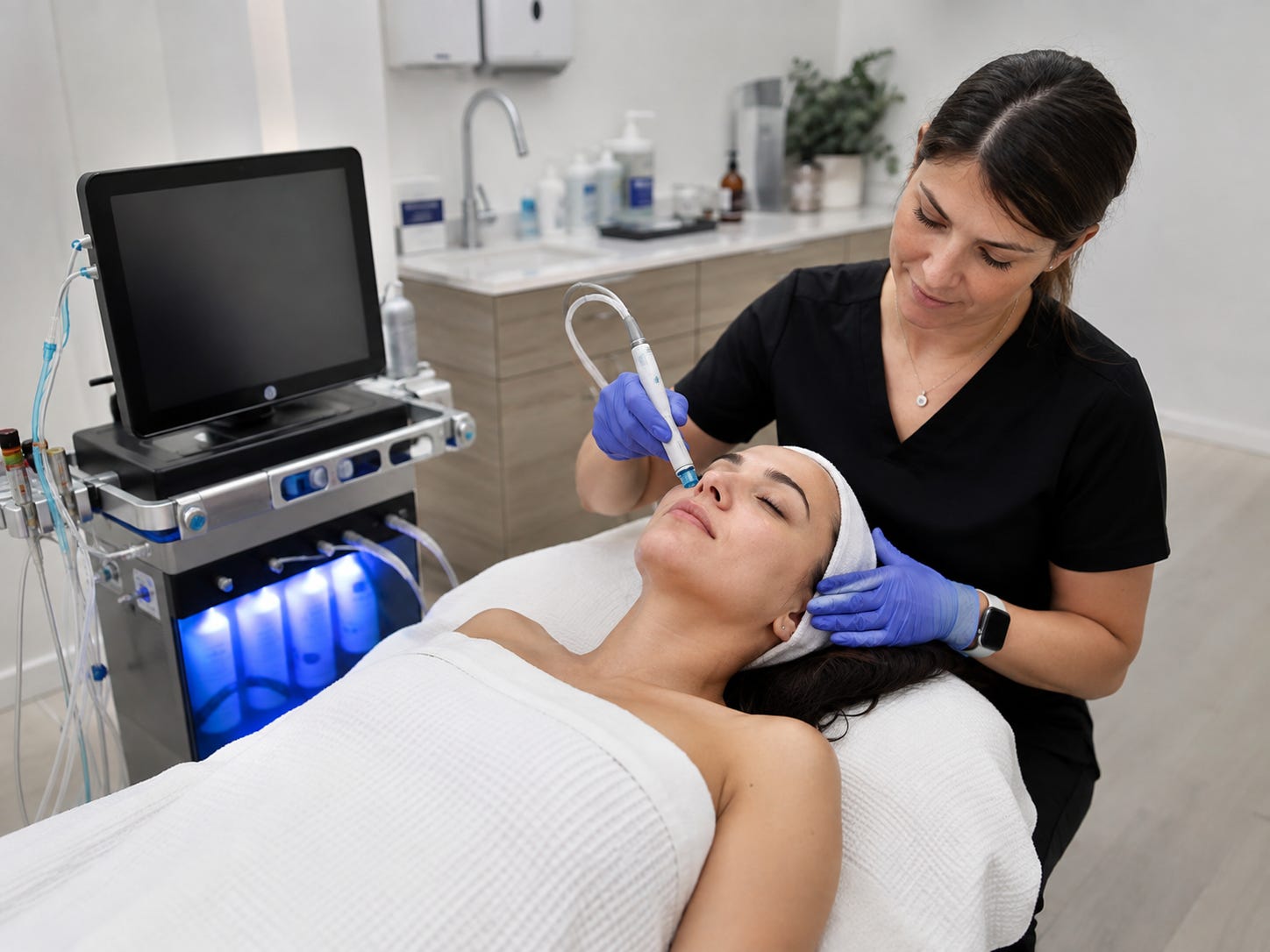
Should dermatologists offer it?
Maybe?—provided it is described honestly.
Patients should understand that the evidence for durable therapeutic benefit is limited, that most demonstrated effects are short-term, and that HydraFacial should not replace established treatment for genuine skin disease.
The ethical problem is not the machine.
Machines are innocent.
The problem begins when the authority of a medical setting blurs the boundary between a cosmetic service and an evidence-based treatment.
A white coat should clarify that distinction.
Not camouflage it.
The bottom line
HydraFacial does something.
It cleans, exfoliates, hydrates and can temporarily improve the appearance of skin.
Small studies also suggest measurable biological effects.
But the evidence remains limited, the studies are tiny, durable outcomes are poorly demonstrated and convincing comparative trials are largely absent.
So HydraFacial does not need to be ineffective to be oversold.
That is the point.
The suction is real.
The serum is real.
The glow may be real.
The transformation remains considerably less certain.
And patients deserve to know the difference.
References
Freedman BM. Hydradermabrasion: an innovative modality for nonablative facial rejuvenation. Journal of Cosmetic Dermatology. 2008;7(4):275–280.
Storgard R, Mauricio-Lee J, Mauricio T, Zaiac M, Karnik J. Efficacy and tolerability of HydraFacial clarifying treatment series in the treatment of active acne vulgaris. Journal of Clinical and Aesthetic Dermatology. 2022;15(12):42–46.
Razi S, Truong TM, Khan S, Sanabria B, Rao B. Hydradermabrasion through the lens of line-field confocal optical coherence tomography. Skin Research and Technology. 2024;30(4):e13684.