

A patient recently came to see me with persistent facial pain, tenderness and swelling, two months after having Endolift elsewhere. The symptoms were maximal over the cheekbone region — the same area where she had received dermal filler roughly two years earlier.
That association is interesting. It does not establish causation. The possibilities remain open: a delayed inflammatory reaction involving the old filler, thermal alteration of pre-existing filler, infection, or a direct complication of Endolift. I have not yet concluded which.
But it made me look closely at Endolift. How good is the evidence that it actually tightens skin? What do we know about applying thermal energy where filler may already exist? And perhaps most practically: is it actually better than fractional CO₂ laser, which we already know remodels collagen?
What exactly is Endolift?
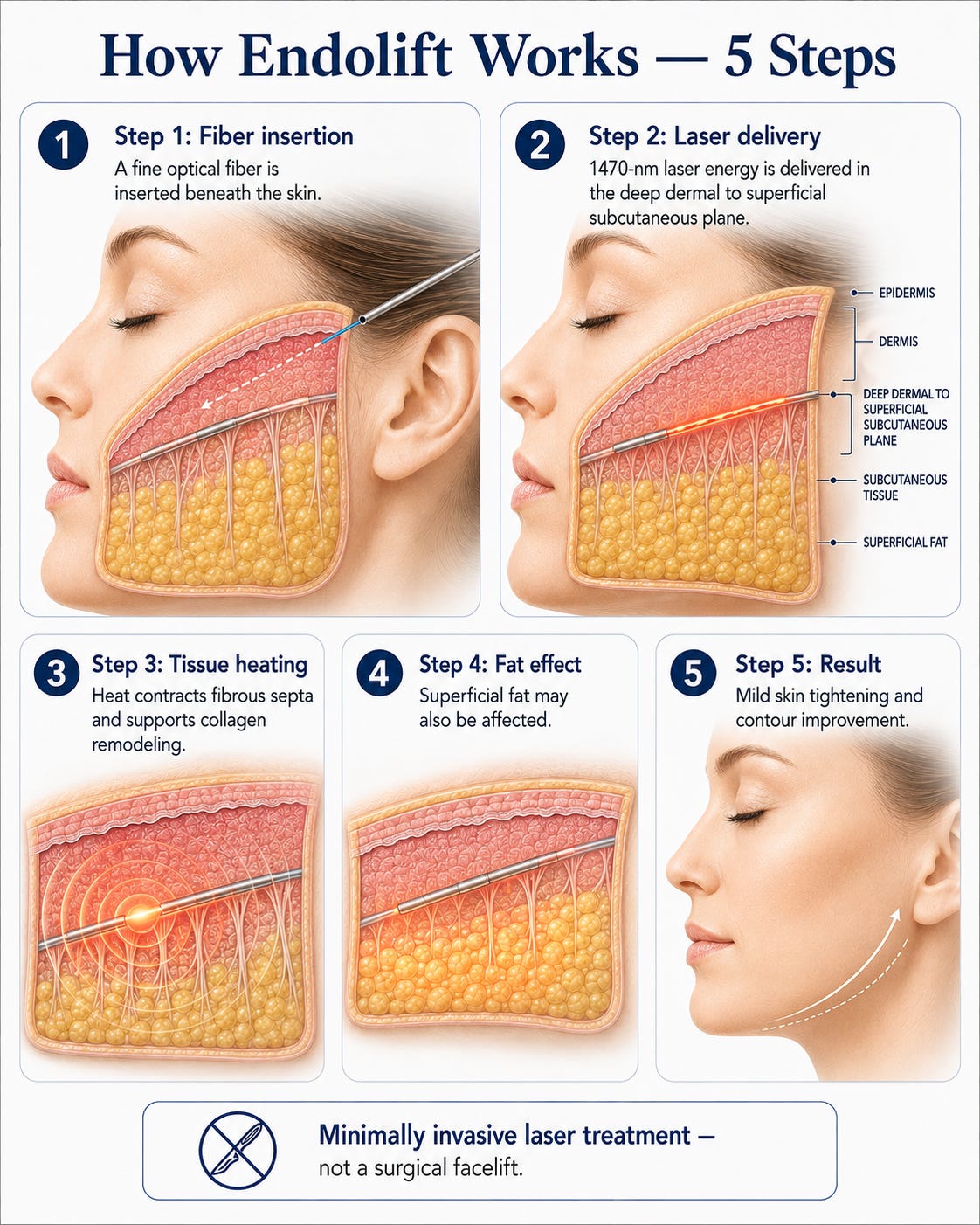
Endolift uses a 1470-nm diode laser delivered through a very fine optical fibre inserted beneath the skin. The aim is to heat deep dermal and superficial subcutaneous tissue, producing collagen remodelling and, depending on treatment depth and energy, some effect on superficial fat.
Calling it a “non-surgical facelift” is generous. There is no dissection or repositioning of tissue, and a laser fibre is physically being passed under the skin. Minimally invasive laser treatment is less glamorous but more accurate.
Does it work?
Probably — but the evidence is much thinner than the advertising.
A 2022 study involving 96 patients reported improvement in lower-face laxity after Endolift, with follow-up extending to 18 months. However, there was no untreated or sham-Endolift group, and the outcome depended largely on clinical ptosis grading rather than objective three-dimensional measurement.[1]
A 2024 systematic review of 23 studies was broadly favourable, while acknowledging that most of the evidence was lower-level observational research.[2] A more critical systematic review in 2025 found only seven eligible studies and reported high risk of bias, inconsistent treatment parameters and inadequate safety data. The authors concluded that confidently establishing efficacy and safety remains difficult.[3]
There is genuine biological evidence. A 2025 human histological study found increased dermal thickness and collagen deposition after subdermal 1470-nm laser treatment at moderate energy settings. At the highest energy tested, however, collagen fragmentation and poorer elastin organisation appeared.[4]
In laser medicine, apparently, more cooking does not necessarily improve the dish.
But fractional CO₂ already stimulates collagen
This is the comparison I find more interesting.
“Stimulates collagen” is often presented as though it were some special property of Endolift. It isn’t.
Fractional CO₂ has considerably more established evidence for dermal remodelling. In a prospective study, Naouri and colleagues objectively measured skin mechanical properties using a Cutometer before and after fractional CO₂ resurfacing. Elasticity improved by 5.9%, with significant improvements in several other biomechanical parameters.[5]
Even more persuasive is a split-face human histology study. Sixteen women received fractional CO₂ treatment to one periorbital side before blepharoplasty, while the opposite side served as an untreated control. Histology showed significantly greater type I and type III collagen on the treated side.[6]
So if the argument for Endolift is simply:
“It heats tissue, stimulates collagen and tightens skin,”
fractional CO₂ can reasonably reply:
“Welcome to the club.”
Is Endolift actually better than fractional CO₂?
Here the answer is remarkably simple.
We do not know.
I could find no head-to-head randomized trial showing that Endolift produces greater tightening than fractional CO₂, no comparative histological study showing greater collagen production, and no convincing evidence that its results last longer.
Endolift does have a plausible anatomical advantage. Because the fibre is passed beneath the skin, it can deliver energy to superficial fat and fibrous septa that fractional CO₂ cannot directly reach. That may prove useful for some patients with lower-face heaviness or jowling.
But that is a theoretical advantage based on treatment depth, not demonstrated clinical superiority.
For wrinkles, photodamage, texture and dermal collagen remodelling, fractional CO₂ has the more mature and objectively measured evidence base.

And what if there is already filler there?
This is where my patient’s presentation becomes particularly relevant.
Hyaluronic-acid filler is not thermally inert. A 2024 review found that energy-based treatments can alter HA filler degradation, depending on the device, depth, energy, filler characteristics and treatment timing.[7]
Delayed inflammatory reactions to HA filler are also recognised. Published incidence estimates vary substantially — roughly 0.3% to 4.25% has been reported — and reactions may present with swelling, tenderness or nodules months after injection. Immune stimulation and local trauma are among the proposed triggers.[8,9]
Most importantly, I could find no published study specifically examining Endolift performed through or adjacent to pre-existing HA filler.
That does not prove that Endolift caused my patient’s symptoms.
It means we do not know.
And “we don’t know” should never quietly turn into “there is no risk”.
What about the FDA?
The laser platform used for Endolift has US FDA 510(k) clearance as a Class II surgical laser, including for soft-tissue applications and laser-assisted lipolysis.
That does not mean the FDA has clinically proven Endolift to be a “non-surgical facelift”. The FDA’s 2026 clearance documentation specifically states that clinical performance data were not required to establish substantial equivalence.
“FDA-cleared laser platform” is accurate.
“FDA-approved non-surgical facelift” has clearly spent some time with the marketing department.
Am I missing out by not offering Endolift?
At present, I don’t think the evidence says that I am.
I already use fractional CO₂ laser when dermal remodelling, wrinkles and skin tightening are appropriate treatment goals. It has objective biomechanical evidence, controlled human histological evidence and a much longer clinical track record.
That does not make Endolift useless. Its deeper treatment plane may eventually prove advantageous in selected patients, particularly where superficial fat and subcutaneous structures contribute to laxity.
But the burden of proof should be on a newer procedure to demonstrate that it offers something meaningfully better than treatments we already have.
At present, Endolift has not done that.
The bottom line
Endolift is an interesting technology with a credible biological effect and preliminary evidence of tightening. It should not be dismissed.
But there is currently no hard evidence that it tightens skin better than fractional CO₂ laser, while fractional CO₂ has the stronger evidence base for objective dermal collagen remodelling.
Endolift may eventually establish a useful niche because it works at a deeper anatomical level. Until comparative trials demonstrate that advantage clinically, buying another expensive machine simply because it “stimulates collagen” is difficult to justify scientifically.
My CO₂ laser already knows that trick.

References
Longo L, Dell’Avanzato R, Longo D. ENDOLIFT® and multi-wavelength laser photobiomodulation: a randomized controlled trial study on 96 subjects, treating skin laxity of the lower third of the face. Laser Therapy. 2022;29:115–120. doi:10.4081/ltj.2022.298.
Nilforoushzadeh MA, Heidari A, Ghane Y, et al. The Endo-lift Laser (Intralesional 1470 nm Diode Laser) for Dermatological Aesthetic Conditions: A Systematic Review. Aesthetic Plast Surg. 2024;48:5097–5114. doi:10.1007/s00266-024-04082-2.
Modena DAO, Yamamoto APM, da Silva TBF. Endolift® is a non-surgical treatment for skin tissue conditions. Is there evidence for its application? Lasers Med Sci. 2025;40:22. doi:10.1007/s10103-025-04288-z.
Bollero D, Orlando G, Dell’Avanzato R, et al. In vivo pilot study of the effects of a subdermal 1470 nm diode laser on human skin. Laser Therapy. 2025;32(1). doi:10.4081/ltj.2025.422.
Naouri M, Atlan M, Perrodeau E, et al. Skin tightening induced by fractional CO₂ laser treatment: quantified assessment of variations in mechanical properties of the skin. J Cosmet Dermatol. 2012;11:201–206. doi:10.1111/j.1473-2165.2012.00627.x.
Sartori JF, Osaki TH, Osaki MH, et al. “Split-Face” Evaluation of Collagen Changes Induced by Periorbital Fractional CO₂ Laser Resurfacing. Aesthet Surg J. 2022;42:239–248. doi:10.1093/asj/sjab357.
Yi KH. Thermal degradation of hyaluronic acid dermal fillers. Plast Aesthet Res. 2024;11:56. doi:10.20517/2347-9264.2024.119.
Michon A. Hyaluronic acid soft tissue filler delayed inflammatory reaction following COVID-19 vaccination — A case report. J Cosmet Dermatol. 2021;20:2684–2690. doi:10.1111/jocd.14312.
Bhojani-Lynch T. Late-Onset Inflammatory Response to Hyaluronic Acid Dermal Fillers. Plast Reconstr Surg Glob Open. 2017;5:e1532. doi:10.1097/GOX.0000000000001532.