“Clinicopathologic correlation required.”
Few phrases in dermatopathology are used as reflexively—and as uncritically—as this one. It appears in reports across the spectrum, from inflammatory dermatoses to neoplasms, often positioned as a responsible disclaimer. In reality, it frequently signals a structural failure.
Not of the biopsy.
Not of the disease.
But of the system interpreting it.
The Illusion of Correlation
The premise sounds reasonable: histology must be interpreted in light of clinical findings. This is undeniably true. Dermatology is a visual specialty; dermatopathology is a pattern-recognition discipline. Neither stands alone.
But here is the problem:
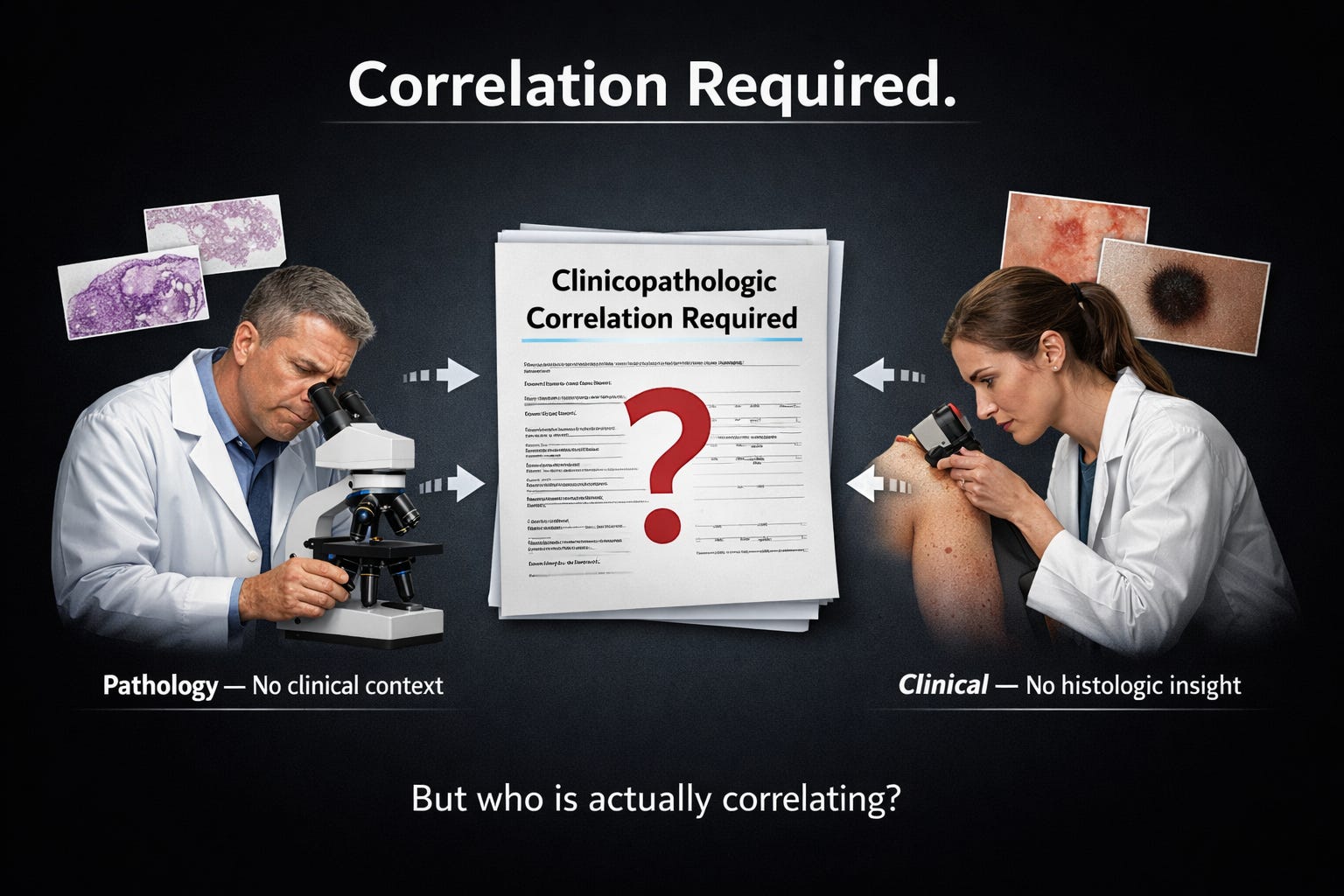
The pathologist often receives minimal, vague, or misleading clinical information.
The clinician often lacks the training to interpret histopathologic nuance.
Each assumes the other will “correlate.”
In practice, neither fully does.
The result is a report that is technically correct—but clinically hollow.
When Pathology Lacks Dermatology
A general pathologist, however competent, is not trained to think morphologically in dermatologic terms.
They may describe:
Spongiosis
Lichenoid infiltrate
Psoriasiform hyperplasia
But without dermatologic context, these are patterns without prioritization.
What matters clinically is not the presence of multiple patterns—but which pattern dominates, and why.
Without that hierarchy, the report devolves into:
“Features are suggestive of a spongiotic/lichenoid/psoriasiform dermatitis. Clinical correlation advised.”
This is not a diagnosis. It is a deferral.
When Dermatology Lacks Pathology
On the other side, clinicians often expect the biopsy to “give the answer.”
But histology is not a lab value—it is an interpretation.
Without understanding:
Reaction patterns
Temporal evolution of lesions
Histologic overlaps
the clinician may:
Over-rely on the report
Misinterpret descriptive terminology as diagnostic certainty
Ignore discordance when it matters most
This creates a dangerous asymmetry: false reassurance from ambiguous pathology.
The Consequence: Diagnostic Dilution
When neither side owns the correlation, three things happen:
Diagnostic specificity collapses
Reports become descriptive rather than decisive.Clinical decision-making weakens
Treatment is based on probabilities that were never clearly defined.Accountability disappears
“Correlation required” becomes a shield rather than a tool.
This is not a minor inefficiency—it directly impacts patient care.
The Only Real Solution: Integrated Expertise
Dermatopathology is not a collaboration between two incomplete perspectives.
It is a single discipline requiring dual competence.
A meaningful report requires someone who can:
Recognize histologic patterns
Rank them by diagnostic weight
Integrate clinical morphology
Resolve discordance—not defer it
This is not optional. It is foundational.
A Hard Truth
Opinion (evidence-informed):
A skin biopsy interpreted by:
a pathologist without dermatologic training, or
a clinician without histopathologic literacy
is often functionally inadequate, even if technically accurate.
This is not about elitism. It is about diagnostic integrity.
What Should Replace “Correlation Required”?
Not elimination—but accountability.
A competent dermatopathology report should:
State the most likely diagnosis
Explicitly address discordant features
Indicate degree of certainty
Suggest targeted next steps when needed
“Correlation required” should be the exception, not the default endpoint.
Final Thought
The biopsy is not the problem.
The problem is the gap between seeing and understanding.
Until the same mind—or at least the same level of expertise—bridges both,
“clinicopathologic correlation” will remain more slogan than solution.