

As India once again debates caste-based reservation, perhaps we should first ask a more basic question:
What does our caste actually tell us about who we are today?
The folowing is an interesting case study- The Aruvela Niyogis, commonly called the “6000 Niyogis,” are a sub-group of Telugu Brahmins (I apparently belong to this tribe). The obvious legend is irresistible: six thousand Brahmins were supposedly recruited by a king for administration or warfare, becoming Brahmins who performed the functions of Kshatriyas.
It is a good story. History appears to be slightly different.
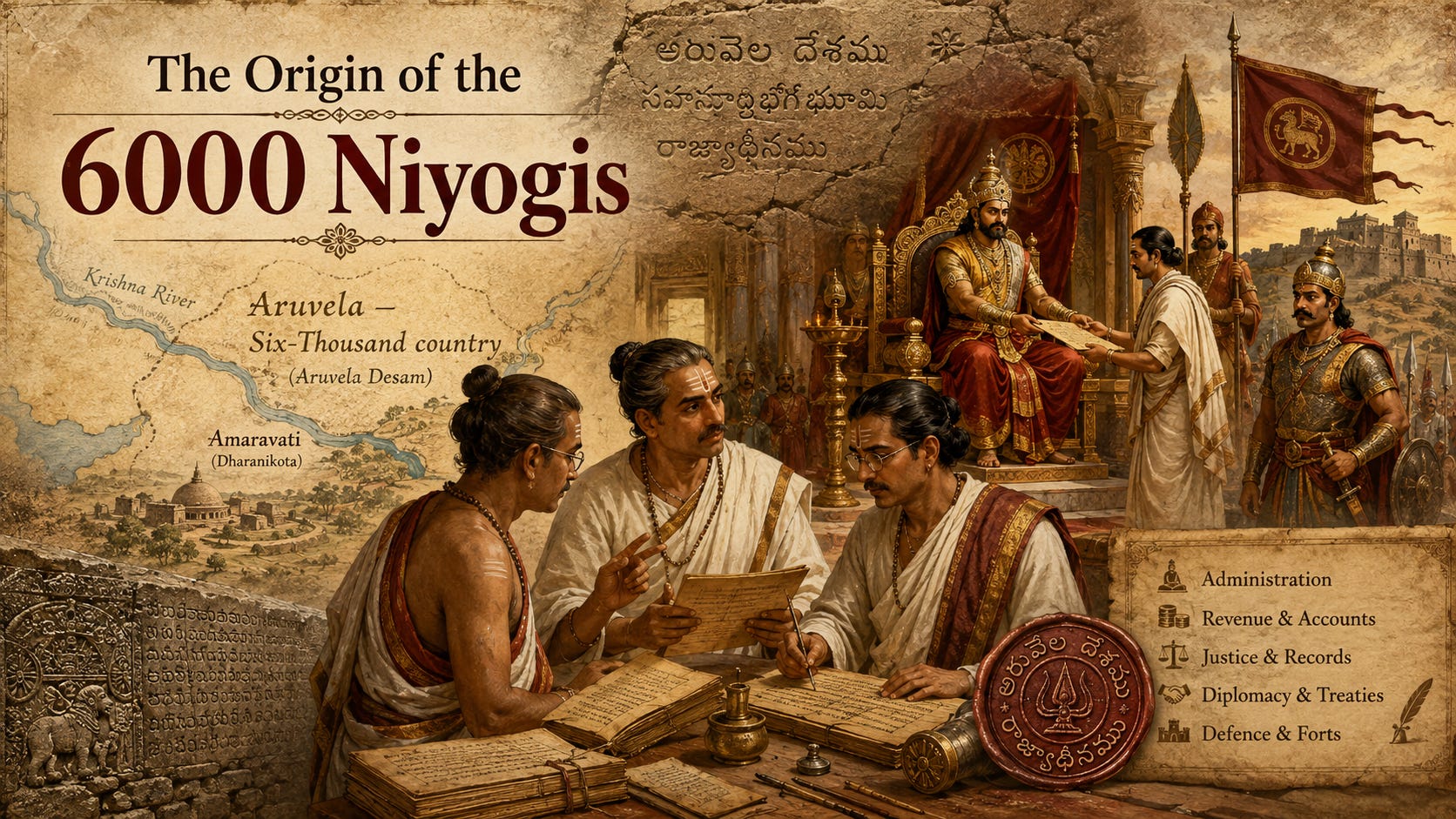
Aruvela literally means six thousand. In medieval Andhra inscriptions, a region south of the Krishna was known as Ṣaṭsahasra—the Six-Thousand country, with the Amaravati–Dharanikota region associated with it. Historical scholarship therefore suggests that Aruvela probably began as a geographical identity, much like several other Telugu communities named after the nadu or territory from which they came.
The second half of the name is even more revealing.
Niyogi derives from niyoga—an appointment or employment. Historian Phillip Wagoner describes Niyogis as laukika, or secular Brahmins, who supported themselves by accepting political and administrative appointments. Their emergence can be traced at least tentatively to the Kakatiya period of the twelfth and thirteenth centuries. Some became village accountants; others became ministers, bureaucrats and court officials. By the Vijayanagara period, Brahmins of this tradition could also become provincial governors, fort commanders and commanders of armies.
Think about what that means.
The ancestors of a community classified as Brahmin were spending generations doing jobs that classical varna theory would often associate with Kshatriyas—governing territories, collecting revenue and sometimes commanding soldiers.
They did not cease to be Brahmins. But their profession had already escaped the neat four-box diagram of Brahmin, Kshatriya, Vaishya and Shudra.
And perhaps therein lies something worth remembering about caste.
Many Indian caste and sub-caste identities undoubtedly became associated with particular occupations. Washermen washed clothes. Smiths worked metal. Trading communities traded. Priestly families performed rituals. Administrative communities administered. Over generations, occupations became family identities, identities became hereditary, and hereditary identities acquired social rank and rules of marriage. Historians consequently caution against imagining caste as a single, unchanged system frozen from antiquity; caste identities have repeatedly been created, altered and renegotiated over time.
But the occupation often disappeared long before the caste name did.
A Niyogi today may be a doctor, engineer, businessman, artist or software developer. A person born into a traditional agricultural caste need never have entered a field. The descendant of a trading community may be a civil servant. The descendant of a priest may never have learnt a Vedic mantra.
We inherited the labels. We did not necessarily inherit the jobs.
That thought seems relevant to the present reservation debate. Protesters at the recent Reservation Hatao Andolan at Jantar Mantar have argued that economic disadvantage rather than caste should increasingly determine state assistance. Those defending caste-based reservation counter that caste is not merely an obsolete occupational label: discrimination, unequal representation and accumulated social disadvantage can persist even when occupations change. Both propositions deserve to be confronted rather than caricatured.
The history of the 6000 Niyogis does not settle that debate.
But it does pose an uncomfortable question.
If caste once partly described what our ancestors did, how much should it determine what their descendants are entitled to—or denied—centuries later?
Perhaps a modern India should increasingly be interested not simply in the caste into which someone was born, but in the disadvantage, discrimination and opportunity that person actually experiences.
After all, history gave us our surnames and our caste labels.
It need not dictate our occupations.
And perhaps, one day, it need not dictate our opportunities either.