

Botox has become one of the most successfully marketed treatments in aesthetic medicine.
A face that moves less is now routinely presented as a face that has aged less.
It has not.
Do see this young lady’s post on Instagram and my comments in the comments section:
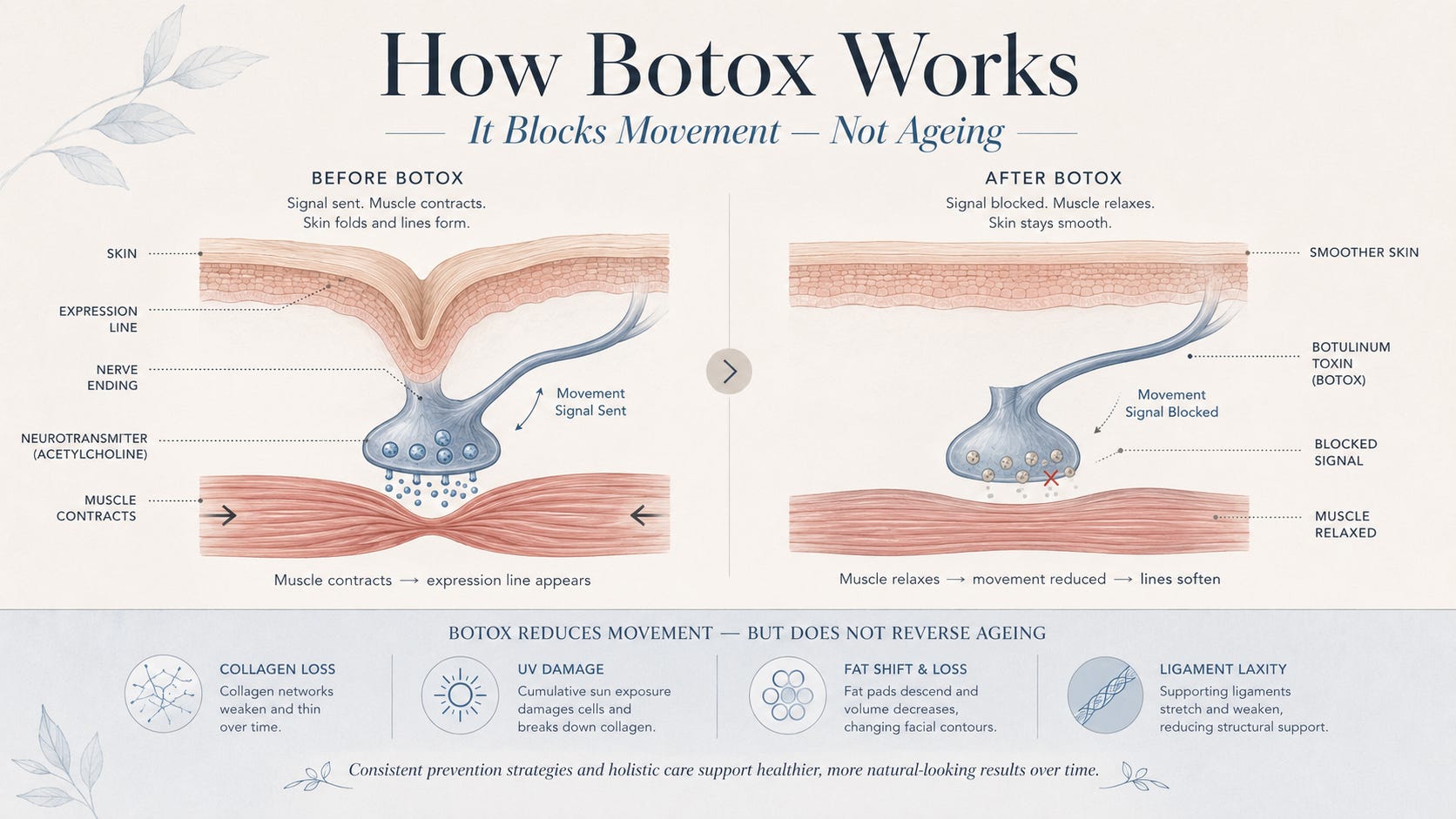
Botulinum toxin does not replace collagen, reverse sun damage or rebuild ageing skin. It weakens the muscles that crease the skin. The forehead looks smoother because it moves less—not because the skin has become younger. Calling this “rejuvenation” sounds attractive. Calling it temporary chemodenervation is less glamorous, but more accurate.
Botox has a legitimate use
Let me say this at the outset. Botox can be very effective for prominent expression lines, and a patient who dislikes deep forehead or frown lines may reasonably choose treatment and be pleased with the result. The problem begins only when reducing muscular movement is presented as treatment of facial ageing itself. The two are not the same.
Botox treats movement, not ageing
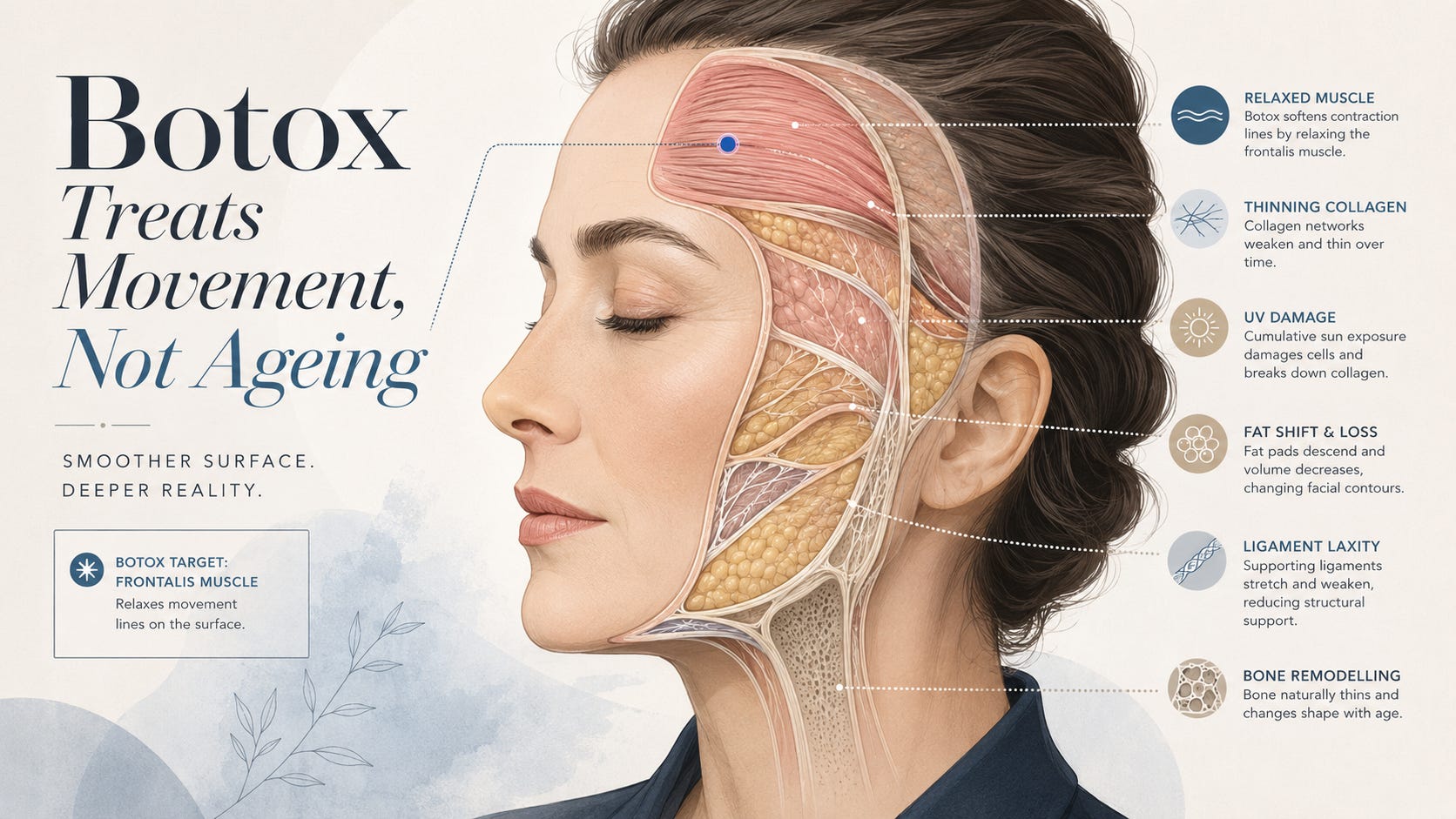
Facial ageing is not caused by one muscle. Collagen is gradually lost, elastin is damaged, ultraviolet exposure injures the dermis, facial fat changes in volume and position, ligaments loosen, and the facial skeleton remodels. Repeated muscle movement contributes to expression lines, and Botox reduces this folding extremely well—but that is only one part of the ageing process. It does not restore lost collagen, reverse solar elastosis, or prevent sagging, volume loss or textural change.
A person can have a very smooth forehead while the skin underneath continues to age normally. That may be a desirable cosmetic result. It is not comprehensive anti-ageing.
Muscle atrophy is part of the pharmacology
Botulinum toxin blocks nerve-to-muscle communication. The injected muscle weakens and, when used less, may lose volume—this is not controversial biology. We deliberately use the same effect when Botox is injected into enlarged masseter muscles to slim the jaw, where shrinkage is openly discussed as the intended result. Yet when the same process occurs in the forehead, “atrophy” tends to disappear from the sales pitch.
The strongest argument here is the known action of the drug itself, not a small MRI study—though that study is worth noting. Researchers reported a 46–48% reduction in procerus muscle volume 12 months after a single injection, while the visible glabellar lines had already returned toward baseline within six to ten months. It sounds dramatic, but the study included only two treated patients, so it cannot tell us how common this is or whether it causes harm. What it does raise is an awkward possibility: structural change in the muscle may outlast the cosmetic benefit for which the patient returns every few months. Reviews suggest such changes may persist beyond the usual three-to-five-month treatment window; what this means after decades of repeated injections is poorly studied. Persistent atrophy may be harmless, or it may alter expression, symmetry or contour if neighbouring muscles compensate. Honestly, we do not know.
“Preventive Botox” is prevention by rebranding
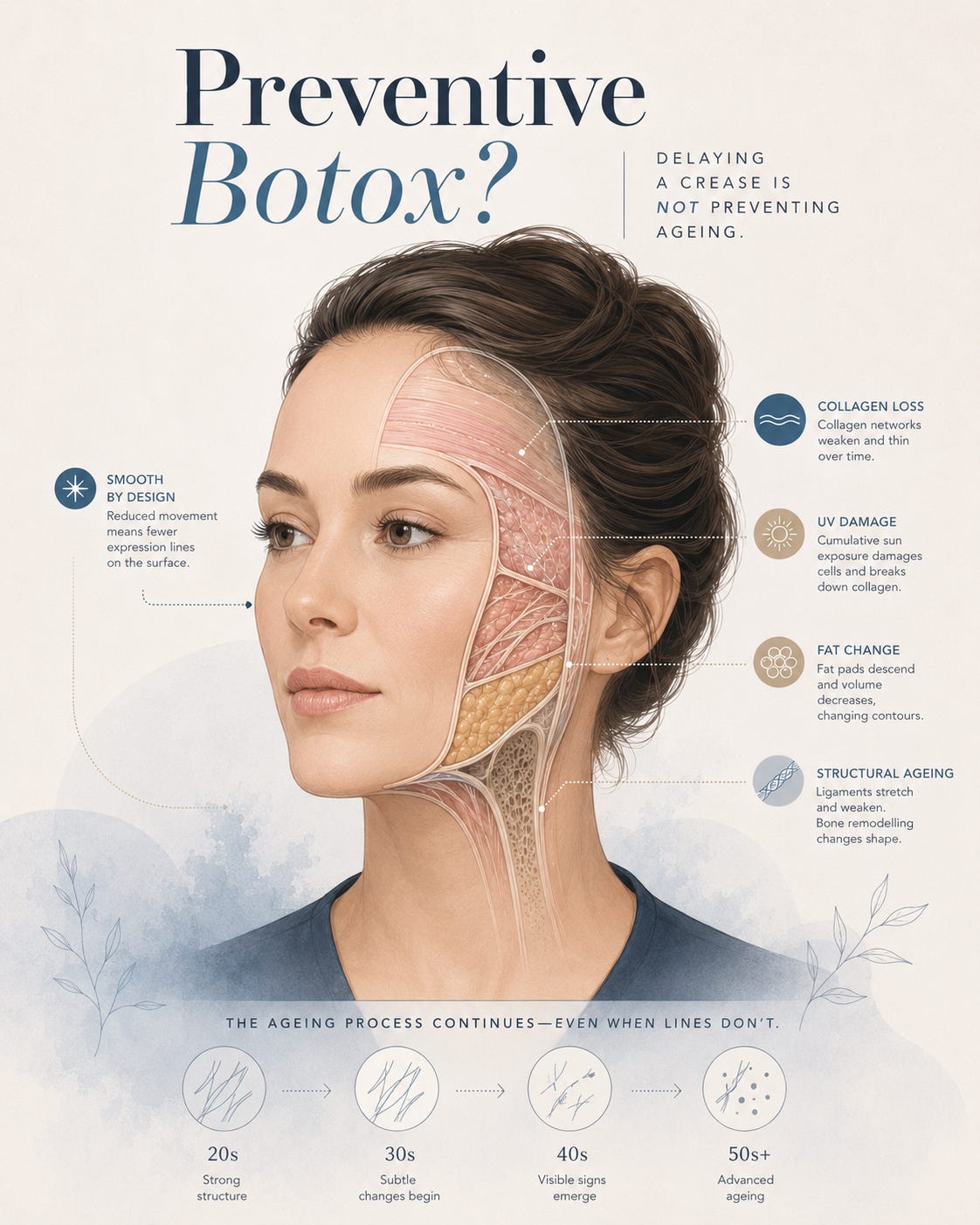
Young adults are increasingly encouraged to start Botox before wrinkles appear, on the reasoning that reducing folding early may delay a crease from setting in. That is plausible for one line—but preventing a crease is not the same as preventing ageing. Collagen still declines, UV radiation still damages the dermis, and fat, ligaments and bone still change underneath. Presenting recurrent muscle weakening as preventive healthcare for the face is marketing, not established science.
Is long-term Botox safe?
The short- and medium-term safety record is reassuring when genuine product is correctly administered; serious adverse events are uncommon and complications like ptosis or asymmetry are usually temporary. That answers a limited question, though—not whether injections repeated every three or four months for decades carry no lasting structural effect.
A 2025 retrospective study followed 50 people treated for an average of 15 years and reported continued effectiveness and good tolerability. But look at what it cannot show: there was no untreated control group, and the cohort consisted entirely of people who had already chosen to continue for 8–26 years. Anyone who stopped—because of a poor result, side effects, changed expression, or cost—would not appear in it. Other cosmetic treatments were incompletely documented, and some outcomes relied on how young patients believed they looked rather than serial measurement of muscle volume or collagen. The lead author also disclosed relationships with Allergan and Merz Aesthetics. None of this invalidates the study, but it makes uncritical reassurance inappropriate. The defensible conclusion: long-term Botox has not been shown to cause major cumulative harm, but decades of repeated chemodenervation have not been studied well enough to call the practice structurally harmless.
What about a facelift?
Surgery is strangely absent from most discussions of injectable treatments’ long-term cost. A facelift treats a different problem—it repositions descended tissue and addresses laxity and jowls, rather than paralysing muscle—and it is a proper operation with real risks: anaesthesia, scarring, recovery, and the possibility of nerve injury. It is not for everyone.
But the financial comparison deserves more honesty, especially in India. Botox is sold as a small expense because each session is considered in isolation; a patient treating several areas every three or four months pays for years. In my observation, that total can eventually match the cost of a facelift. The surgical result is not permanent either, but it typically outlasts an effect that must be renewed several times a year. For a patient with genuine tissue laxity, I find it hard to accept that indefinite Botox is automatically the more sensible choice simply because it avoids an operation. Both options carry trade-offs that deserve honest discussion.
Fillers have their own “temporary” problem
Hyaluronic-acid fillers are often described as disappearing within months. MRI evidence complicates this: in a selected series of 33 patients, midfacial filler remained detectable at least two years after the last injection in every participant, and in one case, roughly 15 years later. This was not a random sample—nine patients were being assessed for swelling, and injection histories were incomplete—so it cannot tell us how often persistence causes problems. But it does challenge the assumption that filler reliably disappears on schedule. Repeatedly adding product without knowing how much remains may contribute to swelling, distortion, or the increasingly familiar overfilled look. Temporary does not always mean gone.
What actually treats ageing skin?
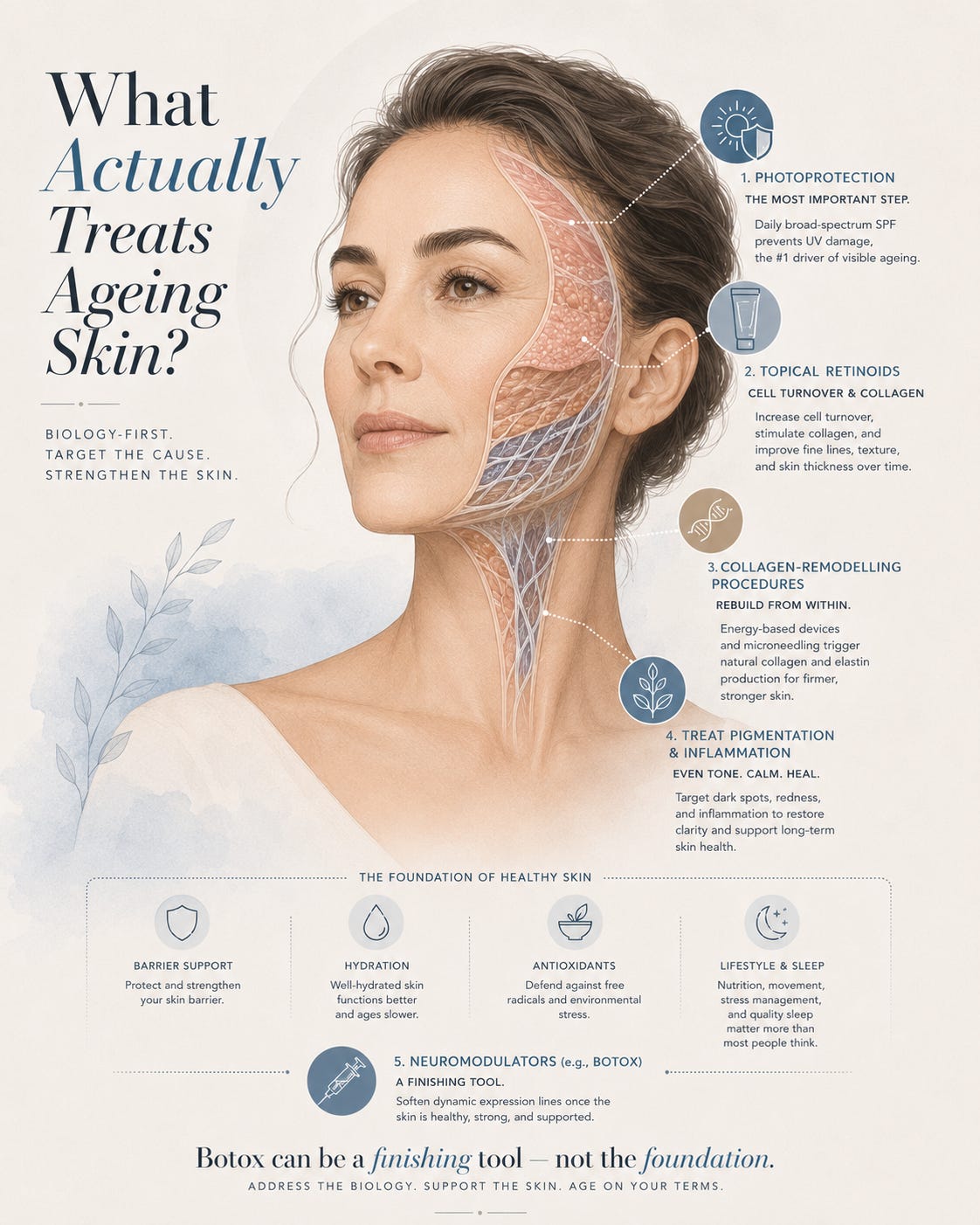
Photoprotection matters because ongoing UV exposure keeps damaging collagen; sunscreen cannot undo existing damage, but it limits further injury.
Topical retinoids have controlled evidence for fine wrinkles, pigmentation and epidermal structure.
Fractional CO₂ laser and microneedling work by controlled injury and collagen remodelling, though both risk post-inflammatory pigmentation, particularly in darker skin.
Platelet-rich plasma offers, at best, modest adjunctive benefit—far weaker than its marketing suggests.
None of these replace Botox, because they address different problems: a laser cannot reproduce the effect of weakening a strong frown muscle, and Botox cannot rebuild sun-damaged or sagging skin.
An anti-ageing programme should begin with the biology of the skin and the structure of the face—not automatically with repeated weakening of the muscle underneath it.
My position
Botox has a legitimate role for patients troubled by prominent dynamic lines, who should be told plainly what it does: it weakens muscle and temporarily reduces selected expression lines, requires repeated injections to maintain, and does nothing to stop the other processes of facial ageing. Muscle atrophy may occur; its long-term structural meaning remains uncertain.
I would not make quarterly Botox the foundation of long-term facial care. My priorities begin with photoprotection and topical retinoids, then treatment of pigmentation or inflammation, then selected collagen-remodelling procedures. Where the main problem is sagging or tissue descent, I would discuss properly performed lifting surgery rather than pretend that repeated muscle paralysis is rejuvenation. Surgery is not for everyone, but it should not be excluded from the conversation simply because injections are easier to sell.
Botox can be a finishing tool. It should not become the philosophy behind facial care.
The uncomfortable truth
A smoother forehead is not necessarily healthier skin. Botox can suppress a wrinkle by weakening the muscle that produces it, but it cannot replace the collagen underneath, and it cannot stop the skin, fat, ligaments and bone from ageing. Modern aesthetic medicine has successfully sold reduced movement as rejuvenation. Sometimes the face has not become younger—it has simply become less able to show its age.
Selected references
Koerte IK, Schroeder AS, Fietzek UM, et al. Muscle atrophy beyond the clinical effect after a single dose of onabotulinumtoxinA injected in the procerus muscle. Dermatol Surg. 2013;39:761–765.
Crook JL, Jahromi AH, Konofaos P. Long-term effects of repeated botulinum toxin injection in cosmetic therapeutics. Ann Plast Surg. 2022;88:345–352.
Trindade de Almeida AR, Marques ERM, Contin LA, et al. Long-term consecutive onabotulinumtoxinA injections for facial aesthetic treatment: a real-world study. Dermatol Surg. 2025;51:1133–1138.
Master M, Azizeddin A, Master V. Hyaluronic acid filler longevity in the mid-face: a review of 33 magnetic resonance imaging studies. Plast Reconstr Surg Glob Open. 2024;12:e5934.
Sitohang IBS, Makes WI, Sandora N, Suryanegara J. Topical tretinoin for treating photoaging: a systematic review of randomized controlled trials. Int J Womens Dermatol. 2022;8:e003.