

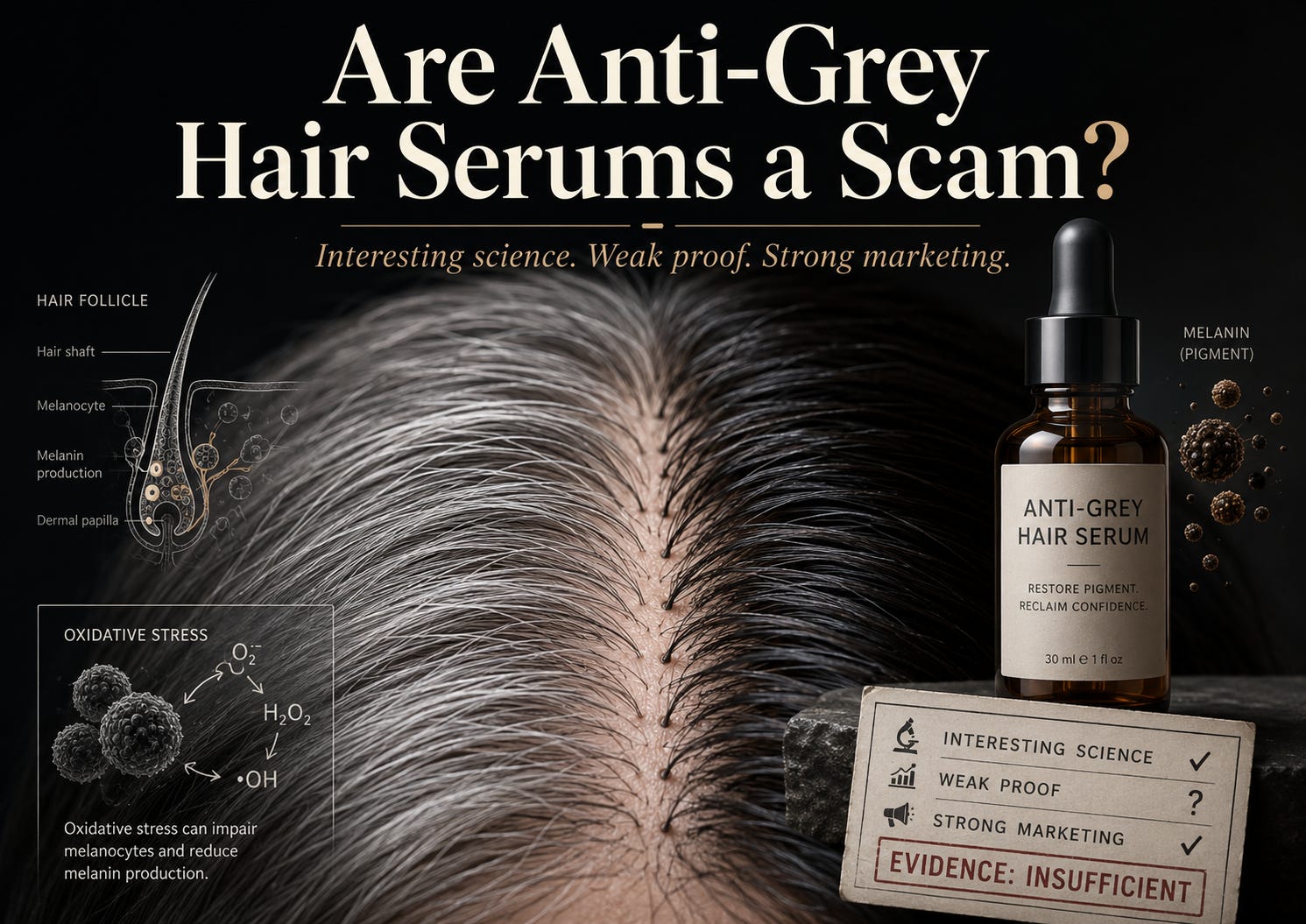
The science sounds impressive. The evidence is not.
Anti-grey hair serums promise to reactivate melanocytes, neutralise hydrogen peroxide, protect pigment stem cells and restore natural hair colour.
These claims are usually accompanied by scientific diagrams, proprietary peptides and phrases such as “clinically proven”.
But what has actually been proved?
Key messages
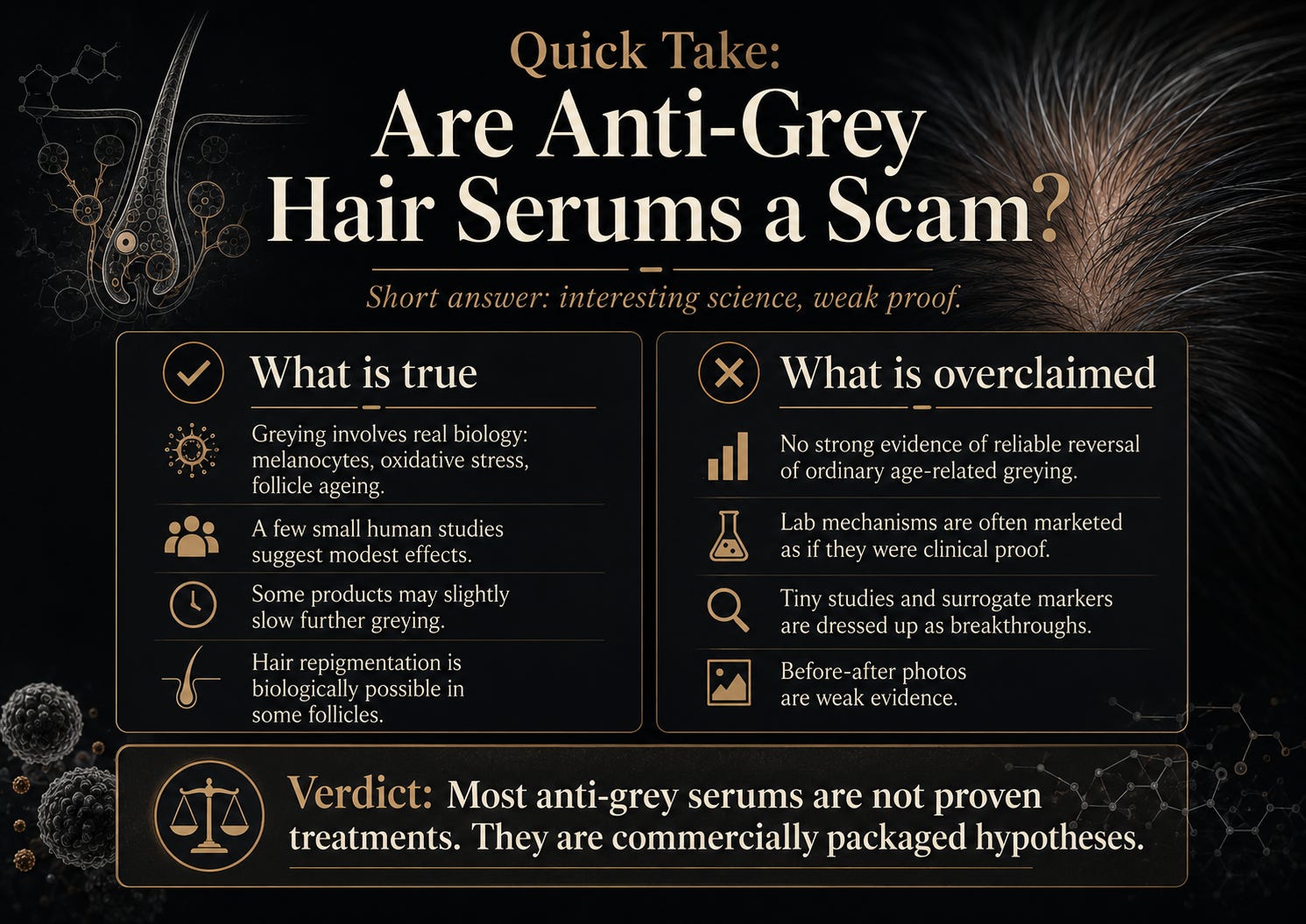
No anti-grey serum has strong, independently replicated evidence that it reliably reverses established age-related greying.
A few small studies have reported modest effects, but some measured laboratory markers rather than visible hair colour.
One controlled trial detected fewer new grey hairs, although neither the participants nor the investigators could see an overall improvement.
“Clinically tested” may mean 15 participants, no placebo group and no meaningful cosmetic endpoint.
Hair dye remains much less scientifically exciting—and far more dependable.
So, are anti-grey serums scams?
Not every product is fraudulent, and some ingredients have biologically plausible effects. But much of the industry is selling an experimental hypothesis with the confidence of an established treatment.
That is science-shaped marketing: the vocabulary of medicine without medicine’s evidentiary burden.
What would genuine reversal look like?
The visible hair shaft is dead tissue. Once a section of hair has grown out grey or white, it cannot suddenly begin producing melanin.
True repigmentation must occur inside the living hair follicle. New hair should emerge darker from the root while the older distal shaft remains grey.
A product that stains or coats the existing shaft may still make hair look darker, but that is a colourant—not biological reversal.
This distinction is often lost in before-and-after photographs. Hair oil, lighting, camera exposure, combing, shaft coatings and temporary colourants can all create the appearance of improvement.
A convincing study must document new proximal pigmentation in the same scalp area under standardised conditions.
Most product advertisements do not provide that evidence.
Why the theory sounds convincing
Hair greying is biologically complex.
Ageing follicles show progressive loss or dysfunction of pigment-producing melanocytes. Oxidative stress, abnormalities of melanocyte stem cells, mitochondrial injury, impaired cellular signalling and changes in the follicular environment may all contribute.[1,2]
One influential human study found hydrogen peroxide accumulation and reduced catalase activity in grey and white hair follicles.[1]
This observation is often converted into a simple marketing story:
Grey hair contains excess hydrogen peroxide.
Our serum contains antioxidants or catalase.
Therefore, our serum reverses grey hair.
The missing steps are substantial.
The active ingredient must remain stable in the bottle, penetrate the scalp, travel sufficiently far into the follicle, reach the pigmentary cells in an effective concentration and produce enough melanin to create a visible difference.
Large enzymes such as catalase and many peptides do not automatically reach the hair bulb simply because they have been applied to the scalp.
An ingredient may work when placed directly onto cultured cells and still do almost nothing when delivered in a cosmetic serum.
That gap between laboratory activity and real-world delivery is rarely discussed in advertising.
What have human studies actually shown?
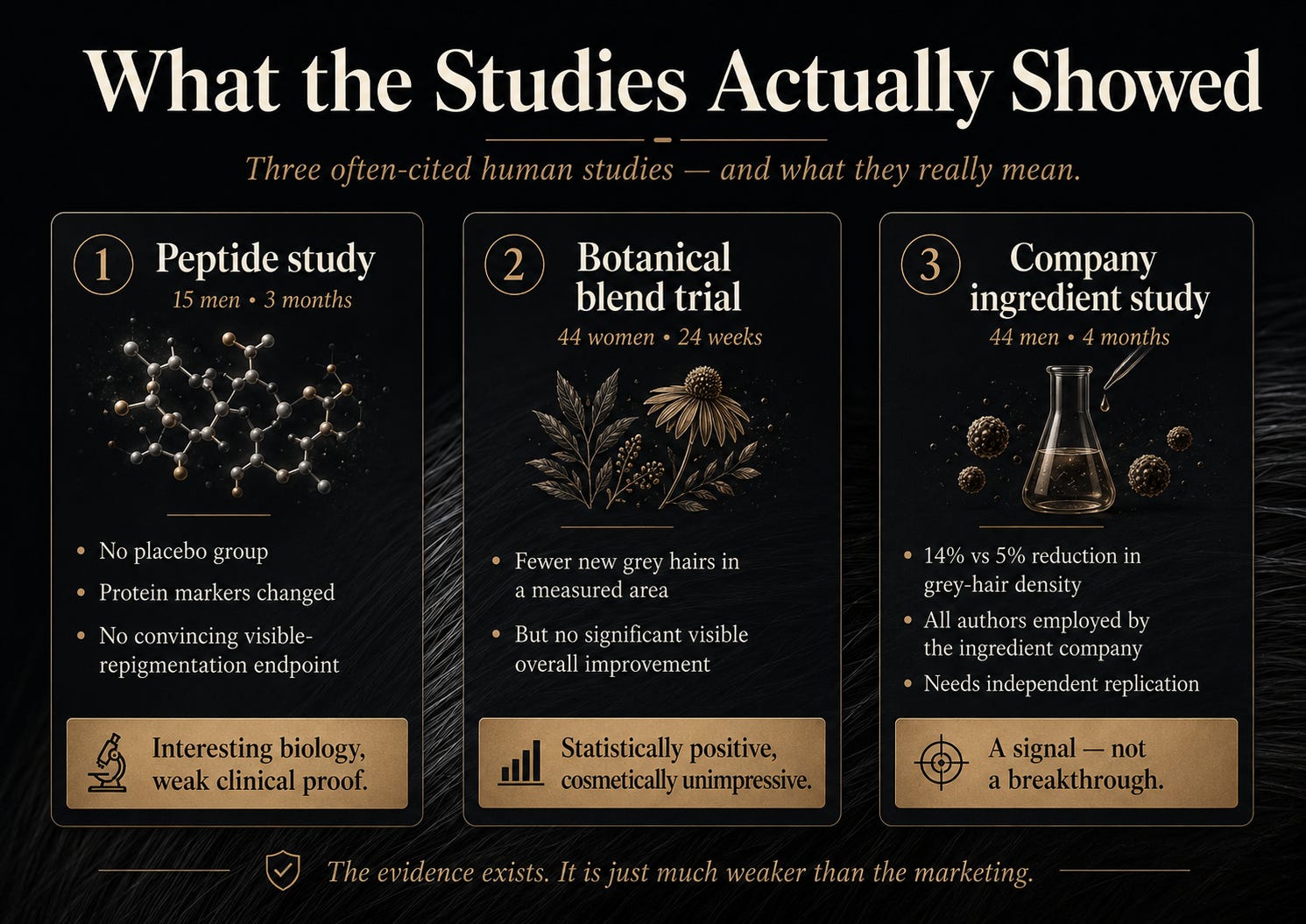
1. A peptide tested in 15 men
Palmitoyl tetrapeptide-20 is designed to influence the α-MSH–MC1R pigmentation pathway.
In a 2018 study, 15 men with premature greying applied a peptide-containing lotion for three months.[3] Researchers reported changes in pigmentation-related proteins, including MC1R, catalase and tyrosinase-related proteins, in plucked hairs.
There was no placebo group and no robust assessment showing that the men became visibly less grey.
What was shown: changes in biological markers.
What was not shown: convincing cosmetic repigmentation.
A changed protein level may justify further research. It does not justify telling consumers that a serum will restore their natural hair colour.
2. A botanical combination tested in 44 women
A randomised, double-blind, placebo-controlled study evaluated APHG-1001, a combination containing extracts of Pueraria lobata, Polygonum multiflorum and ginkgo.[4]
After 24 weeks, fewer new grey hairs appeared in the measured scalp area:
Active product: 6.3 new grey hairs/cm²
Placebo: 11.4 new grey hairs/cm²
That was a statistically significant difference.
However, neither investigator assessment nor participant self-assessment found a significant improvement in the overall visible appearance of greying.
The microscope—or hair count—detected a difference that neither the doctors nor the users could see.
The study suggests that the product may modestly slow the appearance of new grey hairs. It does not show meaningful reversal of established greying.
Statistically detectable does not always mean cosmetically worthwhile.
3. A company-developed ingredient tested in 44 men
A proprietary ingredient developed by Givaudan was studied in 44 men for four months.[5]
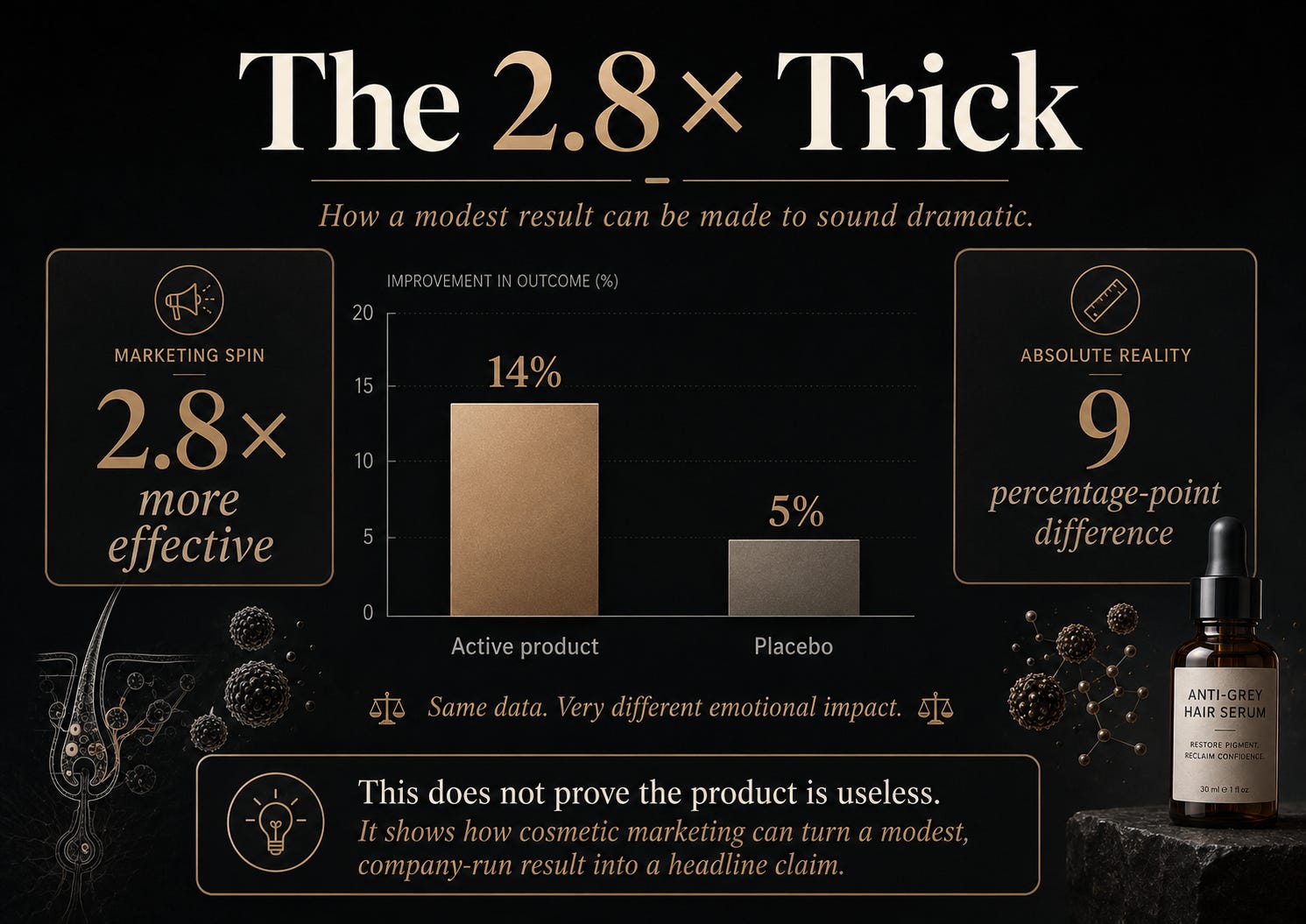
Grey-hair density reportedly fell by:
14% with the active product
5% with placebo
The absolute difference was nine percentage points.
The paper described the active ingredient as having 2.8 times greater efficacy.
Both descriptions refer to the same data. One sounds modest; the other sounds dramatic.
There are further reasons for caution. All six authors were affiliated with Givaudan France, the company developing the ingredient. Despite this, the paper stated that the authors had no conflict of interest.
Industry funding does not automatically invalidate research. Cosmetic products must often be developed and tested by companies.
But employment by the company whose product is being evaluated is clearly relevant to interpretation. A company-sponsored trial should be treated as an initial signal, not final proof.
The findings have not been convincingly reproduced by an independent group in a larger and more diverse population.
What was shown: a small, potentially genuine treatment effect.
What was not shown: substantial, durable and independently replicated reversal.
Can grey hair ever become dark again?
Yes, occasionally.
Researchers have documented spontaneous repigmentation in individual human hairs.[6] Hair darkening has also been reported in patients receiving powerful systemic medicines, including anti-PD-1 and anti-PD-L1 cancer immunotherapy.[7]
In one case series, 14 patients developed hair repigmentation during immune-checkpoint inhibitor treatment.
This demonstrates that some adult follicles retain the biological capacity to resume pigment production.
But it does not validate cosmetic serums.
Cancer immunotherapy profoundly alters immune signalling throughout the body. Spontaneous repigmentation may occur in follicles whose pigmentary machinery has not been permanently lost.
Neither observation proves that a topical antioxidant or peptide can produce the same effect.
Biological possibility is not product efficacy.
How cosmetic language manufactures certainty
Several commonly used phrases sound more meaningful than they are.
“Clinically tested” may mean that a small number of people used the product.
“Dermatologically tested” may refer only to irritation or safety.
“Activates melanocytes” may mean that cultured cells produced more melanin.
“Restores pigmentation pathways” may mean that the level of one protein changed.
“2.8 times more effective” may describe a 14% change compared with 5% on placebo.
“Visible results” may rely on unblinded photographs without standardised lighting.
These statements are not necessarily false.
The problem lies in what consumers are encouraged to infer from them: that their existing grey hair will reliably become dark again.
That has not been demonstrated.
Before-and-after photographs prove very little
Greying is uneven. A scalp contains pigmented, partially pigmented and white hairs, all cycling independently.
Photographs can be influenced by:
lighting and exposure;
wet or oily hair;
differences in hair length;
combing and hair direction;
temporary shaft coatings;
selection of a more favourable scalp area;
selective publication of the best responders.
A credible trial should use a permanently marked scalp area, standardised photography, blinded hair counts, prohibition of dyes and a placebo comparator.
Without these precautions, even an honestly produced photograph can be misleading.
What about vitamins and anti-grey supplements?
Premature or rapidly progressive greying can occasionally occur alongside nutritional deficiency or systemic illness. Testing may be appropriate when the clinical context suggests vitamin B12 deficiency, thyroid disease, iron deficiency or another underlying problem.
Correcting a documented deficiency is reasonable.
Taking vitamins or trace elements simply because hair is grey is not.
Ordinary age-related greying does not prove that the body lacks copper, zinc, biotin, catalase or antioxidants. Excess supplementation can also cause harm.
A nutrient’s involvement in melanin production does not mean that giving more of it will restore an ageing follicle.
My verdict
Anti-grey hair serums are not all scams, but many are marketed in a way that comes uncomfortably close.
A few ingredients have plausible mechanisms. Small studies suggest that selected products might modestly slow new greying or repigment a minority of follicles.
But no serum has yet demonstrated substantial, predictable and durable reversal of age-related greying in large, independent trials.
You are not buying an established treatment. You are paying to test a commercially packaged hypothesis on your own scalp.
Trying a well-tolerated serum is not unreasonable for someone who understands this uncertainty and can afford the expense.
But claims of “clinically proven grey-hair reversal” should not be accepted unless the exact marketed product has shown:
visible new pigmentation from the root;
in a randomised, placebo-controlled trial;
in a meaningful number of participants;
over at least six to twelve months;
with independent replication;
and with results large enough for users—not just statistical software—to notice.
Until then, hair dye remains less glamorous, less biological and much more reliable.
References
Wood JM, et al. Senile hair graying: H₂O₂-mediated oxidative stress affects human hair color by blunting methionine sulfoxide repair. FASEB Journal. 2009;23:2065–2075.
Commo S, Gaillard O, Bernard BA. Human hair greying is linked to a specific depletion of hair follicle melanocytes affecting both the bulb and outer root sheath. British Journal of Dermatology. 2004;150:435–443.
Almeida Scalvino S, et al. Efficacy of an agonist of α-MSH, palmitoyl tetrapeptide-20, in hair pigmentation. International Journal of Cosmetic Science. 2018;40:516–524.
Jo SJ, et al. Efficacy and safety of Pueraria lobata extract in gray hair prevention: a randomized, double-blind, placebo-controlled study. Annals of Dermatology. 2013;25:218–222.
De Tollenaere M, et al. Global repigmentation strategy of grey hair follicles by targeting oxidative stress and stem-cell protection. Applied Sciences. 2021;11:1533.
Rosenberg AM, et al. Quantitative mapping of human hair greying and reversal in relation to life stress. eLife. 2021;10:e67437.
Rivera N, Boada A, Ferrándiz C. Hair repigmentation during immunotherapy treatment with anti-PD-1 and anti-PD-L1 agents for lung cancer. JAMA Dermatology. 2017;153:1162–1165.